|
|

Search for ich again, using less strict matching (136 results)
|
Source: Torp, page b0572, entry 8 View original page image as: [TIFF] [PNG] [View previous entry] [View next entry] |
[Comment on this entry] [View comments] |
The following entry has been hand-corrected once. |
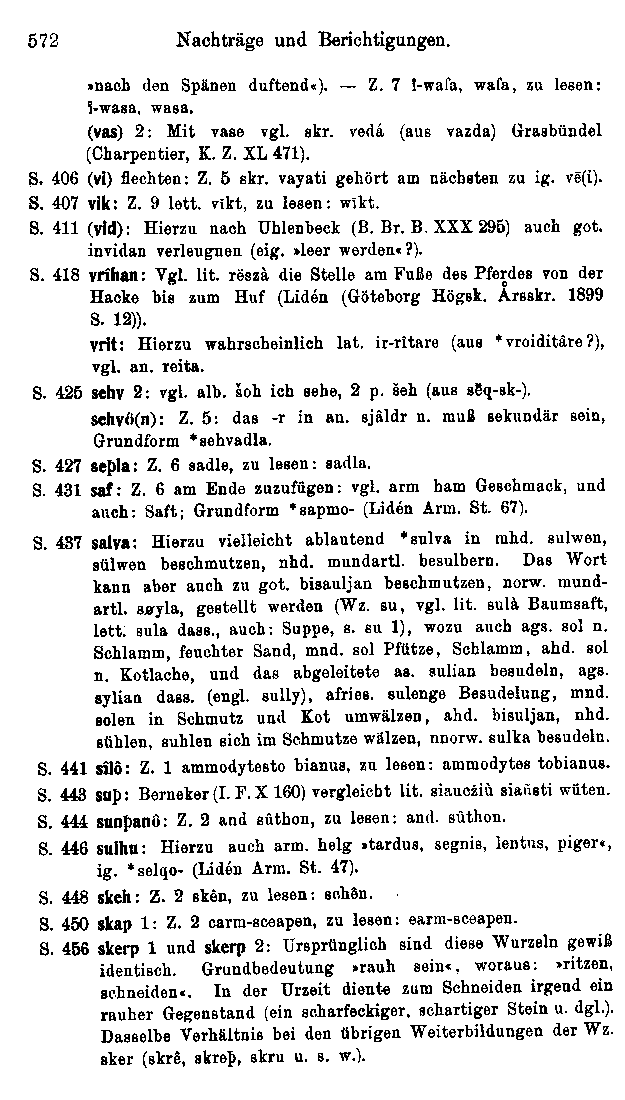
S.
425
sehv
2:
vgl.
alb.
 oh
ich
sehe,
2
p.
eh
(aus
s
oh
ich
sehe,
2
p.
eh
(aus
s q-sk-).
[Translate the German words]
|
Source: Bosworth/Toller, page b0585, entry 24 View original page image as: [TIFF] [PNG] [View previous entry] [View next entry] |
[Comment on this entry] [View comments] |
The following entry has been hand-corrected once. |
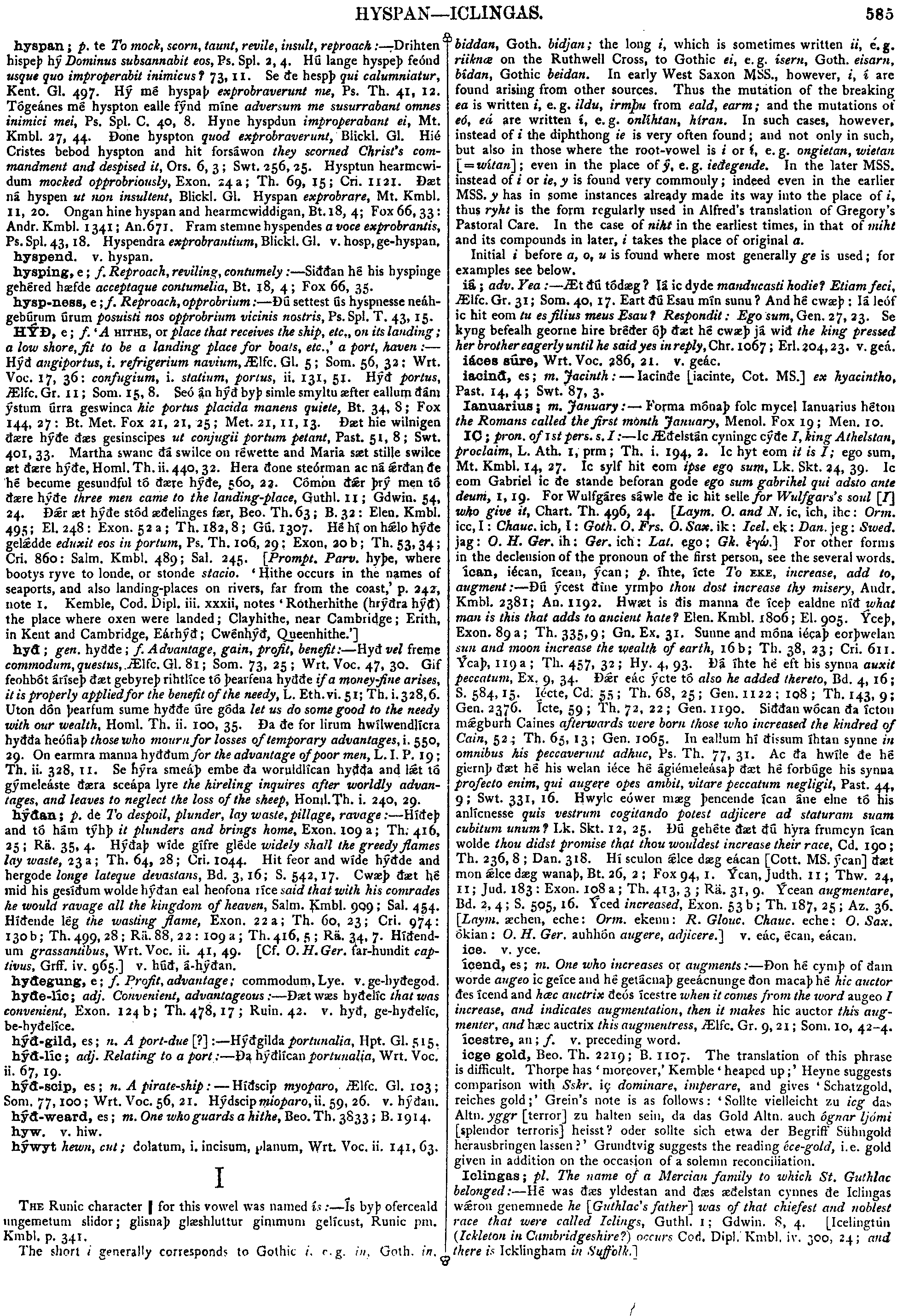
IC;
pron.
of
1st
pers.
s.
I
:--
Ic
Æðelstán
cyningc
cýðe
I,
king
Athelstan,
proclaim,
L.
Ath.
1;
prm;
Th.
i.
194,
2.
Ic
hyt
eom
it
is
I;
ego
sum,
Mt.
Kmbl.
14,
27.
Ic
sylf
hit
eom
ipse
ego
sum,
Lk.
Skt.
24,
39.
Ic
eom
Gabriel
ic
ðe
stande
beforan
gode
ego
sum
gabrihel
qui
adsto
ante
deum,
1,
19.
For
Wulfgáres
sáwle
ðe
ic
hit
selle
for
Wulfgars's
soul
[I]
who
give
it,
Chart.
Th.
496,
24.
[Laym.
O.
and
N.
ic,
ich,
ihc
:
Orm.
icc,
I
:
Chauc.
ich,
I
:
Goth.
O.
Frs.
O.
Sax.
ik
:
Icel.
ek
:
Dan.
jeg
:
Swed.
jag
:
O.
H.
Ger.
ih
:
Ger.
ich
:
Lat.
ego
:
Gk.
&epsilon-tonos; &omega-tonos;.]
For
other
forms
in
the
declension
of
the
pronoun
of
the
first
person,
see
the
several
words.
&omega-tonos;.]
For
other
forms
in
the
declension
of
the
pronoun
of
the
first
person,
see
the
several
words.
|
Source: Bosworth/Toller, page b0608, entry 12 View original page image as: [TIFF] [PNG] [View previous entry] [View next entry] |
[Comment on this entry] [View comments] |
The following entry has been hand-corrected once. |
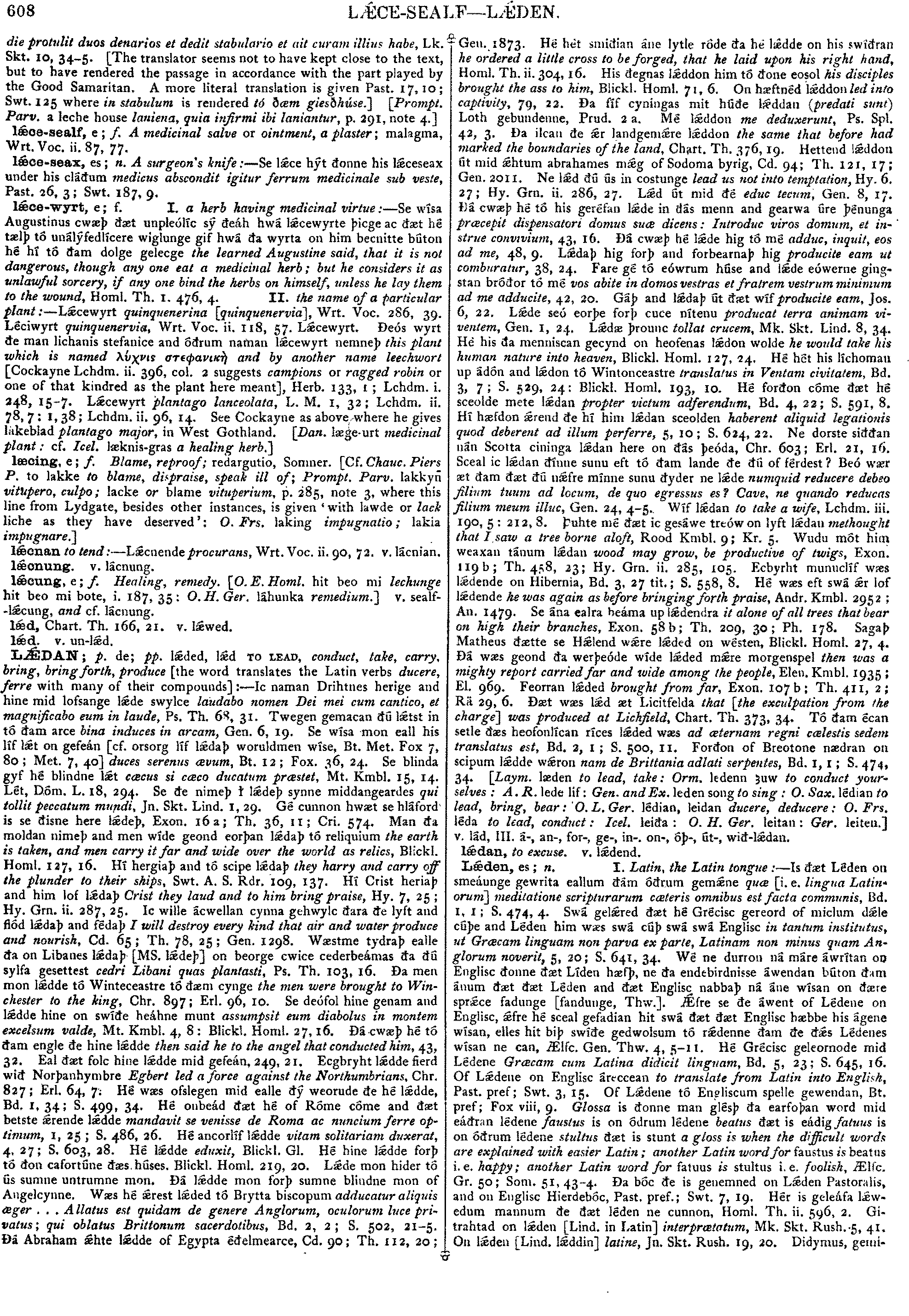
L den,
es;
n.
I.
Latin,
the
Latin
tongue
:--
Is
ðæt
Léden
on
smeáunge
gewrita
eallum
ðám
óðrum
gemne
quæ
[i.e.
lingua
Latinorum]
meditatione
scripturarum
cæteris
omnibus
est
facta
communis,
Bd.
1,
1;
S,
474,
4.
Swá
gelred
ðæt
hé
Grécisc
gereord
of
miclum
dle
cúþe
and
Léden
him
wæs
swá
cúþ
swá
swá
Englisc
in
tantum
institutus,
ut
Græcam
linguam
non
parva
ex
parte,
Latinam
non
minus
quam
Anglorum
noverit,
5,
20;
S.
641,
34.
Wé
ne
durron
ná
máre
áwrítan
on
Englisc
ðonne
ðæt
Léden
hæfþ,
ne
ða
endebirdnisse
áwendan
búton
ðam
ánum
ðæt
ðæt
Léden
and
ðæt
Englisc
nabbaþ
ná
áne
wísan
on
ðære
sprce
fadunge
[fandunge,
Thw.].
Æ-acute;fre
se
ðe
áwent
of
Lédene
on
Englisc,
fre
hé
sceal
gefadian
hit
swá
ðæt
ðæt
Englisc
hæbbe
his
ágene
wísan,
elles
hit
biþ
swíðe
gedwolsum
tó
rdenne
ðam
ðe
ðs
Lédenes
wísan
ne
can,
Ælfc.
Gen.
Thw,
4,
5-11.
Hé
Grécisc
geleornode
mid
Lédene
Græcam
cum
Latina
didicit
linguam,
Bd.
5,
23;
S.
645,
16.
Of
Ldene
on
Englisc
áreccean
to
translate
from
Latin
into
English,
Past.
pref;
Swt.
3,
15.
Of
Ldene
tó
Engliscum
spelle
gewendan,
Bt.
pref;
Fox
viii,
9.
Glossa
is
ðonne
man
glésþ
ða
earfoþan
word
mid
eáðran
lédene
faustus
is
on
ódrum
lédene
beatus
ðæt
is
eádig
fatuus
is
on
óðrum
lédene
stultus
ðæt
is
stunt
a
gloss
is
when
the
difficult
words
are
explained
with
easier
Latin;
another
Latin
word
for
faustus
is
beatus
i.e.
happy;
another
Latin
word
for
fatuus
is
stultus
i.e.
foolish,
Ælfc.
Gr.
50;
Som.
51,
43-4.
Ða
bóc
ðe
is
genemned
on
Lden
Pastoralis,
and
on
Englisc
Hierdebóc,
Past.
pref.;
Swt.
7,
19.
Hér
is
geleáfa
lwedum
mannum
ðe
ðæt
léden
ne
cunnon,
Homl.
Th.
ii.
596,
2.
Gitrahtad
on
lden
[Lind.
in
Latin]
interprætatum,
Mk.
Skt.
Rush.
5,
41.
On
lden
[Lind.
lddin]
latine,
Jn,
Skt.
Rush.
19,
20.
Didymus,
geminus
in
lætin,
Lind.
20,
24,
margin.
Hí
beóþ
oft
óðres
cynnes
on
léden,
and
óðres
cynnes
on
englisc;
wé
cweþaþ
on
léden
hic
liber,
and
on
englisc
ðeós
bóc,
Ælfc.
Gr.
6;
Som.
5,
37-40.
On
léden
latine
and
latialiter,
38;
Som.
41,
32.
Gelrede
on
léden
and
on
grécisc,
Homl.
Skt.
2,
44:
Bd.
4,
1;
S.
564,
11.
Sum
mæssepreóst
cúðe
be
dle
Lýden
understandan
a
certain
mass-priest
could
understand
Latin
partially,
Ælfc.
Gen.
Thw.
p.
1,
20.
[Cf.
Icel.
Látína;
f.]
II.
any
tongue,
speech,
language
:--
Spasmus
ðæt
ys
on
úre
leódene
hneccan
sár
den,
es;
n.
I.
Latin,
the
Latin
tongue
:--
Is
ðæt
Léden
on
smeáunge
gewrita
eallum
ðám
óðrum
gemne
quæ
[i.e.
lingua
Latinorum]
meditatione
scripturarum
cæteris
omnibus
est
facta
communis,
Bd.
1,
1;
S,
474,
4.
Swá
gelred
ðæt
hé
Grécisc
gereord
of
miclum
dle
cúþe
and
Léden
him
wæs
swá
cúþ
swá
swá
Englisc
in
tantum
institutus,
ut
Græcam
linguam
non
parva
ex
parte,
Latinam
non
minus
quam
Anglorum
noverit,
5,
20;
S.
641,
34.
Wé
ne
durron
ná
máre
áwrítan
on
Englisc
ðonne
ðæt
Léden
hæfþ,
ne
ða
endebirdnisse
áwendan
búton
ðam
ánum
ðæt
ðæt
Léden
and
ðæt
Englisc
nabbaþ
ná
áne
wísan
on
ðære
sprce
fadunge
[fandunge,
Thw.].
Æ-acute;fre
se
ðe
áwent
of
Lédene
on
Englisc,
fre
hé
sceal
gefadian
hit
swá
ðæt
ðæt
Englisc
hæbbe
his
ágene
wísan,
elles
hit
biþ
swíðe
gedwolsum
tó
rdenne
ðam
ðe
ðs
Lédenes
wísan
ne
can,
Ælfc.
Gen.
Thw,
4,
5-11.
Hé
Grécisc
geleornode
mid
Lédene
Græcam
cum
Latina
didicit
linguam,
Bd.
5,
23;
S.
645,
16.
Of
Ldene
on
Englisc
áreccean
to
translate
from
Latin
into
English,
Past.
pref;
Swt.
3,
15.
Of
Ldene
tó
Engliscum
spelle
gewendan,
Bt.
pref;
Fox
viii,
9.
Glossa
is
ðonne
man
glésþ
ða
earfoþan
word
mid
eáðran
lédene
faustus
is
on
ódrum
lédene
beatus
ðæt
is
eádig
fatuus
is
on
óðrum
lédene
stultus
ðæt
is
stunt
a
gloss
is
when
the
difficult
words
are
explained
with
easier
Latin;
another
Latin
word
for
faustus
is
beatus
i.e.
happy;
another
Latin
word
for
fatuus
is
stultus
i.e.
foolish,
Ælfc.
Gr.
50;
Som.
51,
43-4.
Ða
bóc
ðe
is
genemned
on
Lden
Pastoralis,
and
on
Englisc
Hierdebóc,
Past.
pref.;
Swt.
7,
19.
Hér
is
geleáfa
lwedum
mannum
ðe
ðæt
léden
ne
cunnon,
Homl.
Th.
ii.
596,
2.
Gitrahtad
on
lden
[Lind.
in
Latin]
interprætatum,
Mk.
Skt.
Rush.
5,
41.
On
lden
[Lind.
lddin]
latine,
Jn,
Skt.
Rush.
19,
20.
Didymus,
geminus
in
lætin,
Lind.
20,
24,
margin.
Hí
beóþ
oft
óðres
cynnes
on
léden,
and
óðres
cynnes
on
englisc;
wé
cweþaþ
on
léden
hic
liber,
and
on
englisc
ðeós
bóc,
Ælfc.
Gr.
6;
Som.
5,
37-40.
On
léden
latine
and
latialiter,
38;
Som.
41,
32.
Gelrede
on
léden
and
on
grécisc,
Homl.
Skt.
2,
44:
Bd.
4,
1;
S.
564,
11.
Sum
mæssepreóst
cúðe
be
dle
Lýden
understandan
a
certain
mass-priest
could
understand
Latin
partially,
Ælfc.
Gen.
Thw.
p.
1,
20.
[Cf.
Icel.
Látína;
f.]
II.
any
tongue,
speech,
language
:--
Spasmus
ðæt
ys
on
úre
leódene
hneccan
sár


 &omicron-tonos;s,
that
is
in
our
language,
a
pain
at
the
back
of
the
neck,
Lchdm.
iii.
110,
1.
Mara
ðæt
ys
on
úre
lýden
biternys,
Ex.
15,
23.
Ealle
hig
sprecaþ
án
lýden
est
unum
labium
omnibus,
Gen.
11,
6.
[Laym.
cerno
an
Englisc
leoden,
ich
iseo,
29677:
Marh.
þe
moneþ
ðat
on
ure
ledene
is
ald
englisch
esterlið
inempnet,
23,
6:
A.
R.
on
ebreuwische
ledene,
136,
24;
on
englische
leodene,
170,
9:
Piers
P.
I
leve
his
ledne
be
in
owre
lordes
ere
lyke
a
pyes
chiteryng,
12,
253:
Chauc.
every
thing
that
any
foul
may
in
his
ledene
seyn,
F.
435
[see
Skeat's
note
in
the
Clarendon
Press
edition].
For
the
extended
use
of
forms
in
Romance
from
latinus
cf.
the
passage,
given
in
that
note,
of
Dante's
Canzone
beginning
'Fresca
rosa
novella,'
'Cantino
gli
augelli
ciascuno
in
suo
latino;'
Parad.
iii.
63
si
che
'l
raffigurar
m'é
piu
latino
[clear];
Convito
bk.
2,
c.
3
a
piu
latinamente
veder
la
sentenza.
In
Old
Spanish
ladino
is
explained
'el
que
sabe
otra
lengua
o
lenguas
ademas
de
la
suya.'
Is
it
possible
that
in
the
case
of
English
the
forms
geþeóde,
þeód
may
have
had
some
influence
in
giving
currency
to
lýden
in
the
general
sense
of
language,
by
suggesting
a
connection
of
this
latter
form
with
leód?]
&omicron-tonos;s,
that
is
in
our
language,
a
pain
at
the
back
of
the
neck,
Lchdm.
iii.
110,
1.
Mara
ðæt
ys
on
úre
lýden
biternys,
Ex.
15,
23.
Ealle
hig
sprecaþ
án
lýden
est
unum
labium
omnibus,
Gen.
11,
6.
[Laym.
cerno
an
Englisc
leoden,
ich
iseo,
29677:
Marh.
þe
moneþ
ðat
on
ure
ledene
is
ald
englisch
esterlið
inempnet,
23,
6:
A.
R.
on
ebreuwische
ledene,
136,
24;
on
englische
leodene,
170,
9:
Piers
P.
I
leve
his
ledne
be
in
owre
lordes
ere
lyke
a
pyes
chiteryng,
12,
253:
Chauc.
every
thing
that
any
foul
may
in
his
ledene
seyn,
F.
435
[see
Skeat's
note
in
the
Clarendon
Press
edition].
For
the
extended
use
of
forms
in
Romance
from
latinus
cf.
the
passage,
given
in
that
note,
of
Dante's
Canzone
beginning
'Fresca
rosa
novella,'
'Cantino
gli
augelli
ciascuno
in
suo
latino;'
Parad.
iii.
63
si
che
'l
raffigurar
m'é
piu
latino
[clear];
Convito
bk.
2,
c.
3
a
piu
latinamente
veder
la
sentenza.
In
Old
Spanish
ladino
is
explained
'el
que
sabe
otra
lengua
o
lenguas
ademas
de
la
suya.'
Is
it
possible
that
in
the
case
of
English
the
forms
geþeóde,
þeód
may
have
had
some
influence
in
giving
currency
to
lýden
in
the
general
sense
of
language,
by
suggesting
a
connection
of
this
latter
form
with
leód?]
|
Source: Bosworth/Toller, page b0726, entry 35 View original page image as: [TIFF] [PNG] [View previous entry] [View next entry] |
[Comment on this entry] [View comments] |
The following entry has been hand-corrected once. |
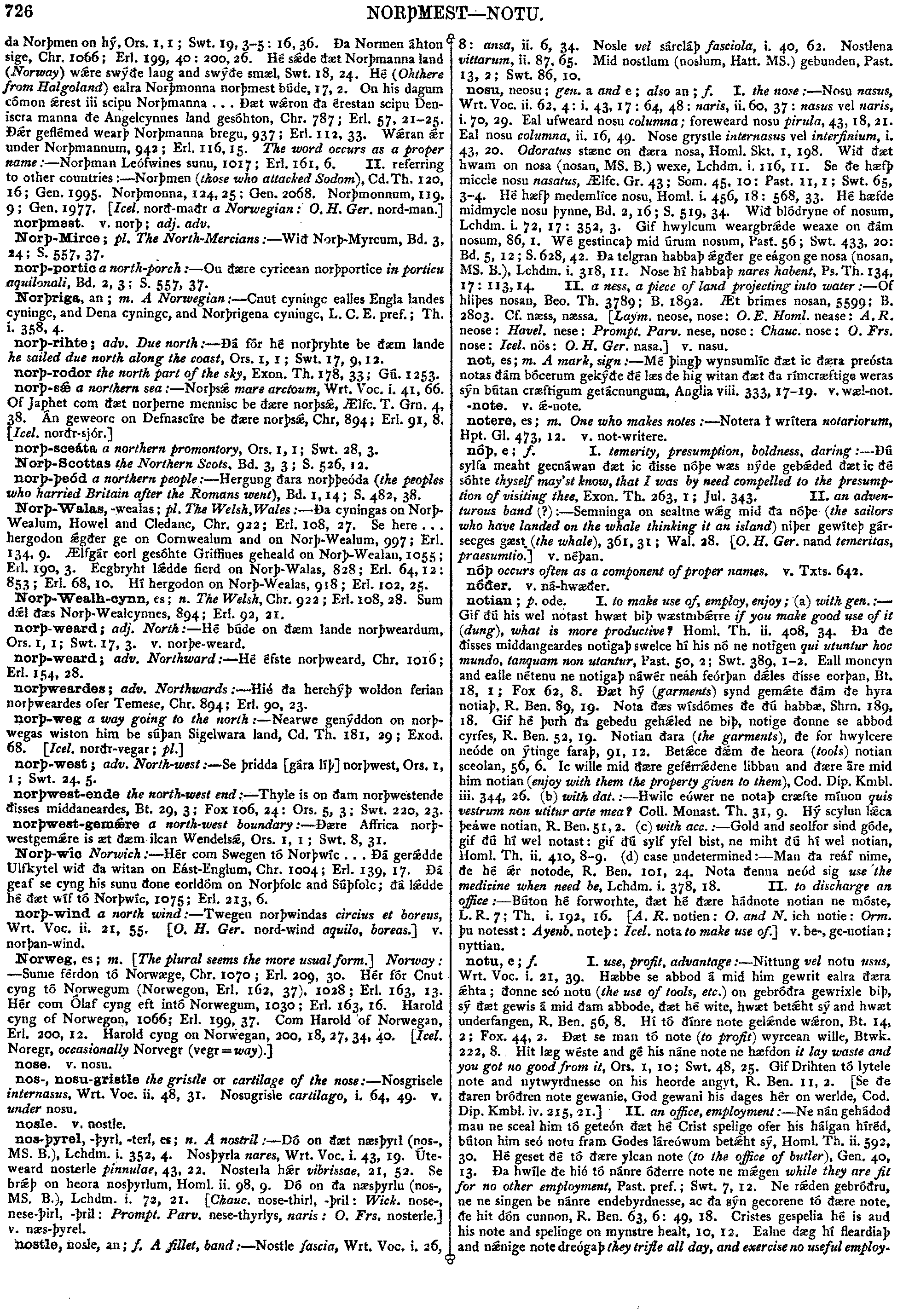
notian;
p.
ode.
I.
to
make
use
of,
employ,
enjoy;
(a)
with
gen.
:--
Gif
ðú
his
wel
notast
hwæt
biþ
wæstnbrre
if
you
make
good
use
of
it
(dung),
what
is
more
productive?
Homl.
Th.
ii.
408,
34.
Ða
ðe
ðisses
middangeardes
notigaþ
swelce
hí
his
nó
ne
notigen
qui
utuntur
hoc
mundo,
tanquam
non
utantur,
Past.
50,
2;
Swt.
389,
1-2.
Eall
moncyn
and
ealle
nétenu
ne
notigaþ
náwér
neáh
feórþan
dles
ðisse
eorþan,
Bt.
18,
1
;
Fox
62,
8.
Ðæt
hý
(garments)
synd
gemte
ðám
ðe
hyra
notiaþ
R.
Ben.
89,
19.
Nota
ðæs
wísdómes
ðe
ðú
habbæ,
Shrn.
189,
18.
Gif
hé
þurh
ða
gebedu
gehled
ne
biþ,
notige
ðonne
se
abbod
cyrfes,
R.
Ben.
52,
19.
Notian
ðara
(the
garments),
ðe
for
hwylcere
neóde
on
ýtinge
faraþ,
91,
12.
Betce
ðm
ðe
heora
(tools)
notian
sceolan,
56,
6.
Ic
wille
mid
ðære
geférrdene
libban
and
ðære
áre
mid
him
notian
(enjoy
with
them
the
property
given
to
them),
Cod.
Dip.
Kmbl.
iii.
344,
26.
(b)
with
dat.
:--
Hwilc
eówer
ne
notaþ
cræfte
mínon
quis
vestrum
non
utitur
arte
mea?
Coll.
Monast.
Th.
31,
9.
Hý
scylun
lca
þeáwe
notian,
R.
Ben.
51,
2.
(c)
with
acc.
:--
Gold
and
seolfor
sind
góde,
gif
ðú
hí
wel
notast
:
gif
ðú
sylf
yfel
bist,
ne
miht
ðú
hí
wel
notian,
Homl.
Th.
ii.
410,
8-9.
(d)
case
undetermined
:--
Man
ða
reáf
nime,
ðe
hé
r
notode,
R.
Ben.
l01,
24.
Nota
ðenna
neód
sig
use
the
medicine
when
need
be,
Lchdm.
i.
378,
18.
II.
to
discharge
an
office
:--
Búton
hé
forworhte,
ðæt
hé
ðære
hádnote
notian
ne
móste,
L.
R.
7
;
Th.
i.
192,
16.
[A.
R.
notien
:
O.
and
N.
ich
notie
:
Orm.
þu
notesst
:
Ayenb.
noteþ
:
Icel.
nota
to
make
use
of.]
v.
be-,
ge-notian
;
nyttian.
|
Source: Bosworth/Toller, page b0758, entry 25 View original page image as: [TIFF] [PNG] [View previous entry] [View next entry] |
[Comment on this entry] [View comments] |
The following entry has been hand-corrected once. |
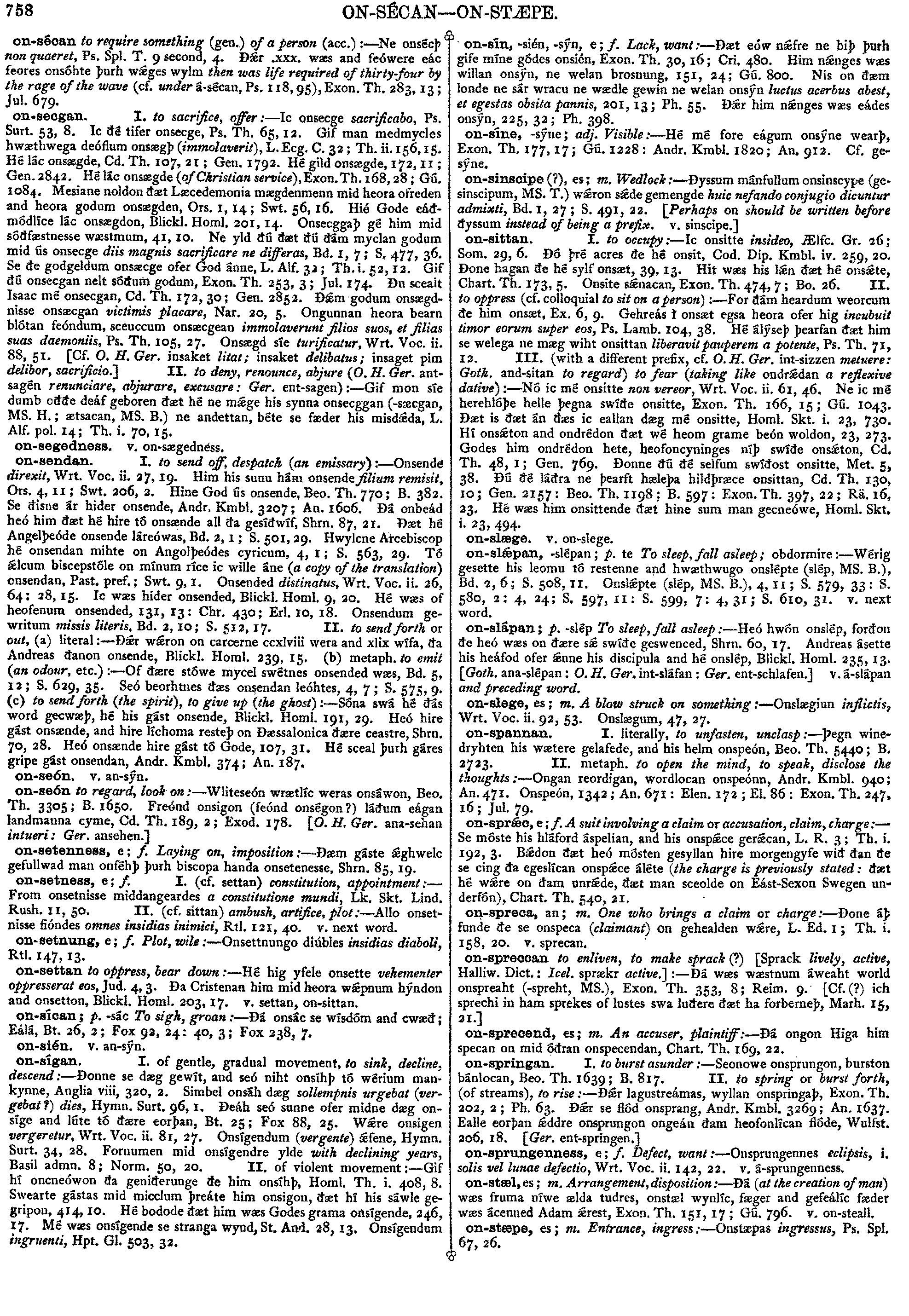
on-spreccan to enliven, to make sprack(?) [Sprack lively, active, Halliw. Dict.: Icel. sprækr active.]:--Ðá wæs wæstnum áweaht world onspreaht (-spreht, MS.), Exon. Th. 353, 8; Reim. 9. [Cf.(?) ich sprechi in ham sprekes of lustes swa luðere ðæt ha forberneþ, Marh. 15, 21.]
|
Source: Bosworth/Toller, page b0810, entry 12 View original page image as: [TIFF] [PNG] [View previous entry] [View next entry] |
[Comment on this entry] [View comments] |
The following entry has been hand-corrected once. |
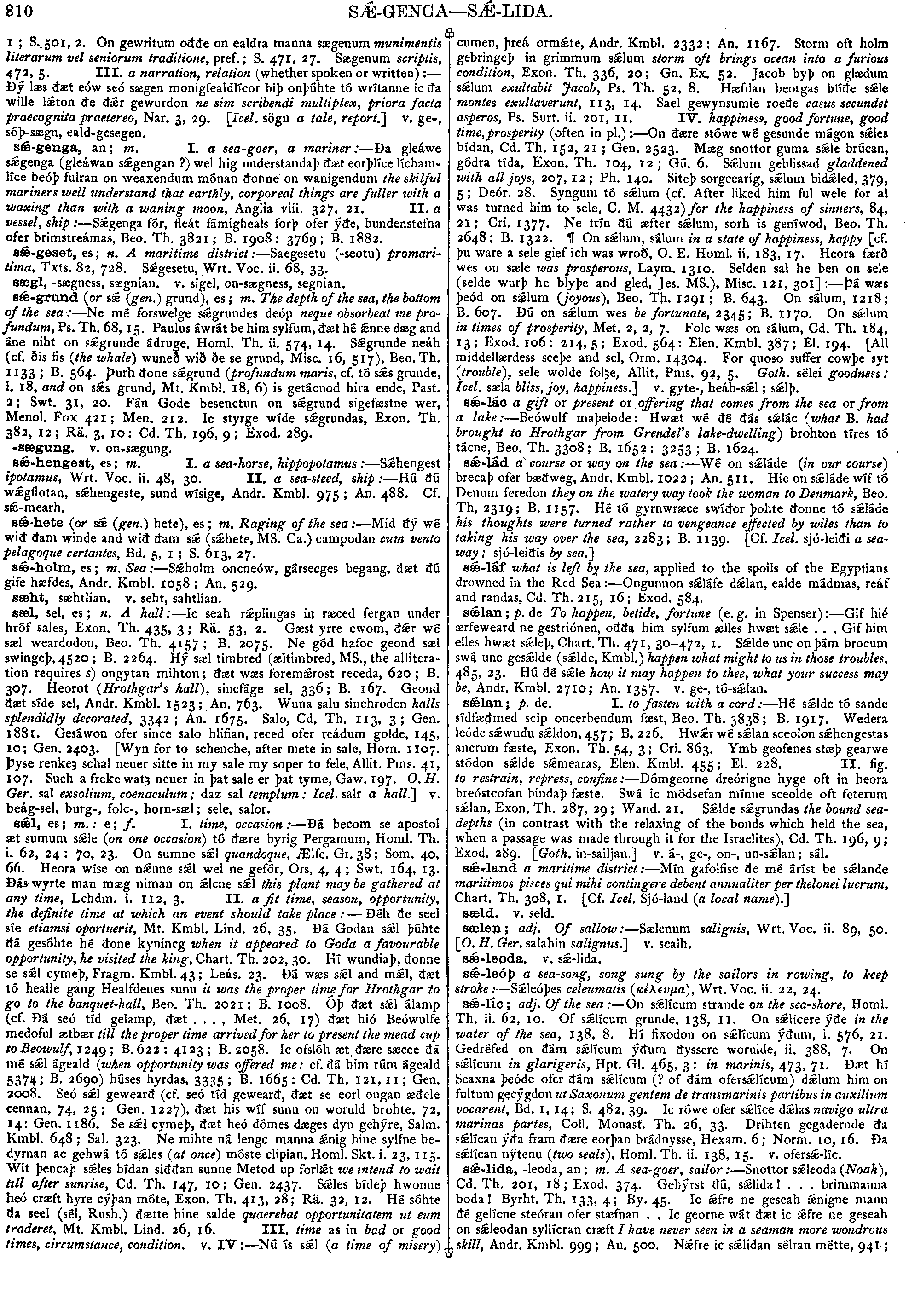
sl,
es;
m.:
e;
f.
I.
time,
occasion:--Ðá
becom
se
apostol
æt
sumum
sle
(on
one
occasion)
tó
ðære
byrig
Pergamum,
Homl.
Th.
i.
62,
24:
70,
23.
On
sumne
sl
quandoque,
Ælfc.
Gr.
38;
Som.
40,
66.
Heora
wíse
on
nnne
sl
wel
ne
gefór,
Ors.
4,
4;
Swt.
164,
13.
Ðás
wyrte
man
mæg
niman
on
lcne
sl
this
plant
may
be
gathered
at
any
time,
Lchdm.
i.
112,
3.
II.
a
fit
time,
season,
opportunity,
the
definite
time
at
which
an
event
should
take
place:--Ðéh
ðe
seel
síe
etiamsi
oportuerit,
Mt.
Kmbl.
Lind.
26,
35.
Ðá
Godan
sl
þúhte
ðá
gesóhte
hé
ðone
kynincg
when
it
appeared
to
Goda
a
favourable
opportunity,
he
visited
the
king,
Chart.
Th.
202,
30.
Hí
wundiaþ,
ðonne
se
sl
cymeþ,
Fragm.
Kmbl.
43;
Leás.
23.
Ðá
wæs
sl
and
ml,
ðæt
tó
healle
gang
Healfdenes
sunu
it
was
the
proper
time
for
Hrothgar
to
go
to
the
banquet-hall,
Beo.
Th.
2021;
B.
1008.
Óþ
ðæt
sl
álamp
(cf.
Ðá
seó
tíd
gelamp,
ðæt
.
.
.
,
Met.
26,
17)
ðæt
hió
Beówulfe
medoful
ætbær
till
the
proper
time
arrived
for
her
to
present
the
mead
cup
to
Beowulf,
1249;
B.
622:
4123;
B.
2058.
Ic
ofslóh
æt
ðære
sæcce
ðá
mé
sl
ágeald
(when
opportunity
was
offered
me:
cf.
ðá
him
rúm
ágeald
5374;
B.
2690)
húses
hyrdas,
3335;
B.
1665:
Cd.
Th.
121,
11;
Gen.
2008.
Seó
sl
gewearð
(cf.
seó
tíd
gewearð,
ðæt
se
eorl
ongan
æðele
cennan,
74,
25;
Gen.
1227),
ðæt
his
wíf
sunu
on
woruld
brohte,
72,
14:
Gen.
1186.
Se
sl
cymeþ,
ðæt
heó
dómes
dæges
dyn
gehýre,
Salm.
Kmbl.
648;
Sal.
323.
Ne
mihte
ná
lengc
manna
nig
hine
sylfne
bedyrnan
ac
gehwá
tó
sles
(at
once)
móste
clipian,
Homl.
Skt.
i.
23,
115.
Wit
þencaþ
sles
bídan
siððan
sunne
Metod
up
forlt
we
intend
to
wait
till
after
sunrise,
Cd.
Th.
147,
10;
Gen.
2437.
Sles
bídeþ
hwonne
heó
cræft
hyre
cýþan
móte,
Exon.
Th.
413,
28;
Rä.
32,
12.
Hé
sóhte
ða
seel
(sél,
Rush.)
ðætte
hine
salde
quaerebat
opportunitatem
ut
eum
traderet,
Mt.
Kmbl.
Lind.
26,
16.
III.
time
as
in
bad
or
good
times,
circumstance,
condition.
v.
IV:--Nú
ís
sl
(a
time
of
misery)
cumen,
þreá
ormte,
Andr.
Kmbl.
2332:
An.
1167.
Storm
oft
holm
gebringeþ
in
grimmum
slum
storm
oft
brings
ocean
into
a
furious
condition,
Exon.
Th.
336,
20;
Gn.
Ex.
52.
Jacob
byþ
on
glædum
slum
exultabit
Jacob,
Ps.
Th.
52,
8.
Hæfdan
beorgas
blíðe
sle
montes
exultaverunt,
113,
14.
Sael
gewynsumie
roeðe
casus
secundet
asperos,
Ps.
Surt.
ii.
201,
11.
IV.
happiness,
good
fortune,
good
time,
prosperity
(often
in
pl.):--On
ðære
stówe
wé
gesunde
mágon
sles
bídan,
Cd.
Th.
152,
21;
Gen.
2523.
Mæg
snottor
guma
sle
brúcan,
gódra
tída,
Exon.
Th.
104,
12;
Gú.
6.
Slum
geblissad
gladdened
with
all
joys,
207,
12;
Ph.
140.
Siteþ
sorgcearig,
slum
bidled,
379,
5;
Deór.
28.
Syngum
tó
slum
(cf.
After
liked
him
ful
wele
for
al
was
turned
him
to
sele,
C.
M.
4432)
for
the
happiness
of
sinners,
84,
21;
Cri.
1377.
Ne
frín
ðú
æfter
slum,
sorh
is
geníwod,
Beo.
Th.
2648;
B.
1322.

On
slum,
sálum
in
a
state
of
happiness,
happy
[cf.
þu
ware
a
sele
gief
ich
was
wroð,
O.
E.
Homl.
ii.
183,
17.
Heora
færð
wes
on
sæle
was
prosperous,
Laym.
1310.
Selden
sal
he
ben
on
iele
(selde
wurþ
he
blyþe
and
gled,
Jes.
MS.),
Misc.
121,
301]:--Þá
wæs
þeód
on
slum
(joyous),
Beo.
Th.
1291;
B.
643.
On
sálum,
1218;
B.
607.
Ðú
on
slum
wes
be
fortunate,
2345;
B.
1170.
On
slum
in
times
of
prosperity,
Met.
2,
2,
7.
Folc
wæs
on
sálum,
Cd.
Th.
184,
13;
Exod.
106:
214,
5;
Exod.
564:
Elen.
Kmbl.
387;
El.
194.
[All
middellærdess
sceþe
and
sel,
Orm.
14304.
For
quoso
suffer
cowþe
syt
(trouble),
sele
wolde
fol e,
Allit.
Pms.
92,
5.
Goth.
sélei
goodness:
Icel.
sæla
bliss,
joy,
happiness.]
v.
gyte-,
heáh-sl;
slþ.
e,
Allit.
Pms.
92,
5.
Goth.
sélei
goodness:
Icel.
sæla
bliss,
joy,
happiness.]
v.
gyte-,
heáh-sl;
slþ.
|
Source: Bosworth/Toller, page b0831, entry 4 View original page image as: [TIFF] [PNG] [View previous entry] [View next entry] |
[Comment on this entry] [View comments] |
The following entry has been hand-corrected once. |
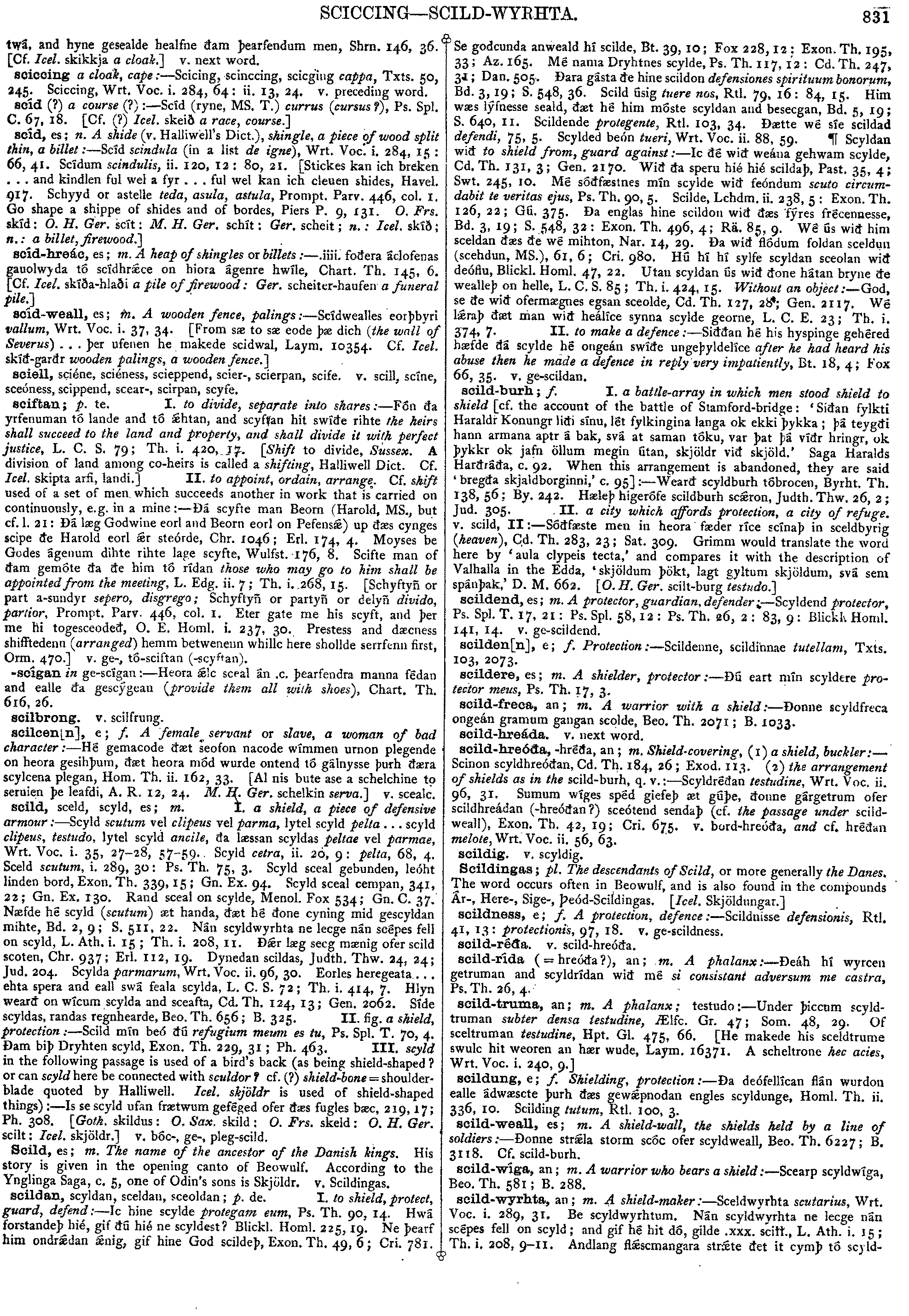
scíd, es; n. A shide (v. Halliwell's Dict. ), shingle, a piece of wood split thin, a billet: -- Scíd scindula (in a list de igne), Wrt. Voc! i. 284, 15 : 66, 41. Scídum scindulis, ii. 120, 12 : 80, 21. [Stickes kan ich breken . . . and kindlen ful wel a fyr . . . ful wel kan ich cleuen shides, Havel. . 917. Schyyd or astelle teda, asula, astula, Prompt. Parv. 446, col. I. Go shape a shippe of shides and of bordes, Piers P. 9, 131. O. Frs. skíd: O. H. Ger. scít: M. H. Ger. schít: Ger. scheit; n. : Icel. skíð; n. : a billet, firewood.]
|
Source: Bosworth/Toller, page b0834, entry 19 View original page image as: [TIFF] [PNG] [View previous entry] [View next entry] |
[Comment on this entry] [View comments] |
The following entry has been hand-corrected once. |
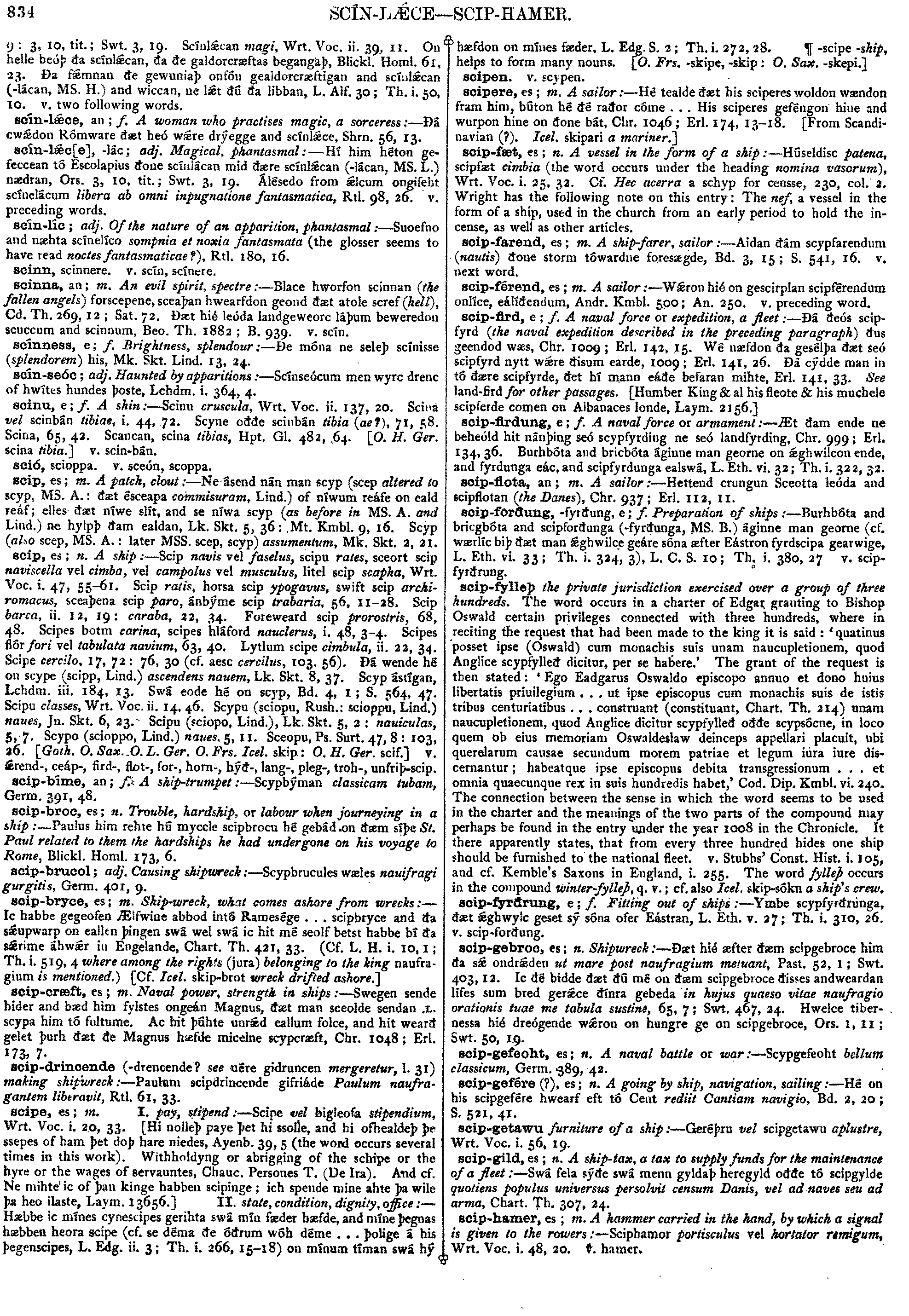
scipe, es; m. I. pay, stipend:--Scipe vel bigleofa stipendium, Wrt. Voc. i. 20, 33. [Hi nolleþ paye þet hi ssolle, and hi ofhealdeþ þe ssepes of ham þet doþ hare niedes, Ayenb. 39, 5 (the word occurs several times in this work). Withholdyng or abrigging of the schipe or the hyre or the wages of servauntes, Chauc. Persones T. (De Ira). And cf. Ne mihte ic of þan kinge habben scipinge; ich spende mine ahte þa wile þa heo ilaste, Laym. 13656.] II. state, condition, dignity, office:--Hæbbe ic mínes cynescipes gerihta swá mín fæder hæfde, and míne þegnas hæbben heora scipe (cf. se déma ðe óðrum wóh déme . . . þolige á his þegenscipes, L. Edg. ii. 3; Th. i. 266, 15-18) on mínum tíman swá hý hæfdon on mínes fæder, L. Edg. S. 2; Th. i. 272, 28. ¶ -scipe -ship, helps to form many nouns. [O. Frs. -skipe, -skip: O. Sax. -skepi.]
|
Source: Bosworth/Toller, page b0843, entry 16 View original page image as: [TIFF] [PNG] [View previous entry] [View next entry] |
[Comment on this entry] [View comments (1)] |
The following entry has been hand-corrected once. |
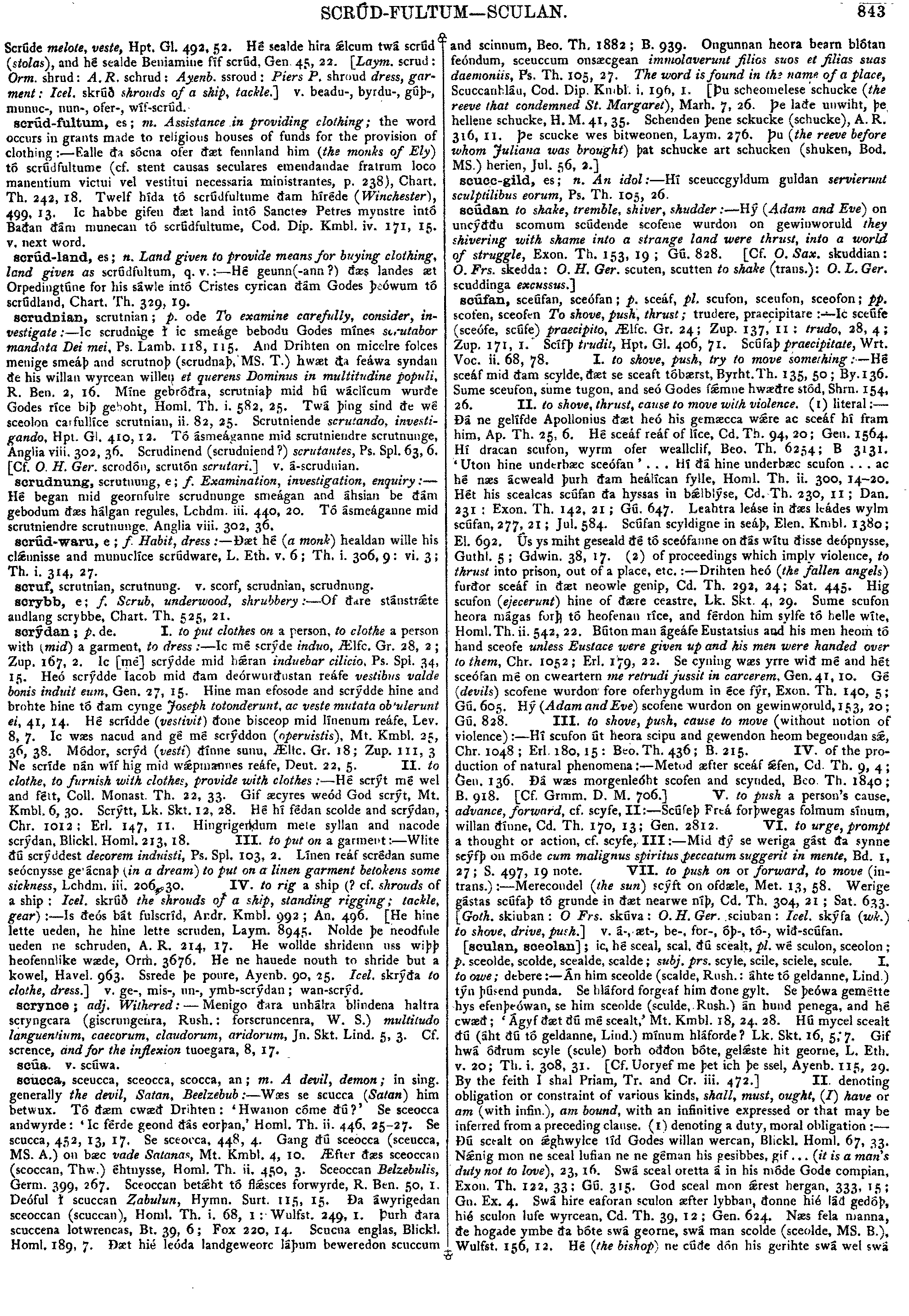
[soulan,
sceolan]
;
ic,
hé
sceal,
scal,
ðú
scéalt,
pl.
wé
sculon,
sceolon
;
p.
sceolde,
scolde,
scealde,
scalde;
subj.
prs,
scyle,
scile,
sciele,
scule.
I.
to
owe;
debere
:--
Án
him
sceolde
(scalde,
Rush.
:
áhte
tó
geldanne,
Lind.
)
týn
þúsend
punda.
Se
hláford
forgeaf
him
ðone
gylt.
Se
þeówa
gemétte
hys
efcnþfówan,
se
him
sceolde
(sculde,
Rush.)
án
hund
penega,
and
hé
cwæð;
'Ágyf
ðæt
ðú
mé
scealt,'
Mt.
Kmbl.
18,
24.
28.
Hú
mycel
scealt
ðú
(áht
ðú
tó
geldanne.
Lind.
)
mínum
hláforde?
Lk.
Skt.
16,
5,
7.
Gif
hwá
óðrum
scyle
(scule)
borh
oððon
bóte,
gelste
hit
georne,
L.
Eth.
v.
20;
Th.
i.
308,
31.
[Cf.
Uoryef
me
þet
ich
þe
ssel,
Ayenb.
115,
29.
By
the
feith
I
shal
Priam,
Tr.
and
Cr.
iii.
472.]
II.
denoting
obligation
or
constraint
of
various
kinds,
shall,
must,
ought,
(I)
have
or
am
(with
infin.
),
am
bound,
with
an
infinitive
expressed
or
that
may
be
inferred
from
a
preceding
clause.
(1)
denoting
a
duty,
moral
obligation
:--
Ðú
scealt
on
ghwylce
tíd
Godes
willan
wercan,
Blickl.
Homl.
67,
33.
Nnig
mon
ne
sceal
lufian
ne
ne
géman
his
gesibbes,
gif.
.
.
(it
is
a
man's
duty
not
to
love),
23,
16.
Swá
sceal
oretta
á
in
his
móde
Gode
compian,
Exon.
Th.
122,
33;
Gú.
315.
God
sceal
mon
rest
hergan,
333,
15;
Gn.
Ex.
4.
Swá
hire
eaforan
sculon
æfter
lybban,
ðonne
hié
lád
gedðþ,
hié
sculon
lufe
wyrcean,
Cd.
Th.
39,
12
;
Gen.
624.
Næs
fela
manna,
ðe
hogade
ymbe
ða
bóte
swá
georne,
swá
man
scolde
(sceolde,
MS.
B.
),
Wulfst.
156,
12.
Hé
(the
bishop)
ne
cúðe
dón
his
gerihte
swá
wel
swá
|
Source: Bosworth/Toller, page b0858, entry 1 View original page image as: [TIFF] [PNG] [View previous entry] [View next entry] |
[Comment on this entry] [View comments] |
The following entry has been hand-corrected once. |
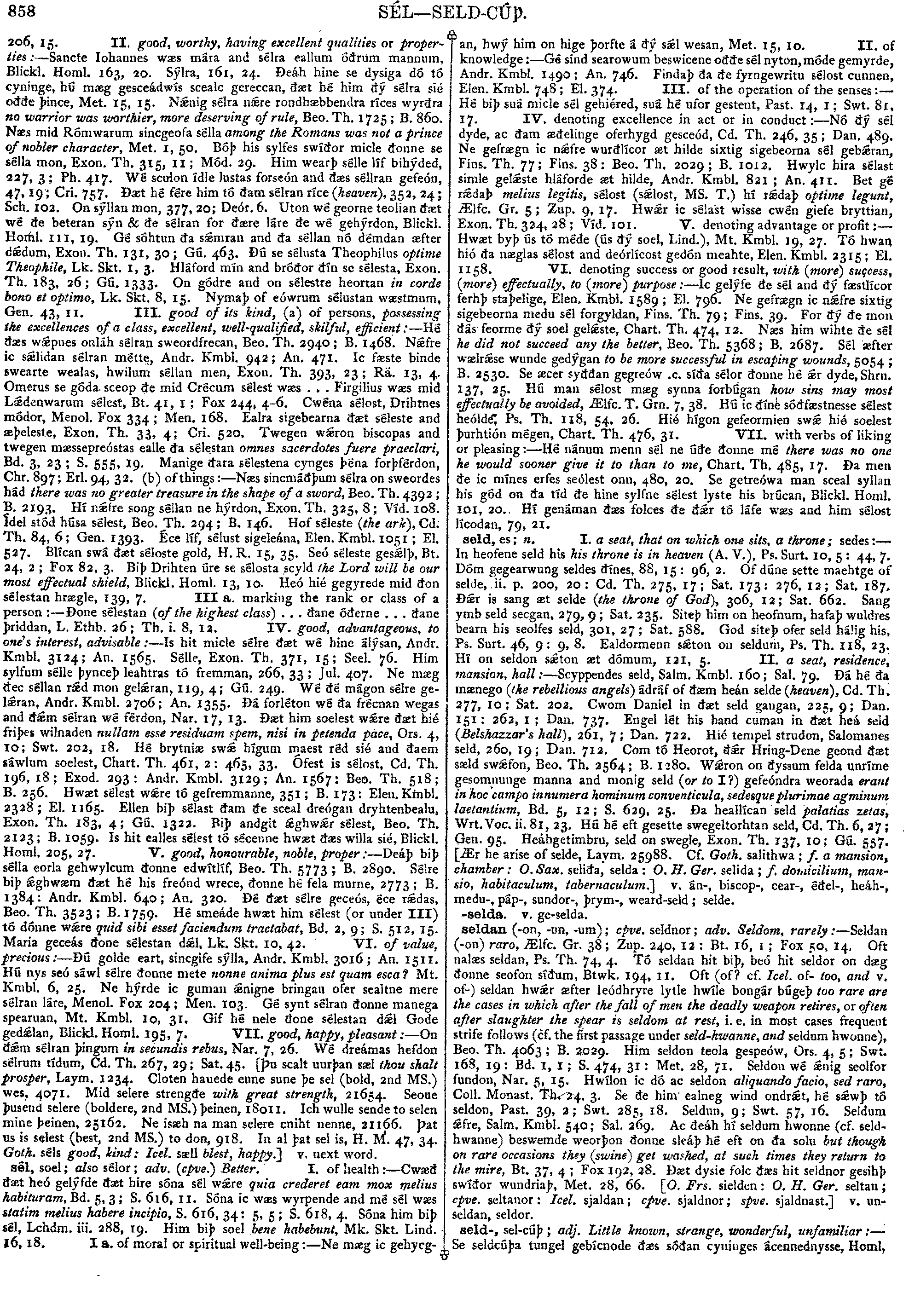
206,
15.
II.
good,
worthy,
having
excellent
qualities
or
properties
:--Sancte
Iohannes
wæs
mára
and
sélra
eallum
óðrum
mannum,
Blickl.
Homl.
163,
20.
Sýlra,
161,
24.
Ðeáh
hine
se
dysiga
dó
tó
cyninge,
hú
mæg
gesceádwís
scealc
gereccan,
ðæt
hé
him
ðý
sélra
sié
oððe
þince,
Met.
15,
15.
Nnig
sélra
nre
rondhæbbendra
ríces
wyrðra
no
warrior
was
worthier,
more
deserving
of
rule,
Beo.
Th.
1725
;
B.
860.
Næs
mid
Rómwarum
sincgeofa
sélla
among
the
Romans
was
not
a
prince
of
nobler
character,
Met.
1,
50.
Bóþ
his
sylfes
swíðor
micle
ðonne
se
sélla
mon,
Exon.
Th.
315,
11
;
Mód.
29.
Him
wearþ
sélle
líf
bihýded,
227,
3
;
Ph.
417.
Wé
sculon
ídle
lustas
forseón
and
ðæs
séllran
gefeón,
47,
19
;
Cri.
757.
Ðæt
hé
fére
him
tó
ðam
sélran
ríce
(heaven),
352,
24
;
Sch.
102.
On
sýllan
mon,
377,
20
;
Deór.
6.
Uton
wé
georne
teolian
ðæt
wé
ðe
beteran
sýn
&
ðe
sélran
for
ðære
láre
ðe
wé
gehýrdon,
Blickl.
Homl.
111,
19.
Gé
sóhtun
ða
smran
and
ða
séllan
nó
démdan
æfter
ddum,
Exon.
Th.
131,
30;
Gú.
463.
Ðú
se
sélusta
Theophilus
optime
Theophile,
Lk.
Skt.
1,
3.
Hláford
mín
and
bróðor
ðín
se
sélesta,
Exon.
Th.
183,
26
;
Gú.
1333.
On
gódre
and
on
sélestre
heortan
in
corde
bono
et
optimo,
Lk.
Skt.
8,
15.
Nymaþ
of
eówrum
sélustan
wæstmum,
Gen.
43,
11.
III.
good
of
its
kind,
(a)
of
persons,
possessing
the
excellences
of
a
class,
excellent,
well-qualified,
skilful,
efficient
:--Hé
ðæs
wpnes
onláh
sélran
sweordfrecan,
Beo.
Th.
2940
;
B.
1468.
Nfre
ic
slidan
sélran
métte,
Andr.
Kmbl.
942
;
An.
471.
Ic
fæste
binde
swearte
wealas,
hwilum
séllan
men,
Exon.
Th.
393,
23
;
Rä.
13,
4.
Omerus
se
góda
sceop
ðe
mid
Crécum
sélest
wæs
.
.
.
Firgilius
wæs
mid
Ldenwarum
sélest,
Bt.
41,
1
;
Fox
244,
4-6.
Cwéna
sélost,
Drihtnes
módor,
Menol.
Fox
334
;
Men.
168.
Ealra
sigebearna
ðæt
séleste
and
æþeleste,
Exon.
Th.
33,
4
;
Cri.
520.
Twegen
wron
biscopas
and
twegen
mæssepreóstas
ealle
ða
sélestan
omnes
sacerdotes
fuere
praeclari,
Bd.
3,
23
;
S.
555,
19.
Manige
ðara
sélestena
cynges
þéna
forþférdon,
Chr.
897
;
Erl.
94,
32.
(b)
of
things
:--Næs
sincmáðþum
sélra
on
sweordes
hád
there
was
no
greater
treasure
in
the
shape
of
a
sword,
Beo.
Th.
4392
;
B.
2193.
Hí
nfre
song
séllan
ne
hýrdon,
Exon.
Th.
325,
8
;
Víd.
108.
Ídel
stód
húsa
sélest.
Beo.
Th.
294
;
B.
146.
Hof
séleste
(the
ark),
Cd.
Th.
84,
6
;
Gen.
1393.
Éce
líf,
sélust
sigeleána,
Elen.
Kmbl.
1051
;
El.
527.
Blícan
swá
ðæt
séloste
gold,
H.
R.
15,
35.
Seó
séleste
geslþ,
Bt.
24,
2
;
Fox
82,
3.
Biþ
Drihten
úre
se
sélosta
scyld
the
Lord
will
be
our
most
effectual
shield.
Blickl.
Homl.
13,
10.
Heó
hié
gegyrede
mid
ðon
sélestan
hrægle,
139,
7.
IIIa.
marking
the
rank
or
class
of
a
person
:--Ðone
sélestan
(of
the
highest
class)
.
.
.
ðane
óðerne
.
.
.
ðane
þriddan,
L.
Ethb.
26
;
Th.
i.
8,
12.
IV.
good,
advantageous,
to
one's
interest,
advisable
:--Is
hit
micle
sélre
ðæt
wé
hine
álýsan,
Andr.
Kmbl.
3124
;
An.
1565.
Sélle,
Exon.
Th.
371,
15
;
Seel.
76.
Him
sylfum
sélle
þynceþ
leahtras
tó
fremman,
266,
33
;
Jul.
407.
Ne
mæg
ðec
séllan
rd
mon
gelran,
119,
4
;
Gú.
249.
Wé
ðé
mágon
sélre
ge lran,
Andr.
Kmbl.
2706
;
An.
1355.
Ðá
forléton
wé
ða
frécnan
wegas
and
ðm
sélran
wé
férdon,
Nar.
17,
13.
Ðæt
him
soelest
wre
ðæt
hié
friþes
wilnaden
nullam
esse
residuam
spem,
nisi
in
petenda
pace,
Ors.
4,
10
;
Swt.
202,
18.
Hé
brytniæ
sw
hígum
maest
réd
sié
and
ðaem
sáwlum
soelest,
Chart.
Th.
461,
2
:
465,
33.
Ófest
is
sélost,
Cd.
Th.
196,
18
;
Exod.
293
:
Andr.
Kmbl.
3129
;
An.
1567
:
Beo.
Th.
518
;
B.
256.
Hwæt
sélest
wre
tó
gefremmanne,
351
;
B.
173
:
Elen.
Kmbl.
2328
;
El.
1165.
Ellen
biþ
sélast
ðam
ðe
sceal
dreógan
dryhtenbealu,
Exon.
Th.
183,
4
;
Gú.
1322.
Biþ
andgit
ghwr
sélest,
Beo.
Th.
2123
;
B.
1059.
Is
hit
ealles
sélest
tó
sécenne
hwæt
ðæs
willa
sié,
Blickl.
Homl.
205,
27.
V.
good,
honourable,
noble,
proper
:--Deáþ
biþ
sélla
eorla
gehwylcum
ðonne
edwítlíf,
Beo.
Th.
5773
;
B.
2890.
Sélre
biþ
ghwæm
ðæt
hé
his
freónd
wrece,
ðonne
hé
fela
murne,
2773
;
B.
1384
:
Andr.
Kmbl.
640
;
An.
320.
Ðé
ðæt
sélre
geceós,
éce
rdas,
Beo.
Th.
3523
;
B.
1759.
Hé
smeáde
hwæt
him
sélest
(or
under
III)
tó
dónne
wre
quid
sibi
esset
faciendum
tractabat,
Bd.
2,
9
;
S.
512,
15.
Maria
geceás
ðone
sélestan
dl,
Lk.
Skt.
10,
42.
VI.
of
value,
precious
:--Ðú
golde
eart,
sincgife
sýlla.
Andr.
Kmbl.
3016
;
An.
1511.
Hú
nys
seó
sáwl
sélre
ðonne
mete
nonne
anima
plus
est
quam
esca
?
Mt.
Kmbl.
6,
25.
Ne
hýrde
ic
guman
nigne
bringan
ofer
sealtne
mere
sélran
láre,
Menol.
Fox
204
;
Men.
103.
Gé
synt
sélran
ðonne
manega
spearuan,
Mt.
Kmbl.
10,
31.
Gif
hé
nele
ðone
sélestan
dl
Gode
gedlan,
Blickl.
Homl.
195,
7,
VII.
good,
happy,
pleasant
:--On
ðm
sélran
þingum
in
secundis
rebus,
Nar.
7,
26.
Wé
dreámas
hefdon
sélrum
tídum,
Cd.
Th.
267,
29
;
Sat.
45.
[Þu
scalt
uurþan
sæl
thou
shalt
prosper,
Laym.
1234.
Cloten
hauede
enne
sune
þe
sel
(bold,
2nd
MS.)
wes,
4071.
Mid
selere
strengðe
with
great
strength,
21654.
Seoue
þusend
selere
(boldere,
2nd
MS.)
þeinen,
18011.
Ich
wulle
sende
to
selen
mine
þeinen,
25162.
Ne
isæh
na
man
selere
cniht
nenne,
21166.
Þat
us
is
selest
(best,
2nd
MS.)
to
don,
918.
In
al
þat
sel
is,
H.
M.
47,
34.
Goth.
séls
good,
kind
:
Icel.
sæll
blest,
happy.]
v.
next
word.
lran,
Andr.
Kmbl.
2706
;
An.
1355.
Ðá
forléton
wé
ða
frécnan
wegas
and
ðm
sélran
wé
férdon,
Nar.
17,
13.
Ðæt
him
soelest
wre
ðæt
hié
friþes
wilnaden
nullam
esse
residuam
spem,
nisi
in
petenda
pace,
Ors.
4,
10
;
Swt.
202,
18.
Hé
brytniæ
sw
hígum
maest
réd
sié
and
ðaem
sáwlum
soelest,
Chart.
Th.
461,
2
:
465,
33.
Ófest
is
sélost,
Cd.
Th.
196,
18
;
Exod.
293
:
Andr.
Kmbl.
3129
;
An.
1567
:
Beo.
Th.
518
;
B.
256.
Hwæt
sélest
wre
tó
gefremmanne,
351
;
B.
173
:
Elen.
Kmbl.
2328
;
El.
1165.
Ellen
biþ
sélast
ðam
ðe
sceal
dreógan
dryhtenbealu,
Exon.
Th.
183,
4
;
Gú.
1322.
Biþ
andgit
ghwr
sélest,
Beo.
Th.
2123
;
B.
1059.
Is
hit
ealles
sélest
tó
sécenne
hwæt
ðæs
willa
sié,
Blickl.
Homl.
205,
27.
V.
good,
honourable,
noble,
proper
:--Deáþ
biþ
sélla
eorla
gehwylcum
ðonne
edwítlíf,
Beo.
Th.
5773
;
B.
2890.
Sélre
biþ
ghwæm
ðæt
hé
his
freónd
wrece,
ðonne
hé
fela
murne,
2773
;
B.
1384
:
Andr.
Kmbl.
640
;
An.
320.
Ðé
ðæt
sélre
geceós,
éce
rdas,
Beo.
Th.
3523
;
B.
1759.
Hé
smeáde
hwæt
him
sélest
(or
under
III)
tó
dónne
wre
quid
sibi
esset
faciendum
tractabat,
Bd.
2,
9
;
S.
512,
15.
Maria
geceás
ðone
sélestan
dl,
Lk.
Skt.
10,
42.
VI.
of
value,
precious
:--Ðú
golde
eart,
sincgife
sýlla.
Andr.
Kmbl.
3016
;
An.
1511.
Hú
nys
seó
sáwl
sélre
ðonne
mete
nonne
anima
plus
est
quam
esca
?
Mt.
Kmbl.
6,
25.
Ne
hýrde
ic
guman
nigne
bringan
ofer
sealtne
mere
sélran
láre,
Menol.
Fox
204
;
Men.
103.
Gé
synt
sélran
ðonne
manega
spearuan,
Mt.
Kmbl.
10,
31.
Gif
hé
nele
ðone
sélestan
dl
Gode
gedlan,
Blickl.
Homl.
195,
7,
VII.
good,
happy,
pleasant
:--On
ðm
sélran
þingum
in
secundis
rebus,
Nar.
7,
26.
Wé
dreámas
hefdon
sélrum
tídum,
Cd.
Th.
267,
29
;
Sat.
45.
[Þu
scalt
uurþan
sæl
thou
shalt
prosper,
Laym.
1234.
Cloten
hauede
enne
sune
þe
sel
(bold,
2nd
MS.)
wes,
4071.
Mid
selere
strengðe
with
great
strength,
21654.
Seoue
þusend
selere
(boldere,
2nd
MS.)
þeinen,
18011.
Ich
wulle
sende
to
selen
mine
þeinen,
25162.
Ne
isæh
na
man
selere
cniht
nenne,
21166.
Þat
us
is
selest
(best,
2nd
MS.)
to
don,
918.
In
al
þat
sel
is,
H.
M.
47,
34.
Goth.
séls
good,
kind
:
Icel.
sæll
blest,
happy.]
v.
next
word.
| Result Page: |  |
Previous | 1 2 3 4 5 6 7 8 9 10 11 12 13 14 | Next |  |
Germanic Lexicon Project (main page)
This search system was written by
Sean Crist
Please consider
volunteering
to correct the data in these online dictionaries.
No rights reserved. Feel free to use these data in any way you please.