|
|

|
Source: Bosworth/Toller, page b0907, entry 3 View original page image as: [TIFF] [PNG] [View previous entry] [View next entry] |
[Comment on this entry] [View comments] |
The following entry has been hand-corrected once. |
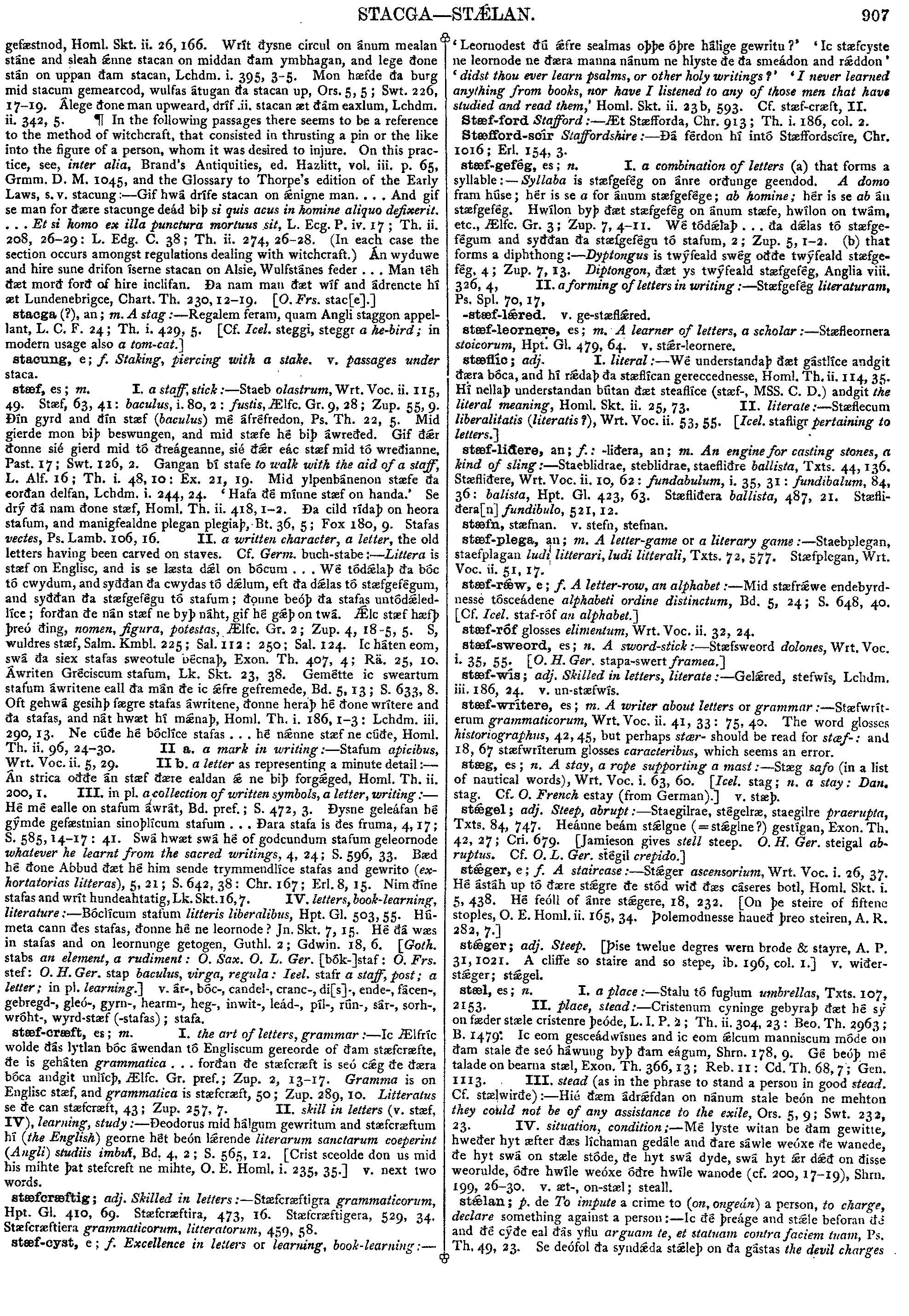
stæf,
es;
m.
I.
a
staff,
stick
:--
Staeb
olastrum,
Wrt.
Voc.
ii.
115,
49.
Stæf,
63,
41:
baculus,
i.
80,
2:
fustis,
Ælfc.
Gr.
9,
28;
Zup.
55,
9.
Ðín
gyrd
and
ðín
stæf
(baculus)
me
áfréfredon,
Ps.
Th.
22,
5.
Mid
gierde
men
biþ
beswungen,
and
mid
stæfe
hé
biþ
áwreðed.
Gif
ð r
ðonne
sié
gierd
mid
tó
ðreágeanne,
sié
ðr
eác
stæf
mid
tó
wreðianne,
Past.
17;
Swt.
126,
2.
Gangan
bí
stafe
to
walk
with
the
aid
of
a
staff,
L.
Alf.
16;
Th.
i.
48,
10:
Ex.
21,
19.
Mid
ylpenbánenon
stæfe
ða
eorðan
delfan,
Lchdm.
i.
244,
24.
'Hafa
ðé
mínne
stæf
on
handa.'
Se
drý
ðá
nam
ðone
stæf
Homl.
Th.
ii.
418,
1-2.
Ða
cild
rídaþ
on
heora
stafum,
and
manigfealdne
plegan
plegiaþ,
Bt.
36,
5;
Fox
180,
9.
Stafas
vectes,
Ps.
Lamb.
106,
16.
II.
a
written
character,
a
letter,
the
old
letters
having
been
carved
on
staves.
Cf.
Germ.
buch-stabe
:--
Littera
is
stæf
on
Englisc,
and
is
se
læsta
dl
on
bócum
...
Wé
tódlaþ
ða
bóc
tó
cwydum,
and
syððan
ða
cwydas
tó
dlum,
eft
ða
dlas
tó
stæfgefégum,
and
syððan
ða
stæfgefégu
tó
stafum;
ðonne
beóþ
ða
stafas
untódledlíce;
forðan
ðe
nán
stæf
ne
byþ
náht,
gif
hé
gþ
on
twá.
Æ-acute;lc
stæf
hæfþ
þreó
ðing,
nomen,
figura,
potestas,
Ælfc.
Gr.
2;
Zup.
4,
18-5,
5.
S,
wuldres
stæf,
Salm.
Kmbl.
225;
Sal.
112:
250;
Sal.
124.
Ic
háten
eom,
swá
ða
siex
stafas
sweotule
bécnaþ,
Exon.
Th.
407,
4;
Rä.
25,
10.
Áwriten
Gréciscum
stafum,
Lk.
Skt.
23,
38.
Gemétte
ic
sweartum
stafum
áwritene
eall
ða
mán
ðe
ic
fre
gefremede,
Bd.
5,
13;
S.
633,
8.
Oft
gehwá
gesihþ
fægre
stafas
áwritene,
ðonne
heraþ
hé
ðone
wrítere
and
ða
stafas,
and
nát
hwæt
hí
mnaþ,
Homl.
Th.
i.
186,
1-3:
Lchdm.
iii.
290,
13.
Ne
cúðe
hé
bóclíce
stafas
...
hé
nnne
stæf
ne
cúðe,
Homl.
Th.
ii.
96,
24-30.
II
a.
a
mark
in
writing
:--
Stafum
apicibus,
Wrt.
Voc.
ii.
5,
29.
II
b.
a
letter
as
representing
a
minute
detail
:--
Án
strica
oððe
án
stæf
ðære
ealdan
ne
biþ
forgged,
Homl.
Th.
ii.
200,
1.
III.
in
pl.
a
collection
of
written
symbols,
a
letter,
writing
:--
Hé
mé
ealle
on
stafum
áwrát,
Bd.
pref.;
S.
472,
3.
Ðysne
geleáfan
hé
gýmde
gefæstnian
sinoþlícum
stafum
...
Ðara
stafa
is
ðes
fruma,
4,
17;
S.
585,
14-17:
41.
Swá
hwæt
swá
hé
of
godcundum
stafum
geleornode
whatever
he
learnt
from
the
sacred
writings,
4.
24;
S.
596,
33.
Bæd
hé
ðone
Abbud
ðæt
hé
him
sende
trymmendlíce
stafas
and
gewrito
(exhortatorias
litteras),
5,
21;
S.
642,
38:
Chr.
167;
Erl.
8,
15.
Nim
ðíne
stafas
and
wrít
hundeahtatig,
Lk.
Skt.
16,
7.
IV.
letters,
book-learning,
literature
:--
Bóclícum
stafum
litteris
liberalibus,
Hpt.
Gl.
503,
55.
Hú
meta
cann
ðes
stafas,
ðonne
hé
ne
leornode?
Jn.
Skt.
7,
15.
Hé
ðá
wæs
in
stafas
and
on
leornunge
getogen,
Guthl.
2;
Gdwin.
18,
6.
[Goth.
stabs
an
element,
a
rudiment:
O.
Sax.
O.
L.
Ger.
[bók-]staf:
O.
Frs.
stef:
O.
H.
Ger.
stap
baculus,
virga,
regula:
Icel.
stafr
a
staff,
post;
a
letter;
in
pl.
learning.]
v.
ár-,
bóc-,
candel-,
cranc-,
di[s]-,
ende-,
fácen-,
gebregd-,
gleó-,
gyrn-,
hearm-,
heg-,
inwit-,
leád-,
píl-,
rún-,
sár-,
sorh-,
wróht-,
wyrd-stæf
(-stafas);
stafa.
r
ðonne
sié
gierd
mid
tó
ðreágeanne,
sié
ðr
eác
stæf
mid
tó
wreðianne,
Past.
17;
Swt.
126,
2.
Gangan
bí
stafe
to
walk
with
the
aid
of
a
staff,
L.
Alf.
16;
Th.
i.
48,
10:
Ex.
21,
19.
Mid
ylpenbánenon
stæfe
ða
eorðan
delfan,
Lchdm.
i.
244,
24.
'Hafa
ðé
mínne
stæf
on
handa.'
Se
drý
ðá
nam
ðone
stæf
Homl.
Th.
ii.
418,
1-2.
Ða
cild
rídaþ
on
heora
stafum,
and
manigfealdne
plegan
plegiaþ,
Bt.
36,
5;
Fox
180,
9.
Stafas
vectes,
Ps.
Lamb.
106,
16.
II.
a
written
character,
a
letter,
the
old
letters
having
been
carved
on
staves.
Cf.
Germ.
buch-stabe
:--
Littera
is
stæf
on
Englisc,
and
is
se
læsta
dl
on
bócum
...
Wé
tódlaþ
ða
bóc
tó
cwydum,
and
syððan
ða
cwydas
tó
dlum,
eft
ða
dlas
tó
stæfgefégum,
and
syððan
ða
stæfgefégu
tó
stafum;
ðonne
beóþ
ða
stafas
untódledlíce;
forðan
ðe
nán
stæf
ne
byþ
náht,
gif
hé
gþ
on
twá.
Æ-acute;lc
stæf
hæfþ
þreó
ðing,
nomen,
figura,
potestas,
Ælfc.
Gr.
2;
Zup.
4,
18-5,
5.
S,
wuldres
stæf,
Salm.
Kmbl.
225;
Sal.
112:
250;
Sal.
124.
Ic
háten
eom,
swá
ða
siex
stafas
sweotule
bécnaþ,
Exon.
Th.
407,
4;
Rä.
25,
10.
Áwriten
Gréciscum
stafum,
Lk.
Skt.
23,
38.
Gemétte
ic
sweartum
stafum
áwritene
eall
ða
mán
ðe
ic
fre
gefremede,
Bd.
5,
13;
S.
633,
8.
Oft
gehwá
gesihþ
fægre
stafas
áwritene,
ðonne
heraþ
hé
ðone
wrítere
and
ða
stafas,
and
nát
hwæt
hí
mnaþ,
Homl.
Th.
i.
186,
1-3:
Lchdm.
iii.
290,
13.
Ne
cúðe
hé
bóclíce
stafas
...
hé
nnne
stæf
ne
cúðe,
Homl.
Th.
ii.
96,
24-30.
II
a.
a
mark
in
writing
:--
Stafum
apicibus,
Wrt.
Voc.
ii.
5,
29.
II
b.
a
letter
as
representing
a
minute
detail
:--
Án
strica
oððe
án
stæf
ðære
ealdan
ne
biþ
forgged,
Homl.
Th.
ii.
200,
1.
III.
in
pl.
a
collection
of
written
symbols,
a
letter,
writing
:--
Hé
mé
ealle
on
stafum
áwrát,
Bd.
pref.;
S.
472,
3.
Ðysne
geleáfan
hé
gýmde
gefæstnian
sinoþlícum
stafum
...
Ðara
stafa
is
ðes
fruma,
4,
17;
S.
585,
14-17:
41.
Swá
hwæt
swá
hé
of
godcundum
stafum
geleornode
whatever
he
learnt
from
the
sacred
writings,
4.
24;
S.
596,
33.
Bæd
hé
ðone
Abbud
ðæt
hé
him
sende
trymmendlíce
stafas
and
gewrito
(exhortatorias
litteras),
5,
21;
S.
642,
38:
Chr.
167;
Erl.
8,
15.
Nim
ðíne
stafas
and
wrít
hundeahtatig,
Lk.
Skt.
16,
7.
IV.
letters,
book-learning,
literature
:--
Bóclícum
stafum
litteris
liberalibus,
Hpt.
Gl.
503,
55.
Hú
meta
cann
ðes
stafas,
ðonne
hé
ne
leornode?
Jn.
Skt.
7,
15.
Hé
ðá
wæs
in
stafas
and
on
leornunge
getogen,
Guthl.
2;
Gdwin.
18,
6.
[Goth.
stabs
an
element,
a
rudiment:
O.
Sax.
O.
L.
Ger.
[bók-]staf:
O.
Frs.
stef:
O.
H.
Ger.
stap
baculus,
virga,
regula:
Icel.
stafr
a
staff,
post;
a
letter;
in
pl.
learning.]
v.
ár-,
bóc-,
candel-,
cranc-,
di[s]-,
ende-,
fácen-,
gebregd-,
gleó-,
gyrn-,
hearm-,
heg-,
inwit-,
leád-,
píl-,
rún-,
sár-,
sorh-,
wróht-,
wyrd-stæf
(-stafas);
stafa.
|
Source: Bosworth/Toller, page d0063, entry 17 View original page image as: [TIFF] [PNG] [View previous entry] [View next entry] |
[Comment on this entry] [View comments] |
The following entry has been hand-corrected once. |
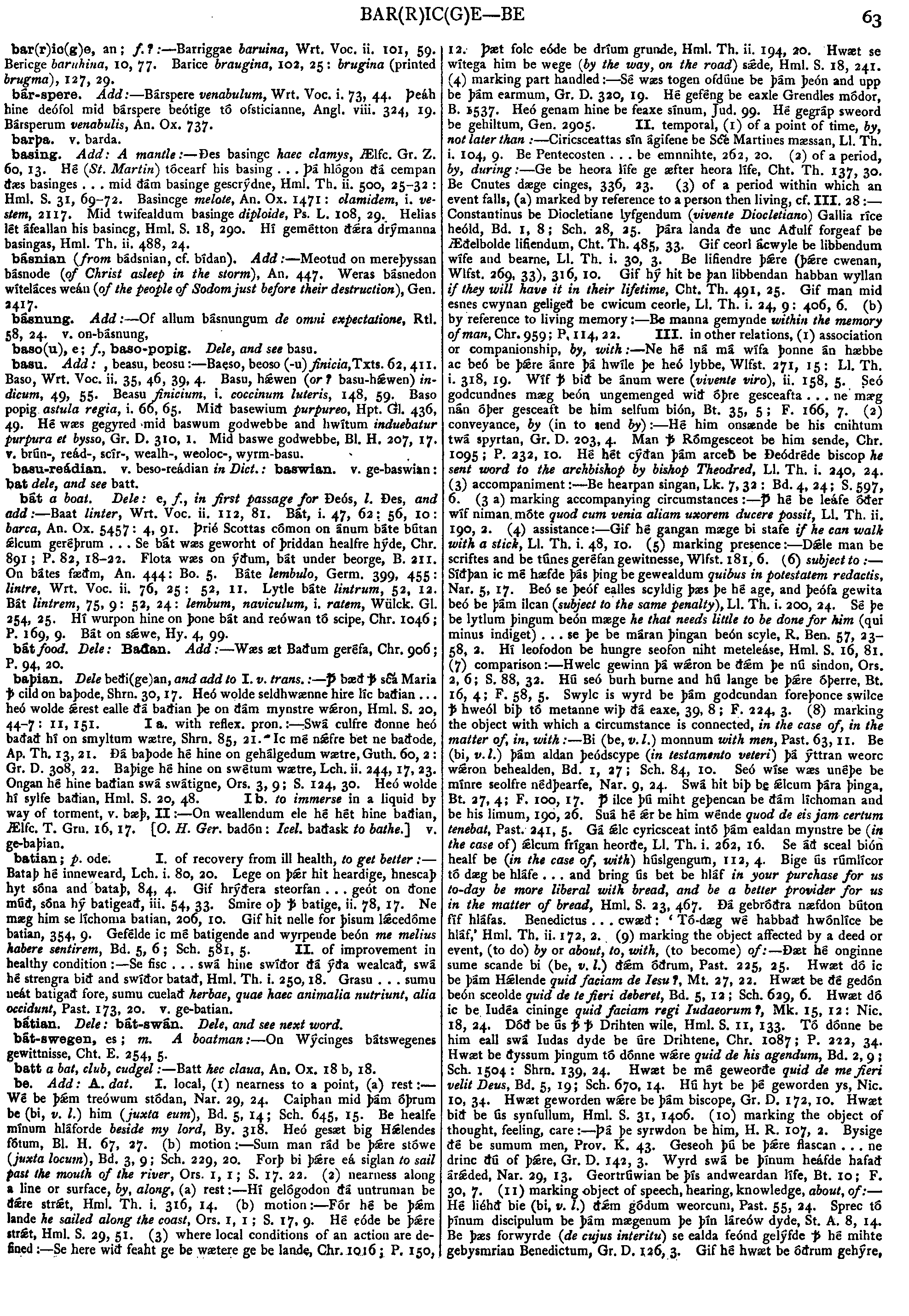
be.
Add:
A.
dat.
I.
local,
(1)
nearness
to
a
point,
(a)
rest:--Wé
be
þm
treówum
stódan,
Nar.
29,
24.
Caiphan
mid
þám
óþrum
be
(bi,
v.
l.)
him
(juxta
eum),
Bd.
5,
14;
Sch.
645,
15.
Be
healfe
mínum
hláforde
beside
my
lord,
By.
318.
Heó
gesæt
big
Hlendes
fótum,
Bl.
H.
67,
27.
(b)
motion:--Sum
man
rád
be
þre
stówe
(juxta
locum),
Bd.
3,
9;
Sch.
229,
20.
Forþ
bi
þre
eá
siglan
to
sail
past
the
mouth
of
the
river,
Ors.
1,
1;
S.
17,
22.
(2)
nearness
along
a
line
or
surface,
by,
along,
(a)
rest:--Hí
gelógodon
ðá
untruman
be
ðre
strt,
Hml.
Th.
i.
316,
14.
(b)
motion:--Fór
hé
be
þm
lande
he
sailed
along
the
coast,
Ors.
1,
1;
S.
17,
9.
Hé
eóde
be
þre
strt,
Hml.
S.
29,
51.
(3)
where
local
conditions
of
an
action
are
defined:--Se
here
wið
feaht
ge
be
wætere
ge
be
lande,
Chr.
1016;
P.
150,
12.
Þæt
folc
eóde
be
dríum
grunde,
Hml.
Th.
ii.
194,
20.
Hwæt
se
wítega
him
be
wege
(by
the
way,
on
the
road)
sde,
Hml.
S.
18,
241.
(4)
marking
part
handled:--Se
wæs
togen
ofdúne
be
þám
þeón
and
upp
be
þám
earmum,
Gr.
D.
320,
19.
Hé
geféng
be
eaxle
Grendles
módor,
B.
1537.
Heó
genam
hine
be
feaxe
sínum,
Jud.
99.
Hé
gegráp
sweord
be
gehiltum,
Gen.
2905.
II.
temporal,
(1)
of
a
point
of
time,
by,
not
later
than:--Ciricsceattas
sín
ágifene
be
S e
Martines
mæssan,
Ll.
Th.
i.
104,
9.
Be
Pentecosten
.
.
.
be
emnnihte,
262,
20.
(2)
of
a
period,
by,
during:--Ge
be
heora
lífe
ge
æfter
heora
lífe,
Cht.
Th.
137,
30.
Be
Cnutes
dæge
cinges,
336,
33.
(3)
of
a
period
within
which
an
event
falls,
(a)
marked
by
reference
to
a
person
then
living,
cf.
III.
28:--Constantinus
be
Diocletiane
lyfgendum
(vivente
Diocletiano)
Gallia
ríce
heóld,
Bd.
1,
8;
Sch.
28,
25.
Þára
landa
ðe
unc
Aðulf
forgeaf
be
Æðelbolde
lifiendum,
Cht.
Th.
485,
33.
Gif
ceorl
ácwyle
be
libbendum
wífe
and
bearne,
Ll.
Th.
i.
30,
3.
Be
lifiendre
þre
(þre
cwenan,
Wlfst.
269,
33),
316,
10.
Gif
hý
hit
be
þan
libbendan
habban
wyllan
if
they
will
have
it
in
their
lifetime,
Cht.
Th.
491,
25.
Gif
man
mid
esnes
cwynan
geligeð
be
cwicum
ceorle,
Ll.
Th.
i.
24,
9:
406,
6.
(b)
by
reference
to
living
memory:--Be
manna
gemynde
within
the
memory
of
man,
Chr.
959;
P.
114,
22.
III.
in
other
relations,
(1)
association
or
companionship,
by,
with:--Ne
hé
ná
má
wífa
þonne
án
hæbbe
ac
beó
be
þre
ánre
þá
hwíle
þe
heó
lybbe,
Wlfst.
271,
15:
Ll.
Th.
i.
318,
19.
Wíf
e
Martines
mæssan,
Ll.
Th.
i.
104,
9.
Be
Pentecosten
.
.
.
be
emnnihte,
262,
20.
(2)
of
a
period,
by,
during:--Ge
be
heora
lífe
ge
æfter
heora
lífe,
Cht.
Th.
137,
30.
Be
Cnutes
dæge
cinges,
336,
33.
(3)
of
a
period
within
which
an
event
falls,
(a)
marked
by
reference
to
a
person
then
living,
cf.
III.
28:--Constantinus
be
Diocletiane
lyfgendum
(vivente
Diocletiano)
Gallia
ríce
heóld,
Bd.
1,
8;
Sch.
28,
25.
Þára
landa
ðe
unc
Aðulf
forgeaf
be
Æðelbolde
lifiendum,
Cht.
Th.
485,
33.
Gif
ceorl
ácwyle
be
libbendum
wífe
and
bearne,
Ll.
Th.
i.
30,
3.
Be
lifiendre
þre
(þre
cwenan,
Wlfst.
269,
33),
316,
10.
Gif
hý
hit
be
þan
libbendan
habban
wyllan
if
they
will
have
it
in
their
lifetime,
Cht.
Th.
491,
25.
Gif
man
mid
esnes
cwynan
geligeð
be
cwicum
ceorle,
Ll.
Th.
i.
24,
9:
406,
6.
(b)
by
reference
to
living
memory:--Be
manna
gemynde
within
the
memory
of
man,
Chr.
959;
P.
114,
22.
III.
in
other
relations,
(1)
association
or
companionship,
by,
with:--Ne
hé
ná
má
wífa
þonne
án
hæbbe
ac
beó
be
þre
ánre
þá
hwíle
þe
heó
lybbe,
Wlfst.
271,
15:
Ll.
Th.
i.
318,
19.
Wíf
 bið
be
ánum
were
(vivente
viro),
ii.
158,
5.
Seó
godcundnes
mæg
beón
ungemenged
wið
óþre
gesceafta
.
.
.
ne
mæg
nán
óþer
gesceaft
be
him
selfum
bión,
Bt.
35,
5;
F.
166,
7.
(2)
conveyance,
by
(in
to
send
by):--Hé
him
onsænde
be
his
cnihtum
twá
spyrtan,
Gr.
D.
203,
4.
Man
Rómgesceot
be
him
sende,
Chr.
1095;
P.
232,
10.
Hé
hét
cýðan
þám
arce
bið
be
ánum
were
(vivente
viro),
ii.
158,
5.
Seó
godcundnes
mæg
beón
ungemenged
wið
óþre
gesceafta
.
.
.
ne
mæg
nán
óþer
gesceaft
be
him
selfum
bión,
Bt.
35,
5;
F.
166,
7.
(2)
conveyance,
by
(in
to
send
by):--Hé
him
onsænde
be
his
cnihtum
twá
spyrtan,
Gr.
D.
203,
4.
Man
Rómgesceot
be
him
sende,
Chr.
1095;
P.
232,
10.
Hé
hét
cýðan
þám
arce be
Ðeódréde
biscop
he
sent
word
to
the
archbishop
by
bishop
Theodred,
Ll.
Th.
i.
240,
24.
(3)
accompaniment:--Be
hearpan
singan,
Lk.
7,
32:
Bd.
4,
24;
S.
597,
6.
(3
a)
marking
accompanying
circumstances:--Þ-bar;
hé
be
leáfe
óðer
wíf
niman
móte
quod
cum
venia
aliam
uxorem
ducere
possit,
Ll.
Th.
ii.
190,
2.
(4)
assistance:--Gif
hé
gangan
mæge
bi
stafe
if
he
can
walk
with
a
stick,
Ll.
Th.
i.
48,
10.
(5)
marking
presence:--Dle
man
be
scriftes
and
be
túnes
geréfan
gewitnesse,
Wlfst.
181,
6.
(6)
subject
to:--Síðþan
ic
mé
hæfde
þás
þing
be
gewealdum
quibus
in
potestatem
redactis,
Nar.
5,
17.
Beó
se
þeóf
ealles
scyldig
þæs
þe
hé
age,
and
þeófa
gewita
beó
be
þám
ilcan
(subject
to
the
same
penalty),
Ll.
Th.
i.
200,
24.
Sé
þe
be
lytlum
þingum
beón
mæge
he
that
needs
little
to
be
done
for
him
(qui
minus
indiget)
.
.
.
se
þe
be
máran
þingan
beón
scyle,
R.
Ben.
57,
23-58,
2.
Hí
leofodon
be
hungre
seofon
niht
meteleáse,
Hml.
S.
16,
81.
(7)
comparison:--Hwelc
gewinn
þá
wron
be
ðm
þe
nú
sindon,
Ors.
2,
6;
S.
88,
32.
Hú
seó
burh
burne
and
hú
lange
be
þre
óþerre,
Bt.
16,
4;
F.
58,
5.
Swylc
is
wyrd
be
þám
godcundan
foreþonce
swilce
hweól
biþ
tó
metanne
wiþ
ðá
eaxe,
39,
8;
F.
224,
3.
(8)
marking
the
object
with
which
a
circumstance
is
connected,
in
the
case
of,
in
the
matter
of,
in,
with:--Bi
(be,
v.
l.)
monnum
with
men,
Past.
63,
11.
Be
(bi,
v.
l.)
þám
aldan
þeódscype
(in
testamento
veteri)
þá
ýttran
weorc
wron
behealden,
Bd.
1,
27;
Sch.
84,
10.
Seó
wíse
wæs
unéþe
be
mínre
seolfre
nédþearfe,
Nar.
9,
24.
Swá
hit
biþ
be
lcum
þára
þinga,
Bt.
27,
4;
F.
100,
17.
Þ-bar;
ilce
þú
miht
geþencan
be
ðám
líchoman
and
be
his
limum,
190,
26.
Suá
hé
r
be
him
wénde
quod
de
eis
jam
certum
tenebat,
Past.
241,
5.
Gá
lc
cyricsceat
intó
þám
ealdan
mynstre
be
(in
the
case
of)
lcum
frígan
heorðe,
Ll.
Th.
i.
262,
16.
Se
áð
sceal
bión
healf
be
(in
the
case
of,
with)
húslgengum,
112,
4.
Bige
ús
rumlícor
tó
dæg
be
hláfe
.
.
.
and
bring
ús
bet
be
hláf
in
your
purchase
for
us
to-day
be
more
liberal
with
bread,
and
be
a
better
provider
for
us
in
the
matter
of
bread,
Hml.
S.
23,
467.
Ðá
gebróðra
næfdon
búton
fíf
hláfas.
Benedictus
.
.
.
cwæð:
'Tó-dæg
wé
habbað
hwónlíce
be
hláf,'
Hml.
Th.
ii.
172,
2.
(9)
marking
the
object
affected
by
a
deed
or
event,
(to
do)
by
or
about,
to,
with,
(to
become)
of:--Ðæt
hé
onginne
sume
scande
bi
(be,
v.
l.)
ðm
óðrum,
Past.
225,
25.
Hwæt
dó
ic
be
þám
Hlende
quid
faciam
de
Iesu?,
Mt.
27,
22.
Hwæt
be
ðé
gedón
beón
sceolde
quid
de
te
fieri
deberet,
Bd.
5,
12;
Sch.
629,
6.
Hwæt
dó
ic
be
Iudéa
cininge
quid
faciam
regi
Iudaeorum?,
Mk.
15,
12:
Nic.
18,
24.
Dóð
be
ús
Drihten
wile,
Hml.
S.
11,
133.
Tó
dónne
be
him
eall
swá
Iudas
dyde
be
úre
Drihtene,
Chr.
1087;
P.
222,
34.
Hwæt
be
ðyssum
þingum
tó
dónne
wre
quid
de
his
agendum,
Bd.
2,
9;
Sch.
1504:
Shrn.
139,
24.
Hwæt
be
mé
geweorðe
quid
de
me
fieri
velit
Deus,
Bd.
5,
19;
Sch.
670,
14.
Hú
hyt
be
þé
geworden
ys,
Nic.
10,
34.
Hwæt
geworden
wre
be
þám
biscope,
Gr.
D.
172,
10.
Hwæt
bið
be
ús
synfullum,
Hml.
S.
31,
1406.
(io)
marking
the
object
of
thought,
feeling,
care:--Þá
þe
syrwdon
be
him,
H.
R.
107,
2.
Bysige
ðé
be
sumum
men,
Prov.
K.
43.
Geseoh
þú
be
þre
flascan
.
.
.
ne
drinc
ðú
of
þre,
Gr.
D.
142,
3.
Wyrd
swá
be
þínum
heáfde
hafað
árded,
Nar.
29,
13.
Geortrúwian
be
þís
andweardan
lífe,
Bt.
10;
F.
30,
7.
(11)
marking
object
of
speech,
hearing,
knowledge,
about,
of:--Hé
liéhð
bie
(bi,
v.
l.)
ðm
gódum
weorcum,
Past.
55,
24.
Sprec
tó
þínum
discipulum
be
þám
mægenum
þe
þín
láreów
dyde,
St.
A.
8,
14.
Be
þæs
forwyrde
(de
cujus
interitu)
se
ealda
feónd
gelýfde
hé
mihte
gebysmrian
Benedictum,
Gr.
D.
126,
3.
Gif
hé
hwæt
be
óðrum
gehýre,
be
Ðeódréde
biscop
he
sent
word
to
the
archbishop
by
bishop
Theodred,
Ll.
Th.
i.
240,
24.
(3)
accompaniment:--Be
hearpan
singan,
Lk.
7,
32:
Bd.
4,
24;
S.
597,
6.
(3
a)
marking
accompanying
circumstances:--Þ-bar;
hé
be
leáfe
óðer
wíf
niman
móte
quod
cum
venia
aliam
uxorem
ducere
possit,
Ll.
Th.
ii.
190,
2.
(4)
assistance:--Gif
hé
gangan
mæge
bi
stafe
if
he
can
walk
with
a
stick,
Ll.
Th.
i.
48,
10.
(5)
marking
presence:--Dle
man
be
scriftes
and
be
túnes
geréfan
gewitnesse,
Wlfst.
181,
6.
(6)
subject
to:--Síðþan
ic
mé
hæfde
þás
þing
be
gewealdum
quibus
in
potestatem
redactis,
Nar.
5,
17.
Beó
se
þeóf
ealles
scyldig
þæs
þe
hé
age,
and
þeófa
gewita
beó
be
þám
ilcan
(subject
to
the
same
penalty),
Ll.
Th.
i.
200,
24.
Sé
þe
be
lytlum
þingum
beón
mæge
he
that
needs
little
to
be
done
for
him
(qui
minus
indiget)
.
.
.
se
þe
be
máran
þingan
beón
scyle,
R.
Ben.
57,
23-58,
2.
Hí
leofodon
be
hungre
seofon
niht
meteleáse,
Hml.
S.
16,
81.
(7)
comparison:--Hwelc
gewinn
þá
wron
be
ðm
þe
nú
sindon,
Ors.
2,
6;
S.
88,
32.
Hú
seó
burh
burne
and
hú
lange
be
þre
óþerre,
Bt.
16,
4;
F.
58,
5.
Swylc
is
wyrd
be
þám
godcundan
foreþonce
swilce
hweól
biþ
tó
metanne
wiþ
ðá
eaxe,
39,
8;
F.
224,
3.
(8)
marking
the
object
with
which
a
circumstance
is
connected,
in
the
case
of,
in
the
matter
of,
in,
with:--Bi
(be,
v.
l.)
monnum
with
men,
Past.
63,
11.
Be
(bi,
v.
l.)
þám
aldan
þeódscype
(in
testamento
veteri)
þá
ýttran
weorc
wron
behealden,
Bd.
1,
27;
Sch.
84,
10.
Seó
wíse
wæs
unéþe
be
mínre
seolfre
nédþearfe,
Nar.
9,
24.
Swá
hit
biþ
be
lcum
þára
þinga,
Bt.
27,
4;
F.
100,
17.
Þ-bar;
ilce
þú
miht
geþencan
be
ðám
líchoman
and
be
his
limum,
190,
26.
Suá
hé
r
be
him
wénde
quod
de
eis
jam
certum
tenebat,
Past.
241,
5.
Gá
lc
cyricsceat
intó
þám
ealdan
mynstre
be
(in
the
case
of)
lcum
frígan
heorðe,
Ll.
Th.
i.
262,
16.
Se
áð
sceal
bión
healf
be
(in
the
case
of,
with)
húslgengum,
112,
4.
Bige
ús
rumlícor
tó
dæg
be
hláfe
.
.
.
and
bring
ús
bet
be
hláf
in
your
purchase
for
us
to-day
be
more
liberal
with
bread,
and
be
a
better
provider
for
us
in
the
matter
of
bread,
Hml.
S.
23,
467.
Ðá
gebróðra
næfdon
búton
fíf
hláfas.
Benedictus
.
.
.
cwæð:
'Tó-dæg
wé
habbað
hwónlíce
be
hláf,'
Hml.
Th.
ii.
172,
2.
(9)
marking
the
object
affected
by
a
deed
or
event,
(to
do)
by
or
about,
to,
with,
(to
become)
of:--Ðæt
hé
onginne
sume
scande
bi
(be,
v.
l.)
ðm
óðrum,
Past.
225,
25.
Hwæt
dó
ic
be
þám
Hlende
quid
faciam
de
Iesu?,
Mt.
27,
22.
Hwæt
be
ðé
gedón
beón
sceolde
quid
de
te
fieri
deberet,
Bd.
5,
12;
Sch.
629,
6.
Hwæt
dó
ic
be
Iudéa
cininge
quid
faciam
regi
Iudaeorum?,
Mk.
15,
12:
Nic.
18,
24.
Dóð
be
ús
Drihten
wile,
Hml.
S.
11,
133.
Tó
dónne
be
him
eall
swá
Iudas
dyde
be
úre
Drihtene,
Chr.
1087;
P.
222,
34.
Hwæt
be
ðyssum
þingum
tó
dónne
wre
quid
de
his
agendum,
Bd.
2,
9;
Sch.
1504:
Shrn.
139,
24.
Hwæt
be
mé
geweorðe
quid
de
me
fieri
velit
Deus,
Bd.
5,
19;
Sch.
670,
14.
Hú
hyt
be
þé
geworden
ys,
Nic.
10,
34.
Hwæt
geworden
wre
be
þám
biscope,
Gr.
D.
172,
10.
Hwæt
bið
be
ús
synfullum,
Hml.
S.
31,
1406.
(io)
marking
the
object
of
thought,
feeling,
care:--Þá
þe
syrwdon
be
him,
H.
R.
107,
2.
Bysige
ðé
be
sumum
men,
Prov.
K.
43.
Geseoh
þú
be
þre
flascan
.
.
.
ne
drinc
ðú
of
þre,
Gr.
D.
142,
3.
Wyrd
swá
be
þínum
heáfde
hafað
árded,
Nar.
29,
13.
Geortrúwian
be
þís
andweardan
lífe,
Bt.
10;
F.
30,
7.
(11)
marking
object
of
speech,
hearing,
knowledge,
about,
of:--Hé
liéhð
bie
(bi,
v.
l.)
ðm
gódum
weorcum,
Past.
55,
24.
Sprec
tó
þínum
discipulum
be
þám
mægenum
þe
þín
láreów
dyde,
St.
A.
8,
14.
Be
þæs
forwyrde
(de
cujus
interitu)
se
ealda
feónd
gelýfde
hé
mihte
gebysmrian
Benedictum,
Gr.
D.
126,
3.
Gif
hé
hwæt
be
óðrum
gehýre,
|
Source: Bosworth/Toller, page d0216, entry 17 View original page image as: [TIFF] [PNG] [View previous entry] [View next entry] |
[Comment on this entry] [View comments] |
The following entry has been hand-corrected once. |
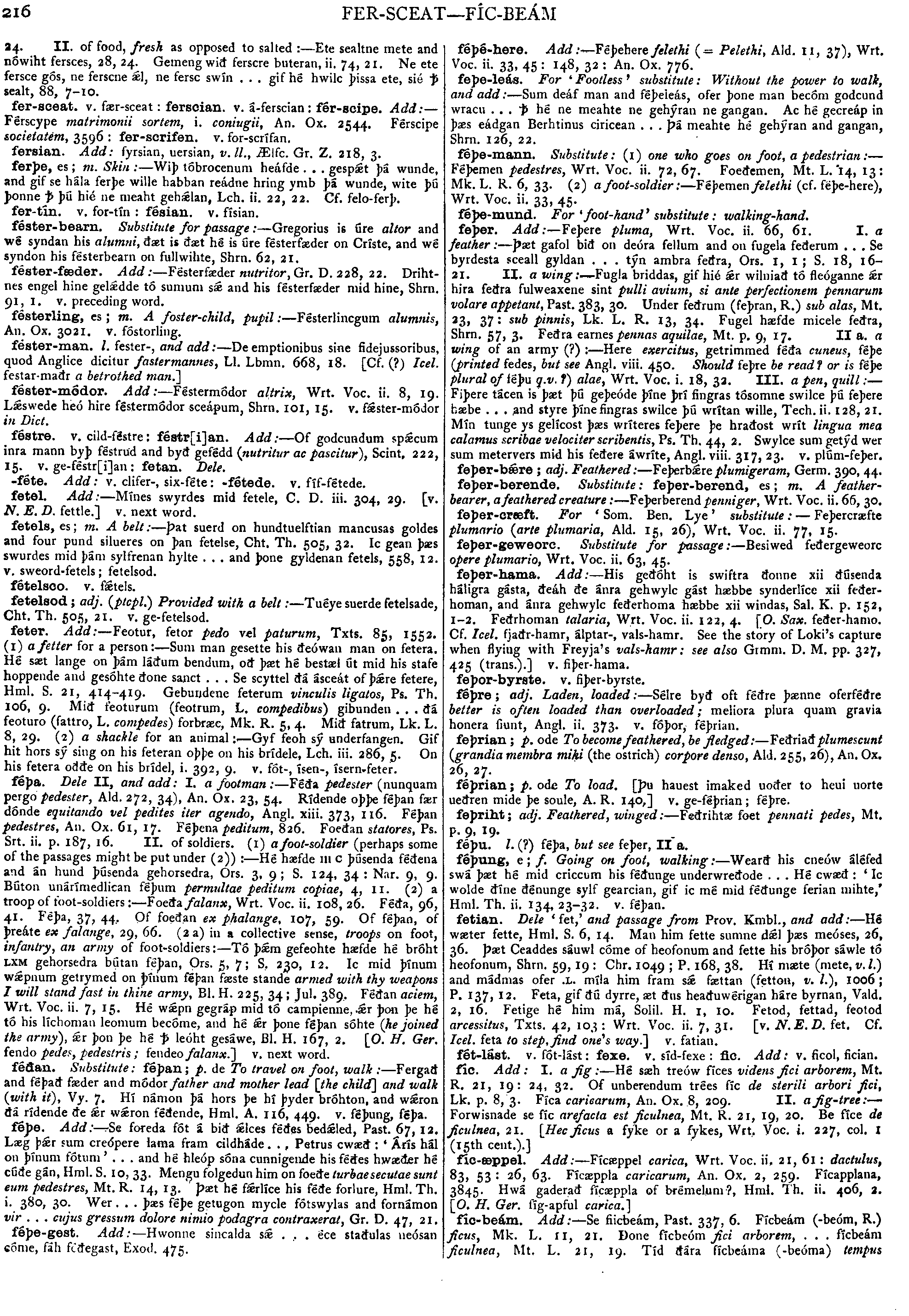
feter.
Add:--Feotur,
fetor
pedo
vel
paturum,
Txts.
85,
1552.
(1)
a
fetter
for
a
person:--Sum
man
gesette
his
ðeówan
man
on
fetera.
Hé
sæt
lange
on
þám
láðum
bendum,
oð
þæt
hé
bestæl
út
mid
his
stafe
hoppende
and
gesóhte
ðone
sanct
.
.
.
Se
scyttel
ðá
ásceát
of
þre
fetere,
Hml.
S.
21,
414-419.
Gebundene
feterum
vinculis
ligatos,
Ps.
Th.
106,
9.
Mið
feoturum
(feotrum,
L.
compedibus)
gibunden
.
.
.
ðá
feoturo
(fattro,
L.
compedes)
forbræc,
Mk.
R.
5,
4.
Mið
fatrum,
Lk.
L.
8,
29.
(2)
a
shackle
for
an
animal:--Gyf
feoh
sý
underfangen.
Gif
hit
hors
sý
sing
on
his
feteran
oþþe
on
his
brídele,
Lch.
iii.
286,
5.
On
his
fetera
oððe
on
his
brídel,
i.
392,
9.
v.
fót-,
ísen-,
ísern-feter.
|
Source: Bosworth/Toller, page d0559, entry 7 View original page image as: [TIFF] [PNG] [View previous entry] [View next entry] |
[Comment on this entry] [View comments] |
The following entry has been hand-corrected once. |
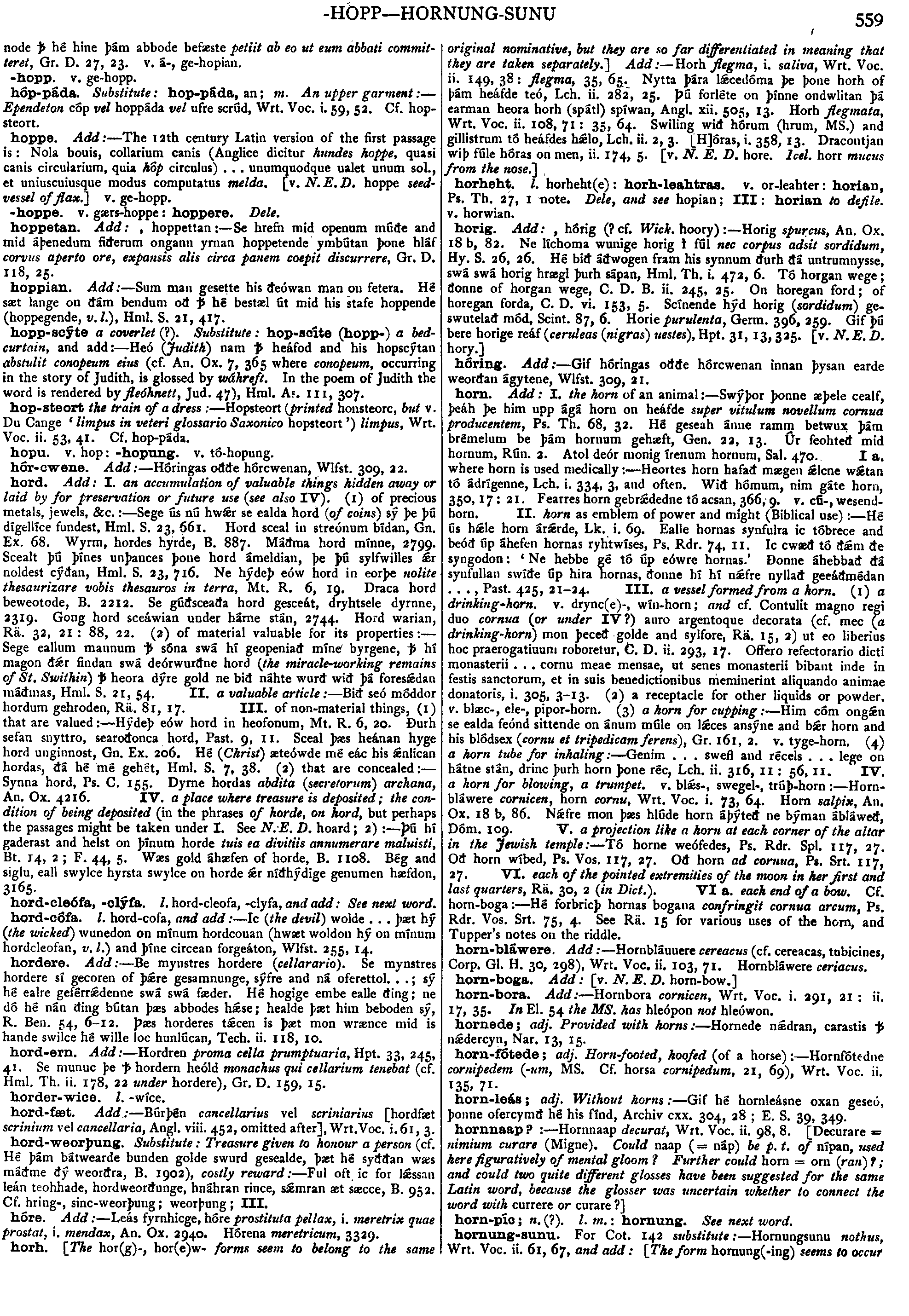
hoppian.
Add
:--
Sum
man
gesette
his
 eówan
man
on
fetera.
H
eówan
man
on
fetera.
H sæt
lange
on
sæt
lange
on
 m
bendum
o
h
bestæl
m
bendum
o
h
bestæl
 t
mid
his
stafe
hoppende
(hoppegende,
v.
l.).
Hml.
S.
21,
417.
t
mid
his
stafe
hoppende
(hoppegende,
v.
l.).
Hml.
S.
21,
417.
|
Source: Bright's OE Grammar, page b0353, entry 29 View original page image as: [TIFF] [PNG] [View previous entry] [View next entry] |
[Comment on this entry] [View comments] |
The following entry has been hand-corrected once. |
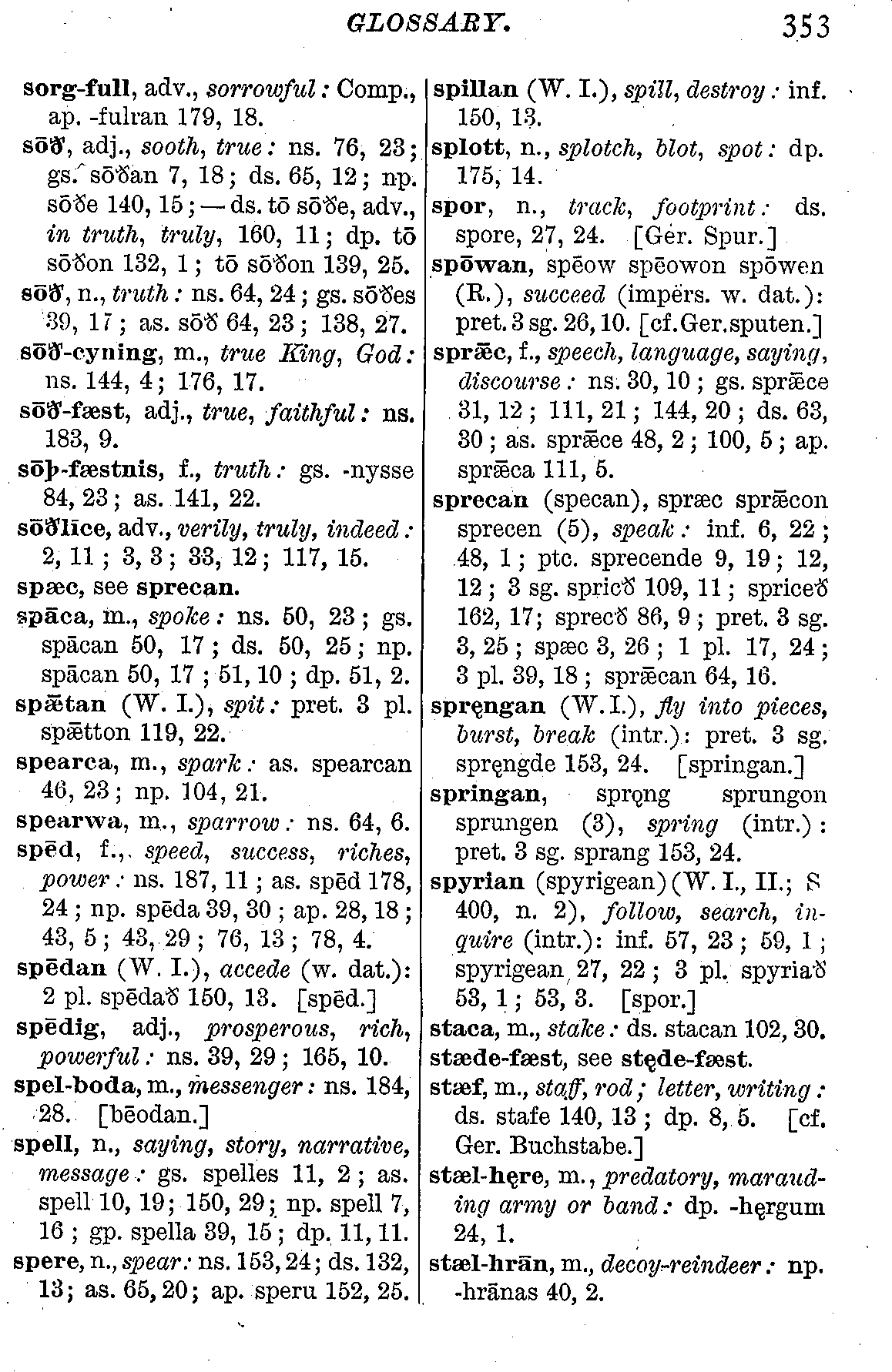
stæf m staff, rod; letter, writing
- ds stafe
Germanic Lexicon Project (main page)
This search system was written by
Sean Crist
Please consider
volunteering
to correct the data in these online dictionaries.
No rights reserved. Feel free to use these data in any way you please.