|
|

|
Source: Bosworth/Toller, page b0606, entry 7 View original page image as: [TIFF] [PNG] [View previous entry] [View next entry] |
[Comment on this entry] [View comments (1)] |
The following entry has been hand-corrected once. |
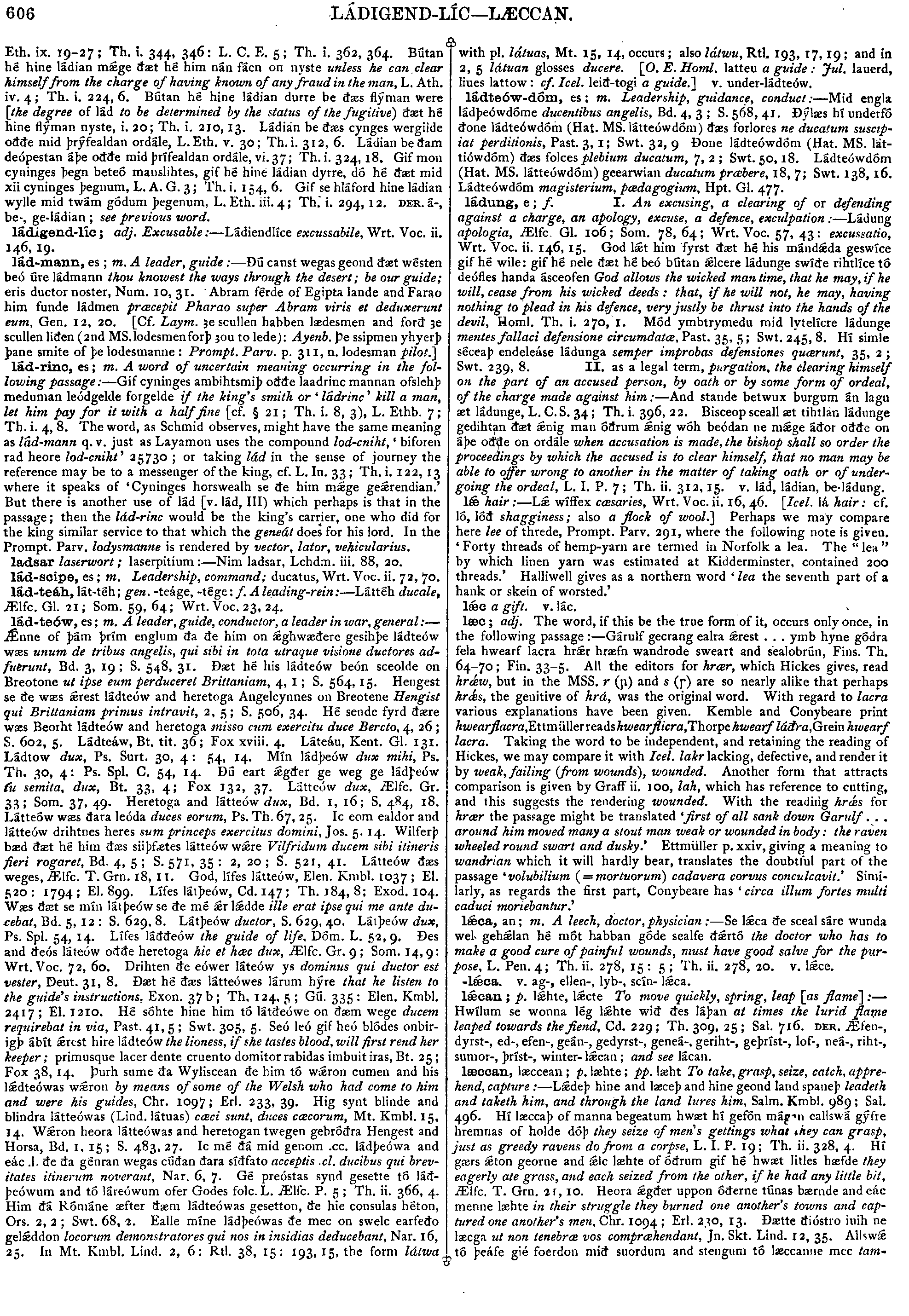
lád-teów,
es;
m.
A
leader,
guide,
conductor,
a
leader
in
war,
general
:--
Æ-acute;Anne
of
þám
þrím
englum
ða
ðe
him
on
 ghwæðere
gesihþe
ládteów
wæs
unum
de
tribus
angelis,
qui
sibi
in
tota
utraque
visione
ductores
adfuerunt,
Bd.
3,
19;
S.
548,
31.
Ðæt
hé
his
ládteów
beón
sceolde
on
Breotone
ut
ipse
eum
perduceret
Brittaniam,
4,
1;
S.
564,
15.
Hengest
se
ðe
wæs
rest
ládteów
and
heretoga
Angelcynnes
on
Breotene
Hengist
qui
Brittaniam
primus
intravit,
2,
5;
S.
506,
34.
Hé
sende
fyrd
ðære
wæs
Beotht
ládteów
and
heretoga
misso
cum
exercitu
duce
Bercto,
4,
26;
S.
602,
5.
Ládteáw,
Bt.
tit.
36;
Fox
xviii.
4.
Láteáu,
Kent.
Gl.
131.
Ládtow
dux,
Ps.
Surt.
30,
4:
54,
14.
Mín
ládþeów
dux
mihi,
Ps.
Th.
30,
4:
Ps.
Spl.
C.
54,
14.
Dú
eart
gðer
ge
weg
ge
ládþeów
tu
semita,
dux,
Bt.
33,
4;
Fox
132.
37.
Látteów
dux,
Ælfc.
Gr.
33;
Som.
37,
49.
Heretoga
and
látteów
dux,
Bd.
1,
16;
S.
484,
18.
Látteów
wæs
ðara
leóda
duces
eorum,
Ps.
Th.
67,
25.
Ic
eom
ealdor
and
látteów
drihtnes
heres
sum
princeps
exercitus
domini,
Jos.
5,
14.
Wilferþ
bæd
ðæt
hé
him
ðæs
siiþfætes
látteów
wre
Vilfridum
ducem
sibi
itineris
fieri
rogaret,
Bd.
4,
5;
S.
571,
35:
2,
20;
S.
521,
41.
Látteów
ðæs
weges,
Ælfc.
T.
Grn.
18,
11.
God,
lífes
látteów,
Elen.
Kmbl.
1037;
El.
520:
1794;
El.
899.
Lífes
látþeów,
Cd.
147;
Th.
184,
8;
Exod.
104.
Wæs
ðæt
se
mín
látþeów
se
ðe
mé
r
ldde
ille
erat
ipse
qui
me
ante
ducebat,
Bd.
5,
12:
S.
629,
8.
Látþeów
ductor,
S.
629,
40.
Látþeów
dux,
Ps.
Spl.
54,
14.
Lífes
láððeów
the
guide
of
life,
Dóm.
L.
52,
9.
Ðes
and
ðeós
láteów
oððe
heretoga
hic
et
hæc
dux,
Ælfc.
Gr.
9;
Som.
14,
9:
Wrt.
Voc.
72,
60.
Drihten
ðe
eówer
láteów
ys
dominus
qui
ductor
est
vester,
Deut.
31,
8.
Ðæt
hé
ðæs
látteówes
lárum
hýre
that
he
listen
to
the
guide's
instructions,
Exon.
37
b;
Th,
124,
5;
Gú.
335:
Elen.
Kmbl.
2417;
El.
1210.
Hé
sóhte
hine
him
tó
látðeówe
on
ðæm
wege
ducem
requirebat
in
via,
Past.
41,
5;
Swt.
305,
5.
Seó
leó
gif
heó
blódes
onbirigþ
ábít
rest
hire
ládteów
the
lioness,
if
she
tastes
blood,
will
first
rend
her
keeper;
primusque
lacer
dente
cruento
domitor
rabidas
imbuit
iras,
Bt.
25;
Fox
38,
14.
Þurh
sume
ða
Wyliscean
ðe
him
tó
wron
cumen
and
his
ldteówas
wron
by
means
of
some
of
the
Welsh
who
had
come
to
him
and
were
his
guides,
Chr.
1097;
Erl.
233,
39.
Hig
synt
blinde
and
blindra
látteówas
(Lind.
látuas)
cæci
sunt,
duces
cæcorum,
Mt.
Kmbl.
15,
14.
Wron
heora
látteówas
and
heretogan
twegen
gebróðra
Hengest
and
Horsa,
Bd.
1,
15;
S.
483,
27.
Ic
mé
ðá
mid
genom
.cc.
ládþeówa
and
eác.
l.
ðe
ða
génran
wegas
cúðan
ðara
síðfato
acceptis
.cl.
ducibus
qui
brevitates
itinerum
noverant,
Nar.
6,
7.
Gé
preóstas
synd
gesette
tó
láðþeówum
and
tó
láreówum
ofer
Godes
folc.
L.
Ælfc.
P.
5;
Th.
ii.
366,
4.
Him
ðá
Rómáne
æfter
ðæm
ládteówas
gesetton,
ðe
hie
consulas
héton,
Ors.
2,
2;
Swt.
68,
2.
Ealle
míne
ládþeówas
ðe
mec
on
swelc
earfeðo
gelddon
locorum
demonstratores
qui
nos
in
insidias
deducebant,
Nar.
16,
25.
In
Mt.
Kmbl.
Lind.
2,
6:
Rtl.
38,
15:
193,
15,
the
form
látwa
with
pl.
látuas,
Mt.
15,
14,
occurs;
also
látwu,
Rtl.
193,
17,
19;
and
in
2,
5
látuan
glosses
ducere.
[O.
E.
Homl.
latteu
a
guide:
Jul.
lauerd,
lines
lattow:
cf.
Icel.
leið-togi
a
guide.]
v.
under-ládteów.
ghwæðere
gesihþe
ládteów
wæs
unum
de
tribus
angelis,
qui
sibi
in
tota
utraque
visione
ductores
adfuerunt,
Bd.
3,
19;
S.
548,
31.
Ðæt
hé
his
ládteów
beón
sceolde
on
Breotone
ut
ipse
eum
perduceret
Brittaniam,
4,
1;
S.
564,
15.
Hengest
se
ðe
wæs
rest
ládteów
and
heretoga
Angelcynnes
on
Breotene
Hengist
qui
Brittaniam
primus
intravit,
2,
5;
S.
506,
34.
Hé
sende
fyrd
ðære
wæs
Beotht
ládteów
and
heretoga
misso
cum
exercitu
duce
Bercto,
4,
26;
S.
602,
5.
Ládteáw,
Bt.
tit.
36;
Fox
xviii.
4.
Láteáu,
Kent.
Gl.
131.
Ládtow
dux,
Ps.
Surt.
30,
4:
54,
14.
Mín
ládþeów
dux
mihi,
Ps.
Th.
30,
4:
Ps.
Spl.
C.
54,
14.
Dú
eart
gðer
ge
weg
ge
ládþeów
tu
semita,
dux,
Bt.
33,
4;
Fox
132.
37.
Látteów
dux,
Ælfc.
Gr.
33;
Som.
37,
49.
Heretoga
and
látteów
dux,
Bd.
1,
16;
S.
484,
18.
Látteów
wæs
ðara
leóda
duces
eorum,
Ps.
Th.
67,
25.
Ic
eom
ealdor
and
látteów
drihtnes
heres
sum
princeps
exercitus
domini,
Jos.
5,
14.
Wilferþ
bæd
ðæt
hé
him
ðæs
siiþfætes
látteów
wre
Vilfridum
ducem
sibi
itineris
fieri
rogaret,
Bd.
4,
5;
S.
571,
35:
2,
20;
S.
521,
41.
Látteów
ðæs
weges,
Ælfc.
T.
Grn.
18,
11.
God,
lífes
látteów,
Elen.
Kmbl.
1037;
El.
520:
1794;
El.
899.
Lífes
látþeów,
Cd.
147;
Th.
184,
8;
Exod.
104.
Wæs
ðæt
se
mín
látþeów
se
ðe
mé
r
ldde
ille
erat
ipse
qui
me
ante
ducebat,
Bd.
5,
12:
S.
629,
8.
Látþeów
ductor,
S.
629,
40.
Látþeów
dux,
Ps.
Spl.
54,
14.
Lífes
láððeów
the
guide
of
life,
Dóm.
L.
52,
9.
Ðes
and
ðeós
láteów
oððe
heretoga
hic
et
hæc
dux,
Ælfc.
Gr.
9;
Som.
14,
9:
Wrt.
Voc.
72,
60.
Drihten
ðe
eówer
láteów
ys
dominus
qui
ductor
est
vester,
Deut.
31,
8.
Ðæt
hé
ðæs
látteówes
lárum
hýre
that
he
listen
to
the
guide's
instructions,
Exon.
37
b;
Th,
124,
5;
Gú.
335:
Elen.
Kmbl.
2417;
El.
1210.
Hé
sóhte
hine
him
tó
látðeówe
on
ðæm
wege
ducem
requirebat
in
via,
Past.
41,
5;
Swt.
305,
5.
Seó
leó
gif
heó
blódes
onbirigþ
ábít
rest
hire
ládteów
the
lioness,
if
she
tastes
blood,
will
first
rend
her
keeper;
primusque
lacer
dente
cruento
domitor
rabidas
imbuit
iras,
Bt.
25;
Fox
38,
14.
Þurh
sume
ða
Wyliscean
ðe
him
tó
wron
cumen
and
his
ldteówas
wron
by
means
of
some
of
the
Welsh
who
had
come
to
him
and
were
his
guides,
Chr.
1097;
Erl.
233,
39.
Hig
synt
blinde
and
blindra
látteówas
(Lind.
látuas)
cæci
sunt,
duces
cæcorum,
Mt.
Kmbl.
15,
14.
Wron
heora
látteówas
and
heretogan
twegen
gebróðra
Hengest
and
Horsa,
Bd.
1,
15;
S.
483,
27.
Ic
mé
ðá
mid
genom
.cc.
ládþeówa
and
eác.
l.
ðe
ða
génran
wegas
cúðan
ðara
síðfato
acceptis
.cl.
ducibus
qui
brevitates
itinerum
noverant,
Nar.
6,
7.
Gé
preóstas
synd
gesette
tó
láðþeówum
and
tó
láreówum
ofer
Godes
folc.
L.
Ælfc.
P.
5;
Th.
ii.
366,
4.
Him
ðá
Rómáne
æfter
ðæm
ládteówas
gesetton,
ðe
hie
consulas
héton,
Ors.
2,
2;
Swt.
68,
2.
Ealle
míne
ládþeówas
ðe
mec
on
swelc
earfeðo
gelddon
locorum
demonstratores
qui
nos
in
insidias
deducebant,
Nar.
16,
25.
In
Mt.
Kmbl.
Lind.
2,
6:
Rtl.
38,
15:
193,
15,
the
form
látwa
with
pl.
látuas,
Mt.
15,
14,
occurs;
also
látwu,
Rtl.
193,
17,
19;
and
in
2,
5
látuan
glosses
ducere.
[O.
E.
Homl.
latteu
a
guide:
Jul.
lauerd,
lines
lattow:
cf.
Icel.
leið-togi
a
guide.]
v.
under-ládteów.
|
Source: Bosworth/Toller, page b0608, entry 10 View original page image as: [TIFF] [PNG] [View previous entry] [View next entry] |
[Comment on this entry] [View comments] |
The following entry has been hand-corrected once. |
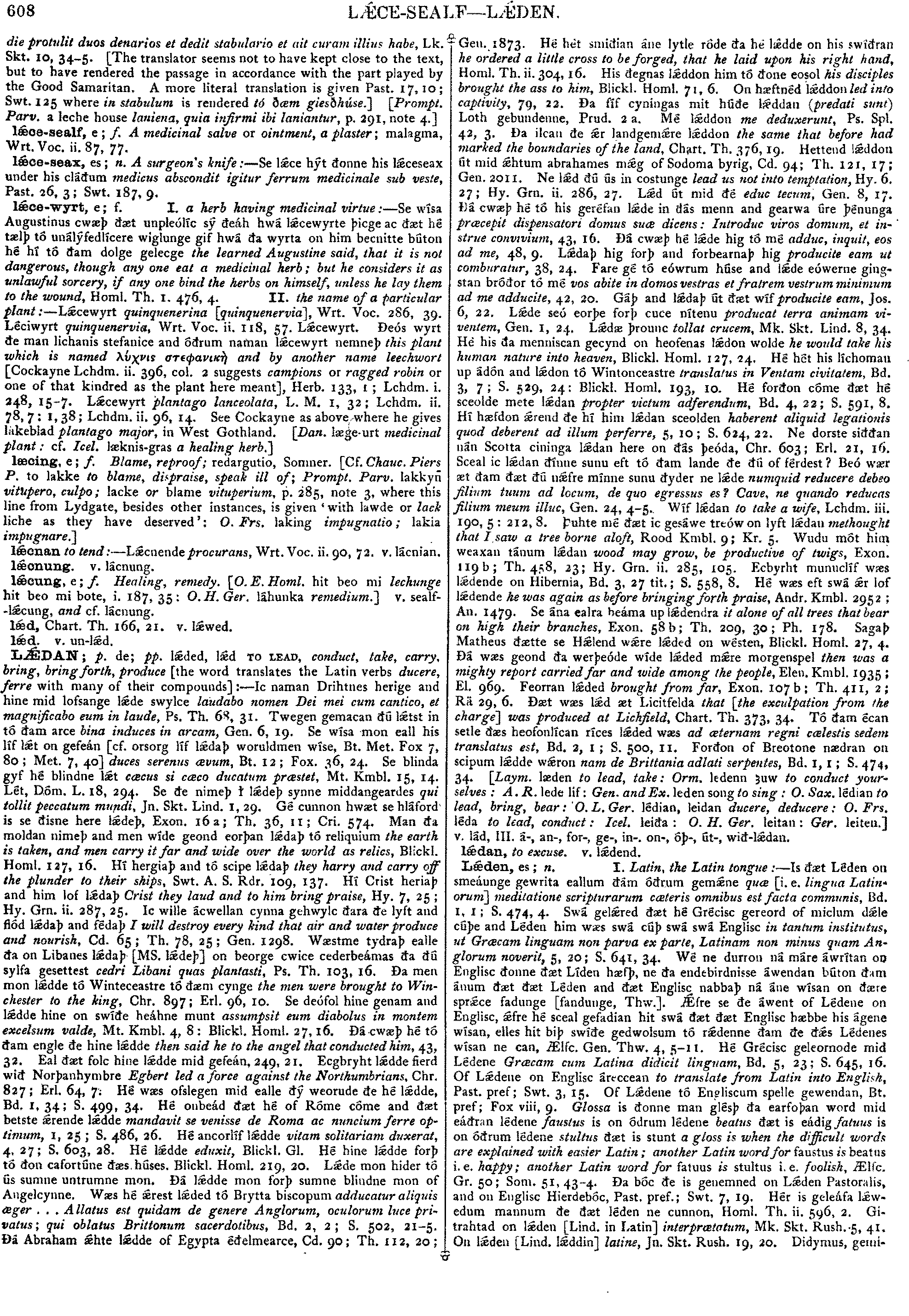
LÆ-acute;DAN;
p.
de;
pp.
lded,
ld
TO
LEAD,
conduct,
take,
carry,
bring,
bring
forth,
produce
[the
word
translates
the
Latin
verbs
ducere,
ferre
with
many
of
their
compounds]
:--
Ic
naman
Drihtnes
herige
and
hine
mid
lofsange
lde
swylce
laudabo
nomen
Dei
mei
cum
cantico,
et
magnificabo
eum
in
laude,
Ps.
Th.
68,
31.
Twegen
gemacan
ðú
ltst
in
tó
ðam
arce
bina
induces
in
arcam,
Gen.
6,
19.
Se
wísa
mon
eall
his
líf
lt
on
gefeán
[cf.
orsorg
líf
ldaþ
woruldmen
wíse,
Bt.
Met.
Fox
7,
80;
Met.
7,
40]
duces
serenus
ævum,
Bt.
12;
Fox.
36,
24,
Se
blinda
gyf
hé
blindne
lt
cæcus
si
cæco
ducatum
præstet,
Mt.
Kmbl.
15,
14.
Lét,
Dóm.
L.
18,
294.
Se
ðe
nimeþ
 ldeþ
synne
middangeardes
qui
tollit
peccatum
mundi,
Jn.
Skt.
Lind.
1,
29.
Gé
cunnon
hwæt
se
hláford
is
se
ðisne
here
ldeþ,
Exon.
16
a;
Th.
36,
11;
Cri.
574.
Man
ða
moldan
nimeþ
and
men
wíde
geond
eorþan
ldaþ
tó
reliquium
the
earth
is
taken,
and
men
carry
it
far
and
wide
over
the
world
as
relics,
Blickl.
Homl.
127,
16.
Hí
hergiaþ
and
tó
scipe
ldaþ
they
harry
and
carry
off
the
plunder
to
their
ships,
Swt.
A.
S.
Rdr.
109,
137.
Hí
Crist
heriaþ
and
him
lof
ldaþ
Crist
they
laud
and
to
him
bring
praise,
Hy.
7,
25;
Hy.
Grn.
ii.
287,
25.
Ic
wille
ácwellan
cynna
gehwylc
ðara
ðe
lyft
and
flód
ldaþ
and
fédaþ
I
will
destroy
every
kind
that
air
and
water
produce
and
nourish,
Cd.
65;
Th.
78,
25;
Gen.
1298.
Wæstme
tydraþ
ealle
ða
on
Libanes
ldaþ
[MS.
ldeþ]
on
beorge
cwice
cederbeámas
ða
ðú
sylfa
gesettest
cedri
Libani
quas
plantasti,
Ps.
Th.
103,
16.
Ða
men
mon
ldde
tó
Winteceastre
tó
ðæm
cynge
the
men
were
brought
to
Winchester
to
the
king,
Chr.
897;
Erl.
96,
10.
Se
deófol
hire
genam
and
ldde
hine
on
swíðe
heáhne
munt
assumpsit
eum
diabolus
in
montem
excelsum
valde,
Mt.
Kmbl.
4,
8:
Blickl,
Homl.
27,
16.
Ðá
cwæþ
hé
tó
ðam
engle
ðe
hine
ldde
then
said
he
to
the
angel
that
conducted
him,
43,
32.
Eal
ðæt
folc
hine
ldde
mid
gefeán,
249,
21.
Ecgbryht
ldde
fierd
wið
Norþanhymbre
Egbert
led
a
force
against
the
Northumbrians,
Chr.
827;
Erl.
64,
7.
Hé
wæs
ofslegen
mid
ealle
ðý
weorude
ðe
hé
ldde,
Bd.
1,
34;
S.
499,
34.
Hé
onbeád
ðæt
hé
of
Róme
cóme
and
ðæt
betste
rende
ldde
mandavit
se
venisse
de
Roma
ac
nuncium
ferre
optimum,
1,
25;
S.
486,
26.
Hé
ancorlíf
ldde
vitam
solitariam
duxerat,
4,
27;
S.
603,
28.
Hé
ldde
eduxit,
Blickl.
Gl.
Hé
hine
ldde
forþ
tó
ðon
cafortúne
ðæs
húses.
Blickl.
Homl.
219,
20.
Lde
mon
hider
tó
ús
sumne
untrumne
mon.
Ðá
ldde
mon
forþ
sumne
blindne
mon
of
Angelcynne.
Wæs
hé
rest
lded
tó
Brytta
biscopum
adducatur
aliquis
æger
...
Allatus
est
quidam
de
genere
Anglorum,
oculorum
lute
privatus;
qui
oblatus
Brittonum
sacerdotibus,
Bd,
2,
2;
S.
502,
21-5.
Ðá
Abraham
hte
ldde
of
Egypta
éðelmearce,
Cd.
90;
Th.
112,
20;
Gen.
1873.
Hé
hét
smiðian
áne
lytle
róde
ða
hé
lvdde
on
his
swíðran
he
ordered
a
little
cross
to
be
forged,
that
he
laid
upon
his
right
hand,
Homl.
Th.
ii.
304,
16.
His
ðegnas
lddon
him
tó
ðone
eosol
his
disciples
brought
the
ass
to
him,
Blickl.
Homl.
71,
6.
On
hæftnéd
lddon
led
into
captivity,
79,
22.
Ða
fíf
cyningas
mit
húde
lddan
(predati
sunt)
Loth
gebundenne,
Prud.
2
a.
Mé
lddon
me
deduxerunt,
Ps.
Spl.
42,
3.
Ða
ilcan
ðe
r
landgemre
lddon
the
same
that
before
had
marked
the
boundaries
of
the
land,
Chart.
Th.
376,
19.
Hettend
lddon
út
mid
htum
abrahames
mg
of
Sodoma
byrig,
Cd.
94;
Th.
121,
17;
Gen.
2011.
Ne
ld
ðú
ús
in
costunge
lead
us
not
into
temptation,
Hy.
6,
27;
Hy.
Grn.
ii.
286,
27,
Ld
út
mid
ðé
educ
tecum,
Gen.
8,
17.
Ðá
cwæþ
hé
tó
his
geréfan
lde
in
ðás
menn
and
gearwa
úre
þénunga
præcepit
dispensatori
domus
suæ
dicen:
Introduc
viros
domum,
et
instrue
convivium,
43,
16.
Ðá
cwæþ
hé
lde
hig
tó
mé
adduc,
inquit,
eos
ad
me,
48,
9.
Ldaþ
hig
forþ
and
forbearnaþ
hig
producite
eam
ut
comburatur,
38,
24.
Fare
gé
tó
eówrum
húse
and
lde
eówerne
gingstan
bróðor
tó
mé
vos
abite
in
domos
vestras
et
fratrem
vestrum
minimum
ad
me
adducite,
42,
20.
Gáþ
and
ldaþ
út
ðæt
wíf
producite
eam,
Jos.
6,
22.
Lde
seó
eorþe
forþ
cuce
nítenu
producat
terra
animam
viventem,
Gen.
1,
24.
Ldæ
þrounc
tollat
crucem,
Mk.
Skt.
Lind.
8,
34.
Hé
his
ða
menniscan
gecynd
on
heofenas
ldon
wolde
he
would
take
his
human
nature
into
heaven,
Blickl.
Homl.
127,
24.
Hé
hét
his
líchoman
up
ádón
and
ldon
tó
Wintonceastre
translatus
in
Ventam
civitatem,
Bd.
3,
7;
S.
529,
24:
Blickl.
Homl.
193,
10.
Hé
forðon
cóme
ðæt
hé
sceolde
mete
ldan
propter
victum
adferendum,
Bd,
4,
22;
S.
591,
8.
Hí
hæfdon
rend
ðe
hí
him
ldan
sceolden
haberent
aliquid
legationis
quod
deberent
ad
illum
perferre,
5,
10;
S.
624,
22.
Ne
dorste
siððn
nán
Scotta
cininga
ldan
here
on
ðás
þeóda,
Chr.
603;
Erl.
21,
16.
Sceal
ic
ldan
ðínne
sunu
eft
tó
ðam
lande
ðe
ðú
of
férdest?
Beó
wær
æt
ðam
ðæt
ðú
nfre
mínne
sunu
ðyder
ne
lde
numquid
reducere
debeo
frilium
tuum
ad
locum,
de
quo
egressus
es?
Cave,
ne
quando
reducas
filium
meum
illuc,
Gen.
24,
4-5.
Wíf
ldan
to
take
a
wife,
Lchdm.
iii.
190,
5:
212,
8.
Þuhte
mé
ðæt
ic
gesáwe
treów
on
lyft
ldan
methought
that
I,
saw
a
tree
borne
aloft,
Rood
Kmbl.
9;
Kr.
5.
Wudu
mót
him
weaxan
tánum
ldan
wood
may
grow,
be
productive
of
twigs,
Exon.
119
b;
Th.
458,
23;
Hy.
Grn.
ii.
285,
105.
Ecbyrht
munuclíf
wæs
ldende
on
Hibernia,
Bd.
3,
27
tit,;
S.
558,
8.
Hé
wæs
eft
swá
r
lof
ldende
he
was
again
as
before
bringing
forth
praise,
Andr.
Kmbl.
2952;
An.
1479.
Se
ána
ealra
heáma
up
ldendra
it
alone
of
all
trees
that
bear
on
high
their
branches,
Exon.
58
b;
Th.
209,
30;
Ph.
178.
Sagaþ
Matheus
ðætte
se
Hlend
wre
lded
on
wésten,
Blickl.
Homl.
27,
4.
Ðá
wæs
geond
ða
werþeóde
wíde
lded
mre
morgenspel
then
was
a
mighty
report
carried
far
and
wide
among
the
people,
Elen.
Kmbl.
1935;
El.
969.
Feorran
lded
brought
from
far,
Exon.
107
b;
Th.
411,
2;
Rä
29,
6.
Ðæt
wæs
ld
æt
Licitfelda
that
[the
exculpation
from
the
charge]
was
produced
at
Lichfield,
Chart.
Th.
373,
34.
Tó
ðam
écan
setle
ðæs
heofonlícan
ríces
lded
wæs
ad
æternam
regni
cælestis
sedem
translatus
est,
Bd.
2,
1;
S.
500,
11.
Forðon
of
Breotone
nædran
on
scipum
ldde
wron
nam
de
Brittania
adlati
serpentes,
Bd.
1,
1;
S.
474,
34.
[Laym.
læden
to
lead,
take:
Orm.
ledenn
ldeþ
synne
middangeardes
qui
tollit
peccatum
mundi,
Jn.
Skt.
Lind.
1,
29.
Gé
cunnon
hwæt
se
hláford
is
se
ðisne
here
ldeþ,
Exon.
16
a;
Th.
36,
11;
Cri.
574.
Man
ða
moldan
nimeþ
and
men
wíde
geond
eorþan
ldaþ
tó
reliquium
the
earth
is
taken,
and
men
carry
it
far
and
wide
over
the
world
as
relics,
Blickl.
Homl.
127,
16.
Hí
hergiaþ
and
tó
scipe
ldaþ
they
harry
and
carry
off
the
plunder
to
their
ships,
Swt.
A.
S.
Rdr.
109,
137.
Hí
Crist
heriaþ
and
him
lof
ldaþ
Crist
they
laud
and
to
him
bring
praise,
Hy.
7,
25;
Hy.
Grn.
ii.
287,
25.
Ic
wille
ácwellan
cynna
gehwylc
ðara
ðe
lyft
and
flód
ldaþ
and
fédaþ
I
will
destroy
every
kind
that
air
and
water
produce
and
nourish,
Cd.
65;
Th.
78,
25;
Gen.
1298.
Wæstme
tydraþ
ealle
ða
on
Libanes
ldaþ
[MS.
ldeþ]
on
beorge
cwice
cederbeámas
ða
ðú
sylfa
gesettest
cedri
Libani
quas
plantasti,
Ps.
Th.
103,
16.
Ða
men
mon
ldde
tó
Winteceastre
tó
ðæm
cynge
the
men
were
brought
to
Winchester
to
the
king,
Chr.
897;
Erl.
96,
10.
Se
deófol
hire
genam
and
ldde
hine
on
swíðe
heáhne
munt
assumpsit
eum
diabolus
in
montem
excelsum
valde,
Mt.
Kmbl.
4,
8:
Blickl,
Homl.
27,
16.
Ðá
cwæþ
hé
tó
ðam
engle
ðe
hine
ldde
then
said
he
to
the
angel
that
conducted
him,
43,
32.
Eal
ðæt
folc
hine
ldde
mid
gefeán,
249,
21.
Ecgbryht
ldde
fierd
wið
Norþanhymbre
Egbert
led
a
force
against
the
Northumbrians,
Chr.
827;
Erl.
64,
7.
Hé
wæs
ofslegen
mid
ealle
ðý
weorude
ðe
hé
ldde,
Bd.
1,
34;
S.
499,
34.
Hé
onbeád
ðæt
hé
of
Róme
cóme
and
ðæt
betste
rende
ldde
mandavit
se
venisse
de
Roma
ac
nuncium
ferre
optimum,
1,
25;
S.
486,
26.
Hé
ancorlíf
ldde
vitam
solitariam
duxerat,
4,
27;
S.
603,
28.
Hé
ldde
eduxit,
Blickl.
Gl.
Hé
hine
ldde
forþ
tó
ðon
cafortúne
ðæs
húses.
Blickl.
Homl.
219,
20.
Lde
mon
hider
tó
ús
sumne
untrumne
mon.
Ðá
ldde
mon
forþ
sumne
blindne
mon
of
Angelcynne.
Wæs
hé
rest
lded
tó
Brytta
biscopum
adducatur
aliquis
æger
...
Allatus
est
quidam
de
genere
Anglorum,
oculorum
lute
privatus;
qui
oblatus
Brittonum
sacerdotibus,
Bd,
2,
2;
S.
502,
21-5.
Ðá
Abraham
hte
ldde
of
Egypta
éðelmearce,
Cd.
90;
Th.
112,
20;
Gen.
1873.
Hé
hét
smiðian
áne
lytle
róde
ða
hé
lvdde
on
his
swíðran
he
ordered
a
little
cross
to
be
forged,
that
he
laid
upon
his
right
hand,
Homl.
Th.
ii.
304,
16.
His
ðegnas
lddon
him
tó
ðone
eosol
his
disciples
brought
the
ass
to
him,
Blickl.
Homl.
71,
6.
On
hæftnéd
lddon
led
into
captivity,
79,
22.
Ða
fíf
cyningas
mit
húde
lddan
(predati
sunt)
Loth
gebundenne,
Prud.
2
a.
Mé
lddon
me
deduxerunt,
Ps.
Spl.
42,
3.
Ða
ilcan
ðe
r
landgemre
lddon
the
same
that
before
had
marked
the
boundaries
of
the
land,
Chart.
Th.
376,
19.
Hettend
lddon
út
mid
htum
abrahames
mg
of
Sodoma
byrig,
Cd.
94;
Th.
121,
17;
Gen.
2011.
Ne
ld
ðú
ús
in
costunge
lead
us
not
into
temptation,
Hy.
6,
27;
Hy.
Grn.
ii.
286,
27,
Ld
út
mid
ðé
educ
tecum,
Gen.
8,
17.
Ðá
cwæþ
hé
tó
his
geréfan
lde
in
ðás
menn
and
gearwa
úre
þénunga
præcepit
dispensatori
domus
suæ
dicen:
Introduc
viros
domum,
et
instrue
convivium,
43,
16.
Ðá
cwæþ
hé
lde
hig
tó
mé
adduc,
inquit,
eos
ad
me,
48,
9.
Ldaþ
hig
forþ
and
forbearnaþ
hig
producite
eam
ut
comburatur,
38,
24.
Fare
gé
tó
eówrum
húse
and
lde
eówerne
gingstan
bróðor
tó
mé
vos
abite
in
domos
vestras
et
fratrem
vestrum
minimum
ad
me
adducite,
42,
20.
Gáþ
and
ldaþ
út
ðæt
wíf
producite
eam,
Jos.
6,
22.
Lde
seó
eorþe
forþ
cuce
nítenu
producat
terra
animam
viventem,
Gen.
1,
24.
Ldæ
þrounc
tollat
crucem,
Mk.
Skt.
Lind.
8,
34.
Hé
his
ða
menniscan
gecynd
on
heofenas
ldon
wolde
he
would
take
his
human
nature
into
heaven,
Blickl.
Homl.
127,
24.
Hé
hét
his
líchoman
up
ádón
and
ldon
tó
Wintonceastre
translatus
in
Ventam
civitatem,
Bd.
3,
7;
S.
529,
24:
Blickl.
Homl.
193,
10.
Hé
forðon
cóme
ðæt
hé
sceolde
mete
ldan
propter
victum
adferendum,
Bd,
4,
22;
S.
591,
8.
Hí
hæfdon
rend
ðe
hí
him
ldan
sceolden
haberent
aliquid
legationis
quod
deberent
ad
illum
perferre,
5,
10;
S.
624,
22.
Ne
dorste
siððn
nán
Scotta
cininga
ldan
here
on
ðás
þeóda,
Chr.
603;
Erl.
21,
16.
Sceal
ic
ldan
ðínne
sunu
eft
tó
ðam
lande
ðe
ðú
of
férdest?
Beó
wær
æt
ðam
ðæt
ðú
nfre
mínne
sunu
ðyder
ne
lde
numquid
reducere
debeo
frilium
tuum
ad
locum,
de
quo
egressus
es?
Cave,
ne
quando
reducas
filium
meum
illuc,
Gen.
24,
4-5.
Wíf
ldan
to
take
a
wife,
Lchdm.
iii.
190,
5:
212,
8.
Þuhte
mé
ðæt
ic
gesáwe
treów
on
lyft
ldan
methought
that
I,
saw
a
tree
borne
aloft,
Rood
Kmbl.
9;
Kr.
5.
Wudu
mót
him
weaxan
tánum
ldan
wood
may
grow,
be
productive
of
twigs,
Exon.
119
b;
Th.
458,
23;
Hy.
Grn.
ii.
285,
105.
Ecbyrht
munuclíf
wæs
ldende
on
Hibernia,
Bd.
3,
27
tit,;
S.
558,
8.
Hé
wæs
eft
swá
r
lof
ldende
he
was
again
as
before
bringing
forth
praise,
Andr.
Kmbl.
2952;
An.
1479.
Se
ána
ealra
heáma
up
ldendra
it
alone
of
all
trees
that
bear
on
high
their
branches,
Exon.
58
b;
Th.
209,
30;
Ph.
178.
Sagaþ
Matheus
ðætte
se
Hlend
wre
lded
on
wésten,
Blickl.
Homl.
27,
4.
Ðá
wæs
geond
ða
werþeóde
wíde
lded
mre
morgenspel
then
was
a
mighty
report
carried
far
and
wide
among
the
people,
Elen.
Kmbl.
1935;
El.
969.
Feorran
lded
brought
from
far,
Exon.
107
b;
Th.
411,
2;
Rä
29,
6.
Ðæt
wæs
ld
æt
Licitfelda
that
[the
exculpation
from
the
charge]
was
produced
at
Lichfield,
Chart.
Th.
373,
34.
Tó
ðam
écan
setle
ðæs
heofonlícan
ríces
lded
wæs
ad
æternam
regni
cælestis
sedem
translatus
est,
Bd.
2,
1;
S.
500,
11.
Forðon
of
Breotone
nædran
on
scipum
ldde
wron
nam
de
Brittania
adlati
serpentes,
Bd.
1,
1;
S.
474,
34.
[Laym.
læden
to
lead,
take:
Orm.
ledenn
 uw
to
conduct
yourselves:
A.
R.
lede
lif:
Gen.
and
Ex.
leden
song
to
sing:
O.
Sax.
lédian
to
lead,
bring,
bear:
O.
L.
Ger.
lédian,
leidan
ducere,
deducere:
O.
Frs.
léda
to
lead,
conduct:
Icel.
leiða:
O.
H.
Ger.
leitan:
Ger.
leiten.]
v.
lád,
III.
á-,
an-,
for-,
ge-,
in-.
on-,
óþ-,
út-,
wið-ldan.
uw
to
conduct
yourselves:
A.
R.
lede
lif:
Gen.
and
Ex.
leden
song
to
sing:
O.
Sax.
lédian
to
lead,
bring,
bear:
O.
L.
Ger.
lédian,
leidan
ducere,
deducere:
O.
Frs.
léda
to
lead,
conduct:
Icel.
leiða:
O.
H.
Ger.
leitan:
Ger.
leiten.]
v.
lád,
III.
á-,
an-,
for-,
ge-,
in-.
on-,
óþ-,
út-,
wið-ldan.
|
Source: Bosworth/Toller, page b0612, entry 3 View original page image as: [TIFF] [PNG] [View previous entry] [View next entry] |
[Comment on this entry] [View comments] |
The following entry has been hand-corrected once. |
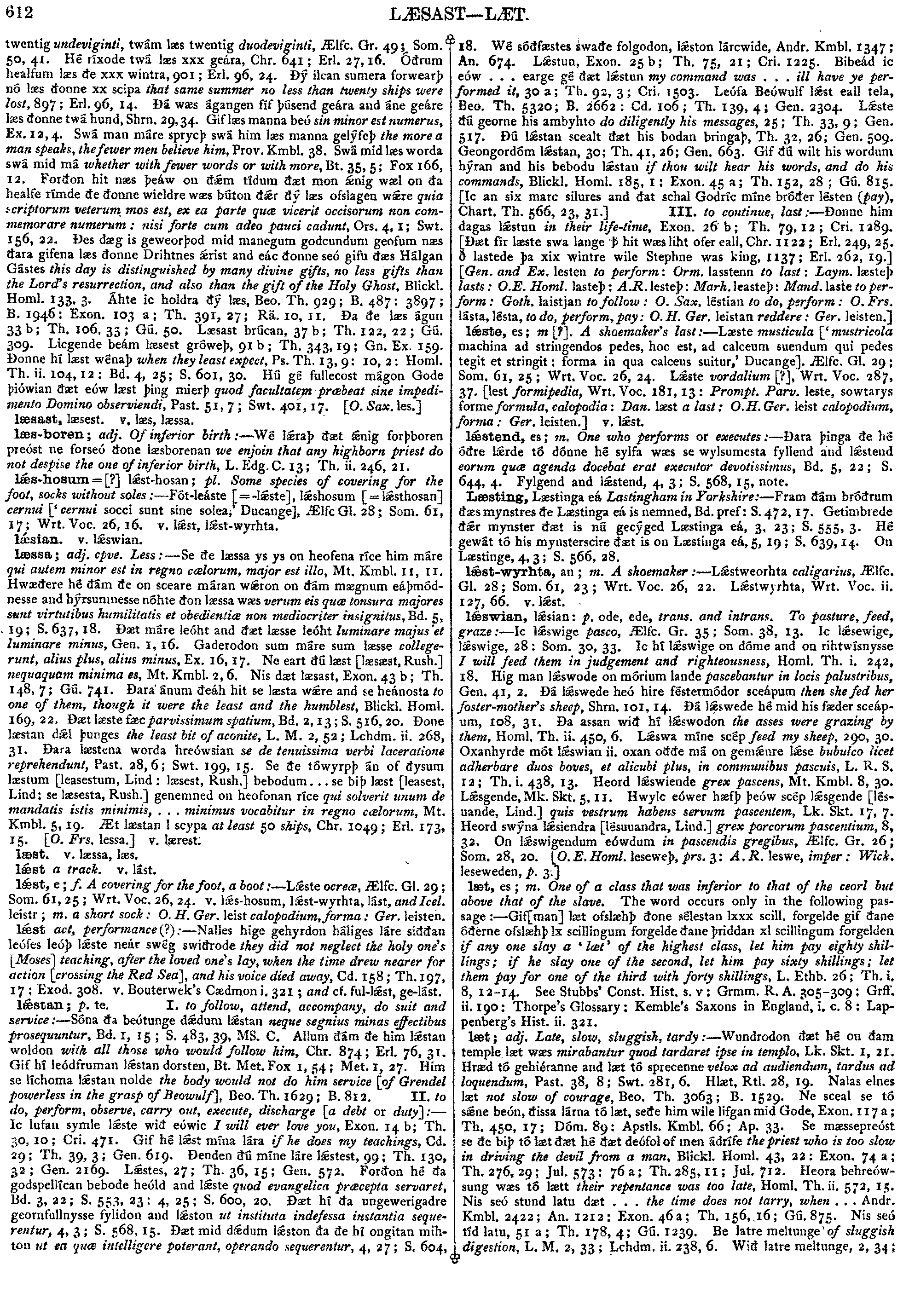
ls-hosum
=
[?]
lst-hosan;
pl.
Some
species
of
covering
for
the
foot,
socks
without
soles
:--
Fót-leáste
[
=
-lste],
lshosum
[
=
lsthosan]
cernui
['cernui
socci
sunt
sine
solea,'
Ducange],
Ælfc
Gl.
28;
Som.
61,
17;
Wrt.
Voc.
26,
16.
v.
lst,
lst-wyrhta.
|
Source: Bosworth/Toller, page b0612, entry 5 View original page image as: [TIFF] [PNG] [View previous entry] [View next entry] |
[Comment on this entry] [View comments] |
The following entry has been hand-corrected once. |
læssa;
adj.
cpve.
Less
:--
Se
ðe
lessa
ys
ys
on
heofena
ríce
him
máre
qui
autem
minor
est
in
regno
cælorum,
major
est
illo,
Mt.
Kmbl.
11,
11.
Hwæðere
hé
ðám
ðe
on
sceare
máran
wron
on
ðám
mægnum
eáþmódnesse
and
hýrsumnesse
nóhte
ðon
læssa
wæs
verum
eis
quæ
tonsura
majores
sunt
virtutibus
humilitatis
et
obedientiæ
non
mediocriter
insignitus,
Bd.
5,
19;
S.
637,
18.
Ðæt
máre
leóht
and
ðæt
læsse
leóht
luminare
majus
et
luminare
minus,
Gen.
1,
16.
Gaderodon
sum
máre
sum
læsse
collegerunt,
alius
plus,
alius
minus,
Ex.
16,
17.
Ne
eart
ðú
læst
[læsæst,
Rush.]
nequaquam
minima
es,
Mt.
Kmbl.
2,
6.
Nis
dæt
læsest,
Exon.
43
b;
Th.
148,
7;
Gú.
741.
Ðará
ánum
ðeáh
hit
se
læsta
wre
and
se
heánosta
to
one
of
them,
though
it
were
the
least
and
the
humblest,
Blickl.
Homl.
169,
22.
Ðæt
læste
fæc
parvissimum
spatium,
Bd.
2,
13;
S.
516,
20.
Ðone
læstan
dl
þunges
the
least
bit
of
aconite,
L.
M.
2,
52;
Lchdm.
ii.
268,
31.
Ðara
læstena
worda
hreówsian
se
de
tenuissima
verbi
laceratione
reprehendunt,
Past.
28,
6;
Swt.
199,
15.
Se
ðe
tówyrpþ
án
of
ðysum
læstum
[leasestum,
Lind:
læsest,
Rush.]
bebodum
...
se
biþ
læst
[leasest,
Lind:
se
læsesta,
Rush.]
genemned
on
heofonan
ríce
qui
solverit
unum
de
mandatis
istis
minimis,...
minimus
vocabitur
in
regno
cælorum,
Mt.
Kmbl.
5,
19.
Æt
læstan
l
scypa
at
least
50
ships,
Chr.
1049;
Erl.
173,
15.
[O.
Frs.
lessa.]
v.
lærest.
|
Source: Bosworth/Toller, page b0612, entry 17 View original page image as: [TIFF] [PNG] [View previous entry] [View next entry] |
[Comment on this entry] [View comments] |
The following entry has been hand-corrected once. |
læt;
adj.
Late,
slow,
sluggish,
tardy
:--
Wundrodon
ðæt
hé
on
ðam
temple,
læt
wæs
mirabantur
quod
tardaret
ipse
in
templo,
Lk.
Skt.
1,
21.
Hræd
tó
gehiéranne
and
læt
tó
sprecenne
velox
ad
audiendum,
tardus
ad
loquendum,
Past.
38,
8;
Swt.
281,
6.
Hlæt,
Rtl.
28,
19.
Nalas
elnes
læt
not
slow
of
courage,
Beo.
Th.
3063;
B.
1529.
Ne
sceal
se
tó
sne
beón,
ðissa
lárna
tó
læt,
seðe
him
wile
lifgan
mid
Gode,
Exon.
117
a;
Th.
450,
17;
Dóm.
89:
Apstls.
Kmbl.
66;
Ap.
33.
Se
mæssepreóst
se
ðe
biþ
tó
læt
ðæt
hé
ðæt
deófol
of
men
ádrífe
the
priest
who
is
too
slow
in
driving
the
devil
from
a
man,
Blickl.
Homl.
43,
22:
Exon.
74
a;
Th.
276,
29;
Jul.
573:
76
a;
Th.
285,
11;
Jul.
712.
Heora
behreówsung
wæs
tó
lætt
their
repentance
was
too
late,
Homl.
Th.
ii.
572,
15.
Nis
seó
stund
latu
dæt
...
the
time
does
not
tarry,
when
...
Andr.
Kmbl.
2422;
An.
1212.
Exon.
46
a;
Th.
156,
16;
Gú.
875.
Nis
seó
tíd
latu,
51
a;
Th.
178,
4;
Gú.
1239.
Be
latre
meltunge
of
sluggish
digestion,
L.
M.
2,
33;
Lchdm.
ii.
238,
6.
Wið
latre
meltunge,
2,
34;
Lchdm.
i.
238,
27.
Late
gange
gradu
lento,
Wrt.
Voc.
ii.
41,
76.
Læte
dissides,
i.
tardi,
141,
6.
Ne
beóþ
fre
tó
late
numquam
sunt
sera,
62,
18.
Swæfna
gewisse
synt
oft
late
dreams
are
certain,
but
often
late
of
fulfilment,
Lchdm.
iii.
186,
27.
Ðæt
hí
ne
beón
ne
wordes
ne
weorces,
ne
ealles
tó
hræde
ne
tó
swíðe
læte,
L.
I.
P.
10;
Th.
ii.
318,
36.
Nalæs
late
wron
eorre
æscberend
tó
ðam
orlege,
Andr.
Kmbl.
92;
An.
46.
On
heortan
læte
[hlatto,
Lind.]
tó
gelýfenne
tardi
corde
ad
credendum,
Lk.
Skt.
24,
25.
Ðæt
hé
ðý
lætra
biþ
tó
uncystum
that
it
[the
body]
be
the
less
ready
to
vices,
L.
E.
I.
3;
Th.
ii.
404,
20.
And
á
swá
hit
forþwerdre
beón
sceolde
swá
wæs
hit
lætre
and
ever
as
things
ought
to
have
been
more
forward,
did
they
go
on
more
slowly,
Chr.
999;
Erl.
134,
33.
Siððan
ðú
sprce
tó
ðínum
þeówe
ic
hæfde
ðé
lætran
tungan
ex
quo
locutus
es
ad
servum
tuum,
impeditioris
et
tardioris
linguæ
sum,
Ex.
4,
10.
[Goth.
lats
slothful:
O.
Sax.
lat:
O.
Frs.
let:
Icel.
latr:
O.
H.
Ger.
laz
piger,
segnis,
stupidus,
tardus:
Ger.
lass.]
v.
unlæt,
lata;
lætemest,
lætest.
|
Source: Bosworth/Toller, page b0615, entry 9 View original page image as: [TIFF] [PNG] [View previous entry] [View next entry] |
[Comment on this entry] [View comments] |
The following entry has been hand-corrected once. |
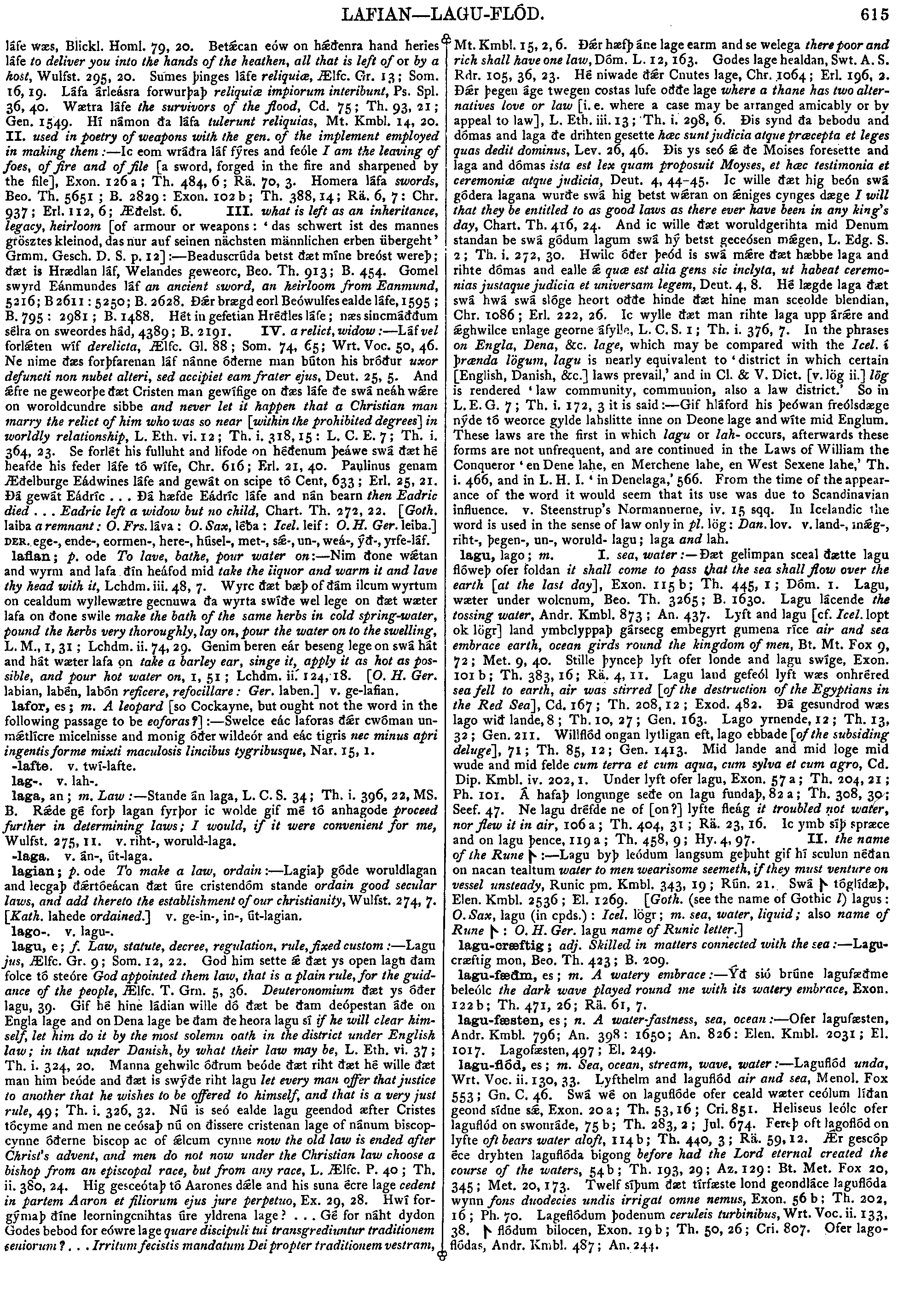
lagu,
e;
f.
Law,
statute,
decree,
regulation,
rule,
fixed
custom
:--
Lagu
jus,
Ælfc.
Gr.
9;
Som.
12,
22.
God
him
sette
ðæt
ys
open
lagu
ðam
folce
tó
steóre
God
appointed
them
law,
that
is
a
plain
rule,
for
the
guidance
of
the
people,
Ælfc.
T.
Grn.
5,
36.
Deuteronomium
ðæt
ys
óðer
lagu,
39.
Gif
hé
hine
ládian
wille
dó
ðæt
be
ðam
deópestan
áðe
on
Engla
lage
and
on
Dena
lage
be
ðam
ðe
heora
lagu
sí
if
he
will
clear
himself,
let
him
do
it
by
the
most
solemn
oath
in
the
district
under
English
law;
in
that
under
Danish,
by
what
their
law
may
be,
L.
Eth.
vi.
37;
Th.
i.
324,
20.
Manna
gehwilc
óðrum
beóde
ðæt
riht
ðæt
hé
wille
ðæt
man
him
beóde
and
ðæt
is
swýðe
riht
lagu
let
every
man
offer
that
justice
to
another
that
he
wishes
to
be
offered
to
himself,
and
that
is
a
very
just
rule,
49;
Th.
i.
326,
32.
Nú
is
seó
ealde
lagu
geendod
offer
Cristes
tócyme
and
men
ne
ceósaþ
nú
on
ðissere
cristenan
lage
of
nánum
biscopcynne
óðerne
biscop
ac
of
lcum
cynne
now
the
old
law
is
ended
after
Christ's
advent,
and
men
do
not
now
under
the
Christian
law
choose
a
bishop
from
an
episcopal
race,
but
from
any
race,
L.
Ælfc.
P.
40;
Th.
ii.
380,
24.
Hig
gesceótaþ
tó
Aarones
dle
and
his
suna
écre
lage
cedent
in
partem
Aaron
et
filiorum
ejus
jure
perpetuo,
Ex.
29,
28.
Hwí
forgýmaþ
ðíne
leorningcnihtas
úre
yldrena
lage?
...
Gé
for
náht
dydon
Godes
bebod
for
eówre
lage
quare
discipuli
tui
transgrediuntur
traditionem
seniorum?
...
Irritum
fecistis
mandatum
Dei
propter
traditionem
vestram,
Mt.
Kmbl.
15,
2,
6.
Ðr
hæfþ
áne
lage
earm
and
se
welega
there
poor
and
rich
shall
have
one
law,
Dóm.
L.
I2,
163.
Godes
lage
healdan,
Swt.
A.
S.
Rdr.
105,
36,
23.
Hé
niwade
ðr
Cnutes
lage,
Chr.
1064;
Erl.
196,
2.
Ðr
þegen
áge
twegen
costas
lufe
oððe
lage
where
a
thane
has
two
alternatives
love
or
law
[i.e.
where
a
case
may
be
arranged
amicably
or
by
appeal
to
law],
L.
Eth.
iii.
13;
Th.
i.
298,
6.
Ðis
synd
ða
bebodu
and
dómas
and
laga
ðe
drihten
gesette
hæc
sunt
judicia
atque
præcepta
et
leges
quas
dedit
dominus,
Lev.
26,
46.
Ðis
ys
seó
ðe
Moises
foresette
and
laga
and
dómas
ista
est
lex
quam
proposuit
Moyses,
et
hæc
testimonia
et
ceremoniæ
atque
judicia,
Deut.
4,
44-45.
Ic
wille
ðæt
hig
beón
swá
gódera
lagana
wurðe
swá
hig
betst
wran
on
niges
cynges
dæge
I
will
that
they
be
entitled
to
as
good
laws
as
there
ever
have
been
in
any
king's
day,
Chart.
Th.
416,
24.
And
ic
wille
ðæt
woruldgerihta
mid
Denum
standan
be
swá
gódum
lagum
swá
hý
betst
geceósen
mgen,
L.
Edg.
S.
2;
Th.
i.
272,
30.
Hwilc
óðer
þeód
is
swá
mre
ðæt
hæbbe
laga
and
rihte
dómas
and
ealle
quæ
est
alia
gens
sic
inclyta,
ut
habeat
ceremonias
justaque
judicia
et
universam
legem,
Deut.
4,
8.
Hé
lægde
laga
ðæt
swá
hwá
swá
slóge
heort
oððe
hinde
ðæt
hine
man
sceolde
blendian,
Chr.
1086;
Erl.
222,
26.
Ic
wylle
ðæt
man
rihte
laga
upp
árre
and
ghwilce
unlage
georne
áfylle,
L.
C.
S.
1;
Th.
i.
376,
7.
In
the
phrases
on
Engla,
Dena,
&c.
lage,
which
may
be
compared
with
the
Icel.
í
þrænda
lögum,
lagu
is
nearly
equivalent
to
'district
in
which
certain
[English,
Danish,
&c.]
laws
prevail,'
and
in
Cl.
&
V.
Dict.
[v.
lög
ii.]
lög
is
rendered
'law
community,
communion,
also
a
law
district.'
So
in
L.
E.
G.
7;
Th.
i.
172,
3
it
is
said
:--
Gif
hláford
his
þeówan
freólsdæge
nýde
tó
weorce
gylde
lahslitte
inne
on
Deone
lage
and
wíte
mid
Englum.
These
laws
are
the
first
in
which
lagu
or
lah-
occurs,
afterwards
these
forms
are
not
unfrequent,
and
are
continued
in
the
Laws
of
William
the
Conqueror
'en
Dene
lahe,
en
Merchene
lahe,
en
West
Sexene
lahe,'
Th.
i.
466,
and
in
L.
H.
I.
'in
Dendaga,'
566.
From
the
time
of
the
appearance
of
the
word
it
would
seem
that
its
use
was
due
to
Scandinavian
influence.
v.
Steenstrup's
Normannerne,
iv.
15
sqq.
In
Icelandic
the
word
is
used
in
the
sense
of
law
only
in
pl.
lög:
Dan.
lov.
v.
land-,
mg-,
riht-,
þegen-,
un-,
woruld-
lagu;
laga
and
lah.
|
Source: Bosworth/Toller, page b0617, entry 4 View original page image as: [TIFF] [PNG] [View previous entry] [View next entry] |
[Comment on this entry] [View comments] |
The following entry has been hand-corrected once. |
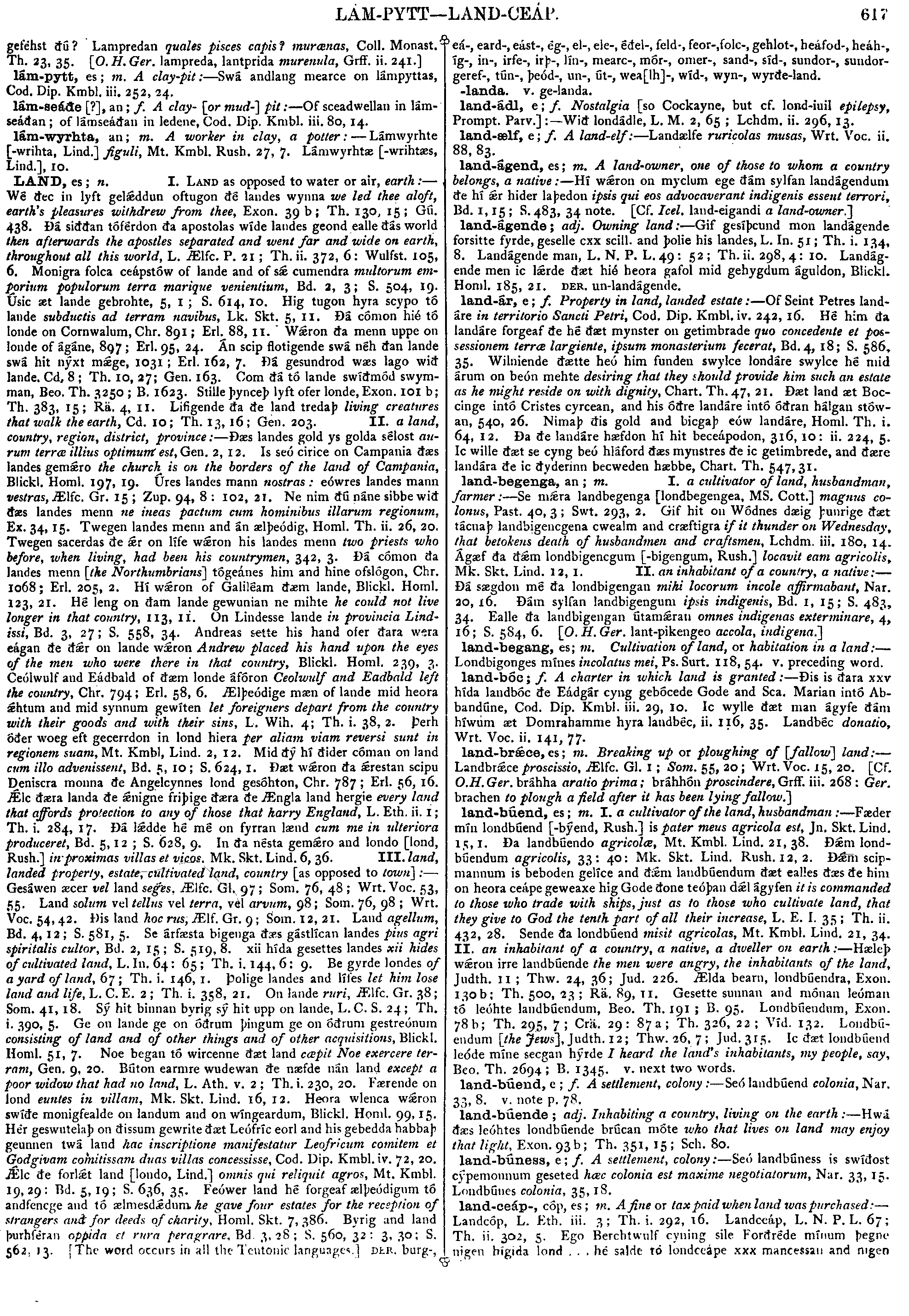
LAND,
es;
n.
I.
LAND
as
opposed
to
water
or
air,
earth
:--
Wé
ðec
in
lyft
gelddun
oftugon
ðé
landes
wynna
we
led
thee
aloft,
earth's
pleasures
withdrew
from
thee,
Exon.
39
b;
Th.
130,
15;
Gú.
438.
Ðá
siððan
tóférdon
ða
apostolas
wíde
landes
geond
ealle
ðás
world
then
afterwards
the
apostles
separated
and
went
far
and
wide
on
earth,
throughout
all
this
world,
L.
Ælfc.
P.
21;
Th.
ii.
372,
6:
Wulfst.
105,
6.
Monigra
folca
ceápstów
of
lande
and
of
s
cumendra
multorum
emporium
populorum
terra
marique
venientium,
Bd.
2,
3;
S.
504,
19.
Úsic
æt
lande
gebrohte,
5,
1;
S.
614,
10.
Hig
tugon
hyra
scypo
tó
lande
subductis
ad
terram
navibus,
Lk.
Skt.
5,
11.
Ðá
cómon
hié
tó
londe
on
Cornwalum,
Chr.
891;
Erl.
88,
11.
Wron
ða
menn
uppe
on
londe
of
ágáne,
897;
Erl.
95,
24.
Án
scip
flotigende
swá
néh
ðan
lande
swá
hit
nýxt
mge,
1031;
Erl.
162,
7.
Ðá
gesundrod
wæs
lago
wið
lande.
Cd,
8;
Th.
10,
27;
Gen.
163.
Cam
ðá
tó
lande
swíðmód
swymman,
Beo.
Th.
3250;
B.
1623.
Stile
þynceþ
lyft
ofer
londe.
Exon.
101
b;
Th.
383,
15;
Rä.
4,
11.
Lifigende
ða
ðe
land
tredaþ
living
creatures
that
walk
the
earth,
Cd.
10;
Th.
13,
16;
Gen.
203.
II.
a
land,
country,
region,
district,
province
:--
Ðæs
landes
gold
ys
golda
sélost
aurum
terræ
illius
optimum
est,
Gen.
2,
12.
Is
seó
cirice
on
Campania
ðæs
landes
gemro
the
church
is
on
the
borders
of
the
land
of
Campania,
Blickl.
Homl.
197,
19.
Úres
landes
mann
nostras:
eówres
landes
mann
vestras,
Ælfc.
Gr.
15;
Zup.
94,
8:
102,
21.
Ne
nim
ðú
náne
sibbe
wið
ðæs
landes
menn
ne
ineas
pactum
cum
hominibus
illarum
regionum,
Ex.
34,
15.
Twegen
landes
menn
and
án
ælþeódig,
Homl.
Th.
ii.
26,
20.
Twegen
sacerdas
ðe
r
on
lífe
wron
his
landes
menn
two
priests
who
before,
when
living,
had
been
his
countrymen,
342,
3.
Ðá
cómon
ða
landes
menn
[the
Northumbrians]
tógeánes
him
and
hine
ofslógon,
Chr.
1068;
Erl.
205,
2.
Hí
wron
of
Galiléam
ðæm
lande,
Blickl.
Homl.
123,
21.
Hé
leng
on
ðam
lande
gewunian
ne
mihte
he
could
not
live
longer
in
that
country,
113,
11.
On
Lindesse
lande
in
provincia
Lindissi,
Bd.
3,
27;
S.
558,
34.
Andreas
sette
his
hand
ofer
ðara
wera
eágan
ðe
ðr
on
lande
wron
Andrew
placed
his
hand
upon
the
eyes
of
the
men
who
were
there
in
that
country,
Blickl.
Homl.
239,
3.
Ceólwulf
and
Eádbald
of
ðæm
londe
áfóron
Ceolwulf
and
Eadbald
left
the
country,
Chr.
794;
Erl.
58,
6.
Ælþeódige
mæn
of
lande
mid
heora
htum
and
mid
synnum
gewíten
let
foreigners
depart
from
the
country
with
their
goods
and
with
their
sins,
L.
Wih.
4;
Th.
i.
38,
2.
Þerh
óðer
woeg
eft
gecerrdon
in
lond
hiera
per
aliam
viam
reversi
sunt
in
regionem
suam,
Mt.
Kmbl,
Lind.
2,
12.
Mid
ðý
hí
ðider
cóman
on
land
cum
illo
advenissent,
Bd.
5,
10;
S.
624,
1.
Ðæt
wron
ða
restan
scipu
Deniscra
monna
ðe
Angelcynnes
lond
gesóhton,
Chr.
787;
Erl.
56,
16.
Æ-acute;lc
ðæra
landa
ðe
nigne
friþige
ðæra
ðe
Ængla
land
hergie
every
land
that
affords
protection
to
any
of
those
that
harry
England,
L.
Eth.
ii.
1;
Th.
i.
284,
17.
Ðá
ldde
hé
mé
on
fyrran
lænd
cum
me
in
ulteriora
produceret,
Bd.
5,
12;
S.
628,
9.
In
ða
nésta
gemro
and
londo
[lond,
Rush.]
in
proximas
villas
et
vicos.
Mk.
Skt.
Lind.
6,
36.
III.
land,
landed
property,
estate,
cultivated
land,
country
[as
opposed
to
town]
:--
Gesáwen
æcer
vel
land
seges.
Ælfc.
Gl.
97;
Som.
76,
48;
Wrt.
Voc.
53,
55.
Land
solum
vel
tellus
vel
terra,
vel
arvum,
98;
Som.
76,
98;
Wrt.
Voc.
54,
42,
Ðis
land
hoc
rus,
Ælf.
Gr.
9;
Som.
12,
21.
Land
agellum,
Bd.
4,
12;
S.
581,
5.
Se
árfæsta
bigenga
ðæs
gástlícan
landes
pius
agri
spiritalis
cultor,
Bd.
2,
15;
S.
519,
8.
xii
hída
gesettes
landes
xii
hides
of
cultivated
land,
L.
In.
64:
65;
Th.
i.
144,
6:
9.
Be
gyrde
londes
of
a
yard
of
land,
67;
Th.
i.
146,
1.
Þolige
landes
and
lífes
let
him
lose
land
and
life,
L.
C.
E.
2;
Th.
i.
358,
21.
On
lande
ruri,
Ælfc.
Gr.
38;
Som.
41,
18.
Sý
hit
binnan
byrig
sý
hit
upp
on
lande,
L.
C.
S.
24;
Th.
i.
390,
5.
Ge
on
lande
ge
on
óðrum
þingum
ge
on
óðrum
gestreónum
consisting
of
land
and
of
other
things
and
of
other
acquisitions,
Blickl.
Homl.
51,
7.
Noe
began
tó
wircenne
ðæt
land
cæpit
Noe
exercere
terram,
Gen.
9,
20.
Búton
earmre
wudewan
ðe
næfde
nán
land
except
a
poor
widow
that
had
no
land,
L.
Ath.
v.
2;
Th.
i.
230,
20.
Færende
on
lond
euntes
in
villam,
Mk.
Skt.
Lind.
16,
12.
Heora
wlenca
wron
swíðe
monigfealde
on
landum
and
on
wíngeardum,
Blickl.
Homl.
99,
15.
Hér
geswutelaþ
on
ðissum
gewrite
ðæt
Leófríc
eorl
and
his
gebedda
habbap
geunnen
twá
land
hac
inscriptione
manifestatur
Leofricum
comitem
et
Godgivam
comitissam
duas
villas
concessisse,
Cod.
Dip.
Kmbl.
iv.
72,
20.
Æ-acute;lc
ðe
forlt
land
[londo,
Lind.]
omnis
qui
reliquit
agros,
Mt.
Kmbl.
19,
29:
Bd.
5,
19;
S.
636,
35.
Feówer
land
hé
forgeaf
ælþeódigum
tó
andfencge
and
tó
ælmesddum
he
gave
four
estates
for
the
reception
of
strangers
and
for
deeds
of
charity,
Homl.
Skt.
7,
386.
Byrig
and
land
þurhféran
oppida
et
rura
peragrare,
Bd.
3,
28;
S.
560,
32:
3,
30;
S.
562,
13.
[The
word
occurs
in
all
the
Teutonic
languages.]
DER.
burg-,
eá-,
eard-,
eást-,
ég-,
el-,
ele-,
éðel-,
feld-,
feor-,
folc-,
gehlot-,
heáfod-,
heáh-,
íg-,
in-,
irfe-,
irp-,
lín-,
mearc-,
mór-,
omer-,
sand-,
síd-,
sundor-,
sundor-geref-,
tún-,
þeód-,
un-,
út-,
wea[lh]-,
wíd-,
wyn-,
wyrðe-land.
|
Source: Bosworth/Toller, page b0618, entry 20 View original page image as: [TIFF] [PNG] [View previous entry] [View next entry] |
[Comment on this entry] [View comments] |
The following entry has been hand-corrected once. |
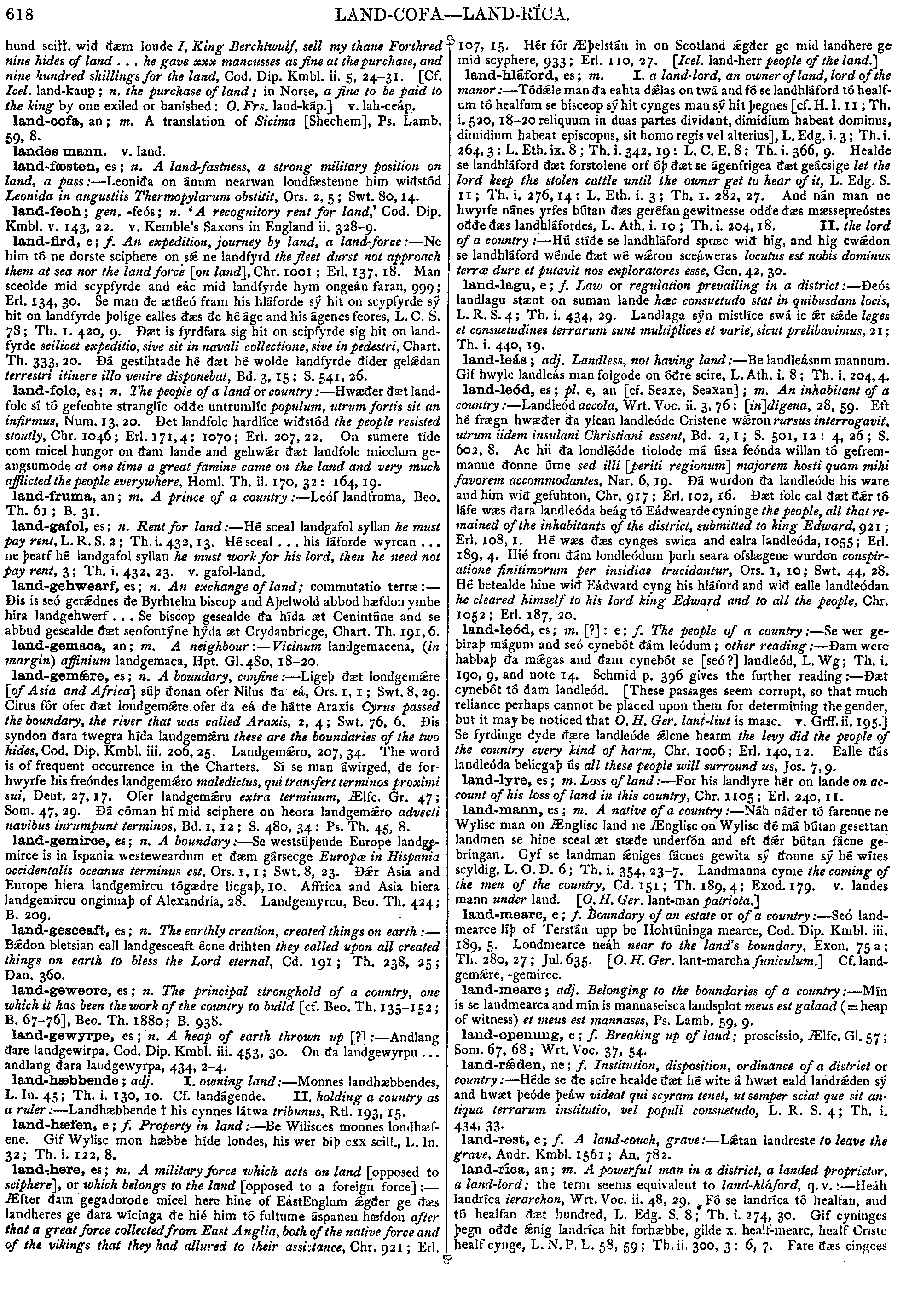
land-lagu,
e;
f.
Law
or
regulation
prevailing
in
a
district
:--
Ðeós
landlagu
stænt
on
suman
lande
hæc
consuetudo
stat
in
quibusdam
locis,
L.
R.
S.
4;
Th.
i.
434,
29.
Landlaga
sýn
mistlíce
swá
ic
r
sde
leges
et
consuetudines
terrarum
sunt
multiplices
et
varie,
sicut
prelibavimus,
21;
Th.
i.
440,
19.
|
Source: Bosworth/Toller, page b0619, entry 9 View original page image as: [TIFF] [PNG] [View previous entry] [View next entry] |
[Comment on this entry] [View comments] |
The following entry has been hand-corrected once. |
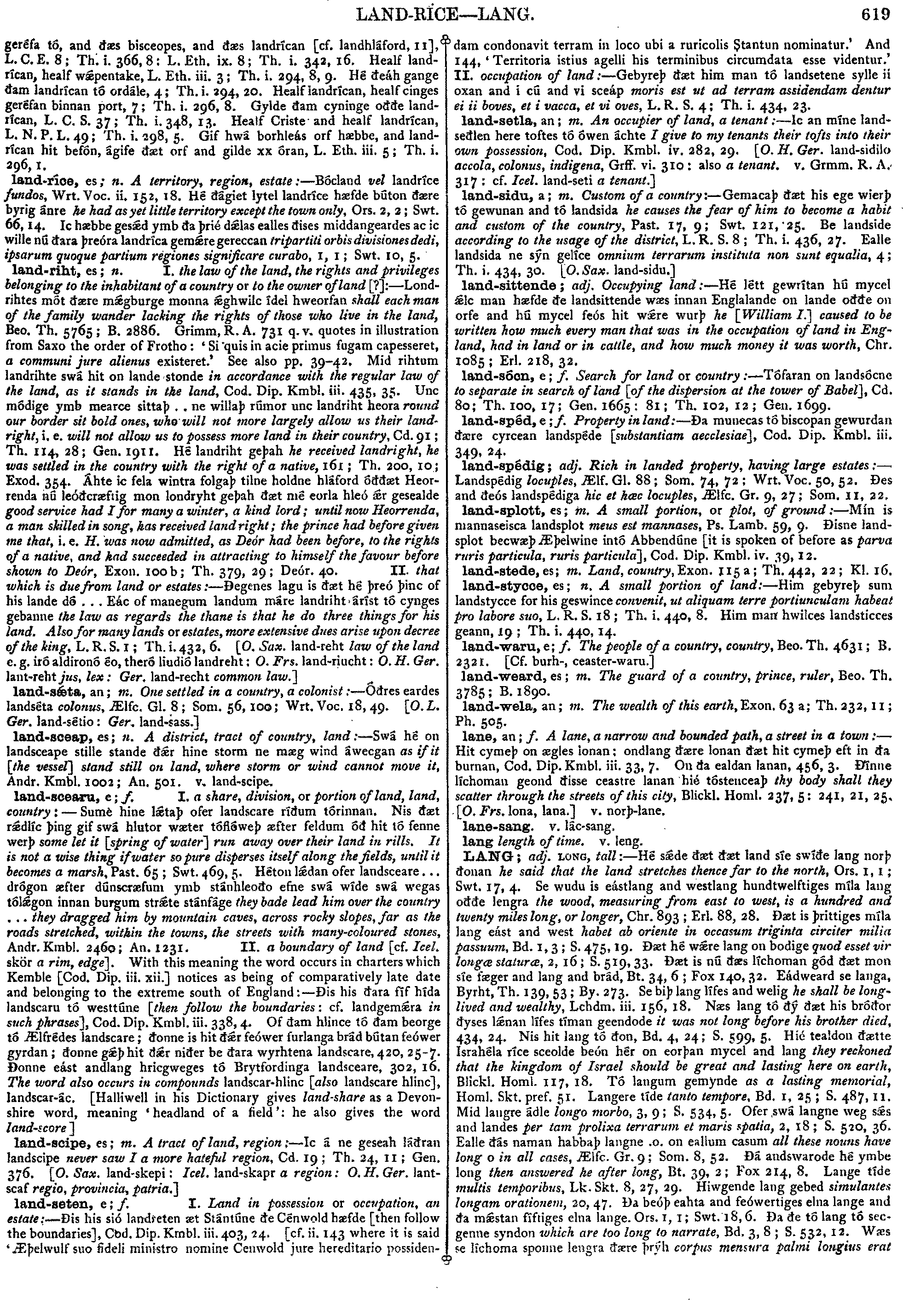
land-sidu, a; m. Custom of a country :-- Gemacaþ ðæt his ege wierþ tó gewunan and tó landsida he causes the fear of him to become a habit and custom of the country, Past. 17, 9; Swt. 121, 25. Be landside according to the usage of the district, L. R. S. 8; Th. 1. 436, 27. Ealle landsida ne sýn gelíce omnium terrarum instituta non sunt equalia, 4; Th. i. 434, 30. [O. Sax. land-sidu.]
|
Source: Bosworth/Toller, page b0623, entry 15 View original page image as: [TIFF] [PNG] [View previous entry] [View next entry] |
[Comment on this entry] [View comments] |
The following entry has been hand-corrected once. |
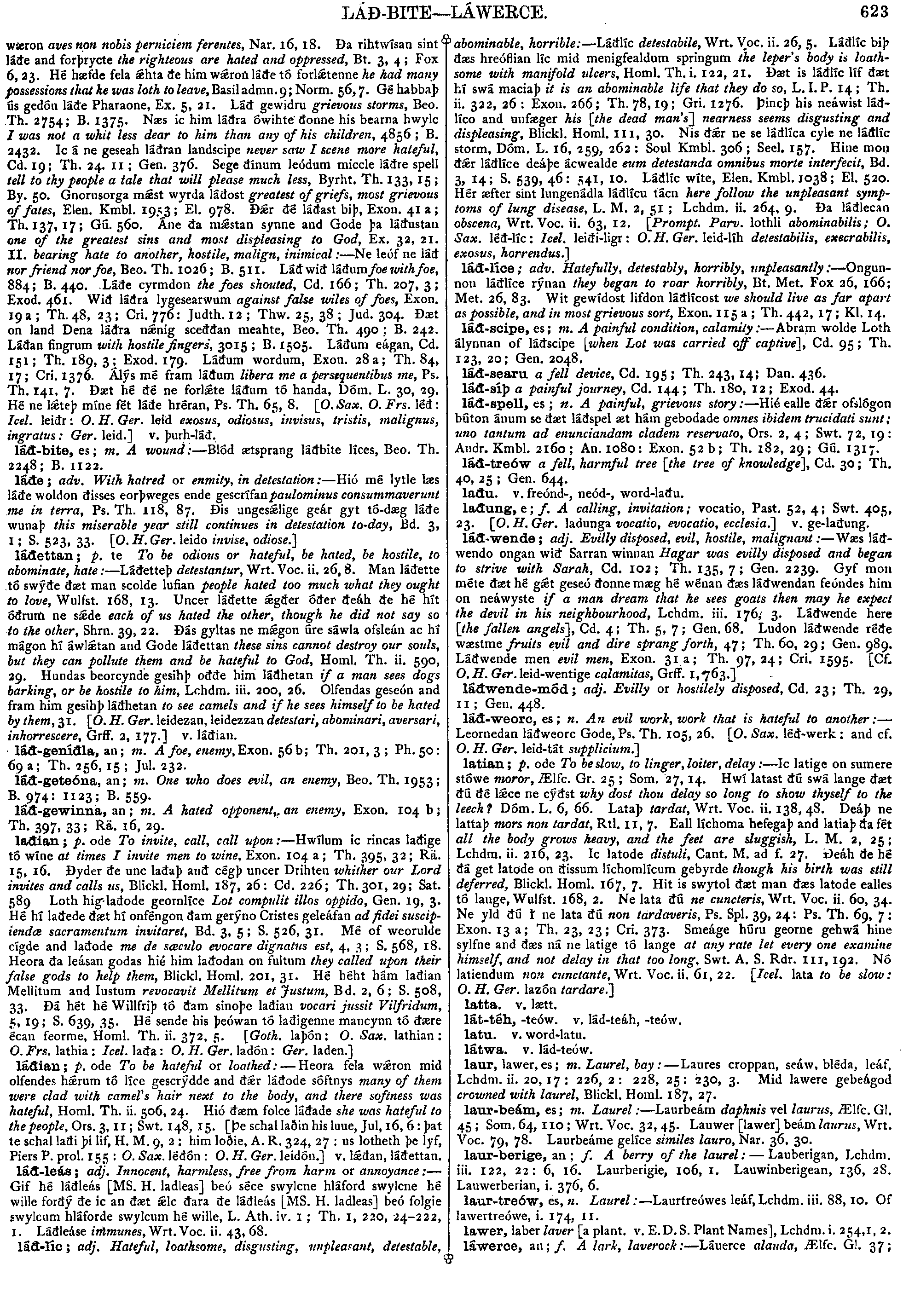
láð-spell,
es;
n.
A
painful,
grievous
story
:--
Hié
ealle
ðr
ofslógon
búton
ánum
se
ðæt
láðspel
æt
hám
gebodade
omnes
ibidem
trucidati
sunt;
uno
tantum
ad
enunciandam
cladem
reservato,
Ors.
2,
4;
Swt.
72,
19:
Andr.
Kmbl.
2160;
An.
1080:
Exon.
52
b;
Th.
182,
29;
Gú.
1317.
| Result Page: |  |
Previous | 16 17 18 19 20 21 22 23 24 25 26 27 28 29 30 31 32 33 34 | Next |  |
Germanic Lexicon Project (main page)
This search system was written by
Sean Crist
Please consider
volunteering
to correct the data in these online dictionaries.
No rights reserved. Feel free to use these data in any way you please.