|
|

|
Source: Cleasby/Vigfusson, page b0703, entry 69 View original page image as: [TIFF] [PNG] [View previous entry] [View next entry] |
[Comment on this entry] [View comments] |
The following entry has been hand-corrected once. |
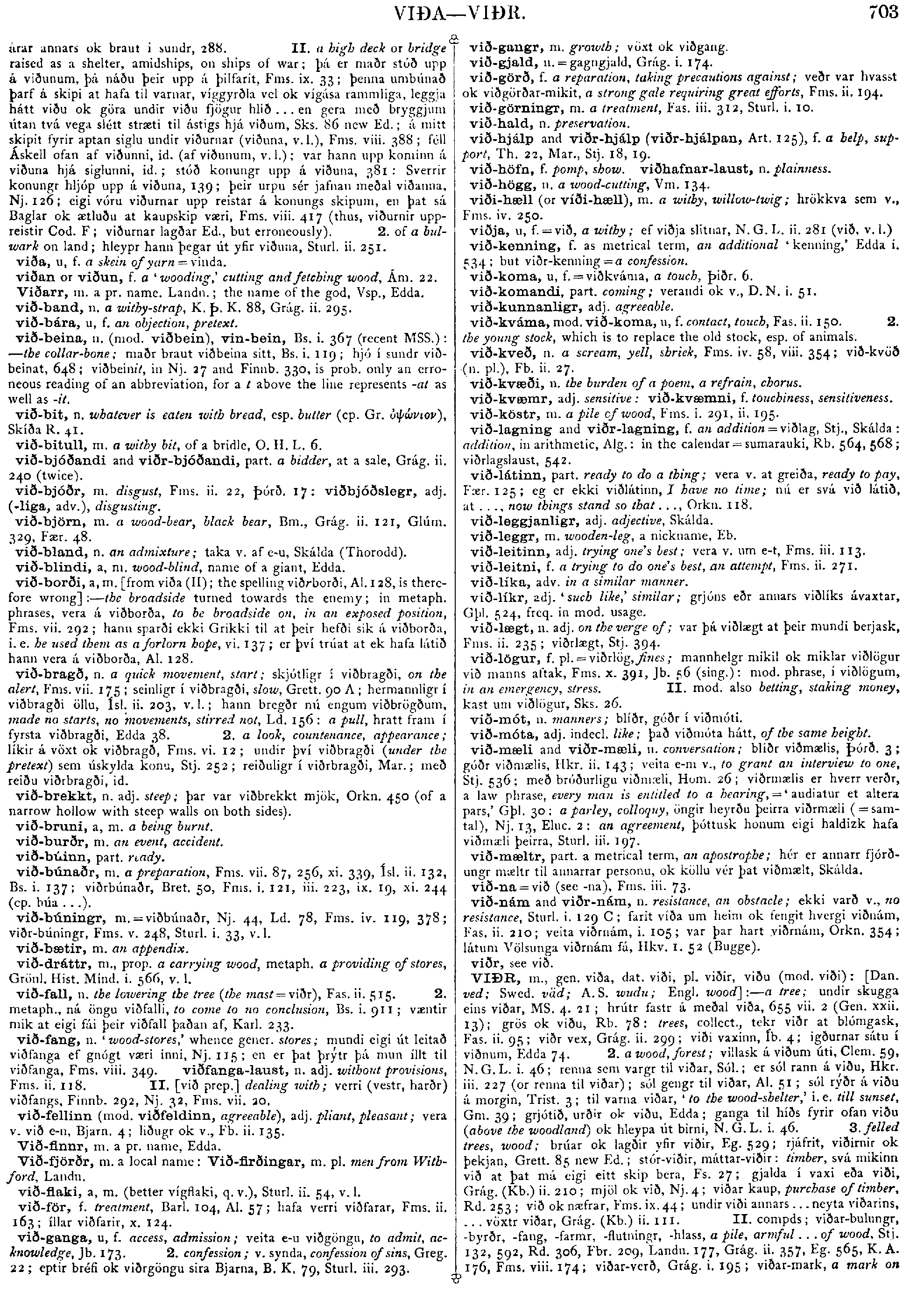
VIÐR, m., gen. viða, dat. viði, pl. viðir, viðu (mod. viði): [Dan. ved; Swed. väd; A.S. wudu; Engl. wood] :-- a tree; undir skugga eins viðar, MS. 4. 21; hrútr fastr á meðal viða, 655 vii. 2 (Gen. xxii. 13); grös ok viðu, Rb. 78: trees, collect., tekr viðr at blómgask, Fas. ii. 95; viðr vex, Grág. ii. 299; viði vaxinn, Íb. 4; igðurnar sátu í viðnum, Edda 74. 2. a wood, forest; villask á viðum úti, Clem. 59, N.G.L. i. 46; renna sem vargr til viðar, Sól.; er sól rann á viðu, Hkr. iii. 227 (or renna til viðar); sól gengr til viðar, Al. 51; sól rýðr á viðu á morgin, Trist. 3; til varna viðar, 'to the wood-shelter,' i.e. till sunset, Gm. 39; grjótið, urðr ok viðu, Edda; ganga til híðs fyrir ofan viðu (above the woodland) ok hleypa út birni, N.G.L. i. 46. 3. felled trees, wood; brúar ok lagðir yfir viðir, Eg. 529; rjáfrit, viðirnir ok þekjan, Grett. 85 new Ed.; stór-viðir, máttar-viðir: timber, svá mikinn við at þat má eigi eitt skip bera, Fs. 27; gjalda í vaxi eða viði, Grág. (Kb.) ii. 210; mjöl ok við, Nj. 4; viðar kaup, purchase of timber, Rd. 253; við ok næfrar, Fms. ix. 44; undir viði annars ... neyta viðarins, ... vöxtr viðar, Grág. (Kb.) ii. 111. II. compds; viðar-bulungr, -byrðr, -fang, -farmr, -flutningr, -hlass, a pile, armful ... of wood, Stj. 132, 592, Rd. 306, Fbr. 209, Landn. 177, Grág. ii. 357, Eg. 565, K. Á. 176, Fms. viii. 174; viðar-verð, Grág. i. 195; viðar-mark, a mark on
|
Source: Cleasby/Vigfusson, page b0704, entry 1 View original page image as: [TIFF] [PNG] [View previous entry] [View next entry] |
[Comment on this entry] [View comments] |
The following entry has been hand-corrected once. |
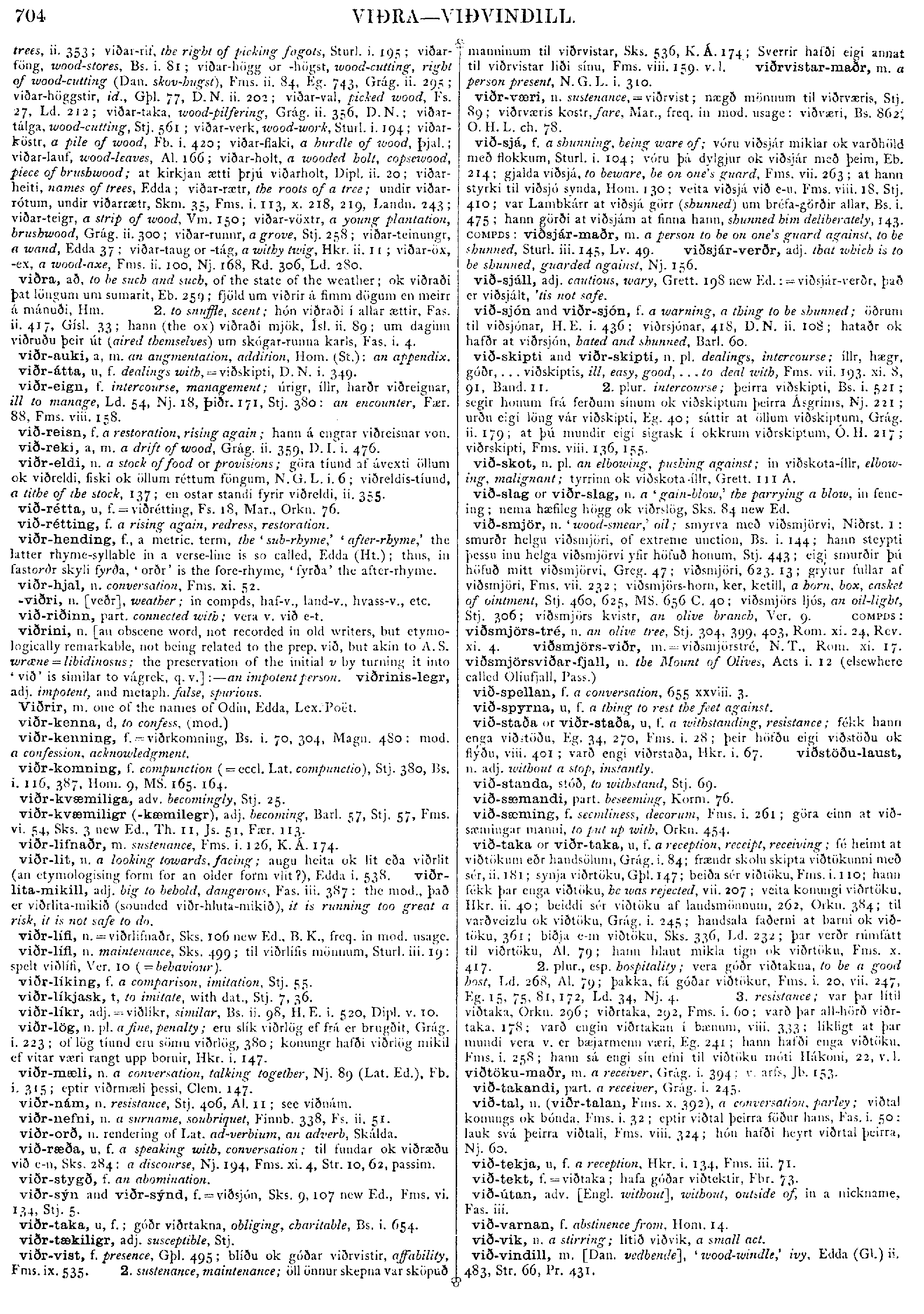
trees, ii. 353; viðar-rif, the right of picking fagots, Sturl. i. 195; viðar-föng, wood-stores, Bs. i. 81; viðar-högg or -högst, wood-cutting, right of wood-cutting (Dan. skov-hugst), Fms. ii. 84, Eg. 743, Grág. ii. 295; viðar-höggstir, id., Gþl. 77, D.N. ii. 202; viðar-val, picked wood, Fs. 27, Ld. 212; viðar-taka, wood-pilfering, Grág. ii. 356, D.N.; viðar-tálga, wood-cutting, Stj. 561; viðar-verk, wood-work, Sturl. i. 194; viðar-köstr, a pile of wood, Fb. i. 420; viðar-flaki, a hurdle of wood, Þjal.; viðar-lauf, wood-leaves, Al. 166; viðar-holt, a wooded holt, copsewood, piece of brushwood; at kirkjan ætti þrjú viðarholt, Dipl. ii. 20; viðar-heiti, names of trees, Edda; viðar-rætr, the roots of a tree; undir viðar-rótum, undir viðarrætr, Skm. 35, Fms. i. 113, x. 218, 219, Landn. 243; viðar-teigr, a strip of wood, Vm. 150; viðar-vöxtr, a young plantation, brushwood, Grág. ii. 300; viðar-runnr, a grove, Stj. 258; viðar-teinungr, a wand, Edda 37; viðar-taug or -tág, a withy twig, Hkr. ii. 11; viðar-öx, -ex, a wood-axe, Fms. ii. 100, Nj. 168, Rd. 306, Ld. 280.
|
Source: Cleasby/Vigfusson, page b0704, entry 7 View original page image as: [TIFF] [PNG] [View previous entry] [View next entry] |
[Comment on this entry] [View comments] |
The following entry has been hand-corrected once. |
við-reki, a, m. a drift of wood, Grág. ii. 359, D.I. i. 476.
|
Source: Cleasby/Vigfusson, page b0708, entry 8 View original page image as: [TIFF] [PNG] [View previous entry] [View next entry] |
[Comment on this entry] [View comments] |
The following entry has been hand-corrected once. |
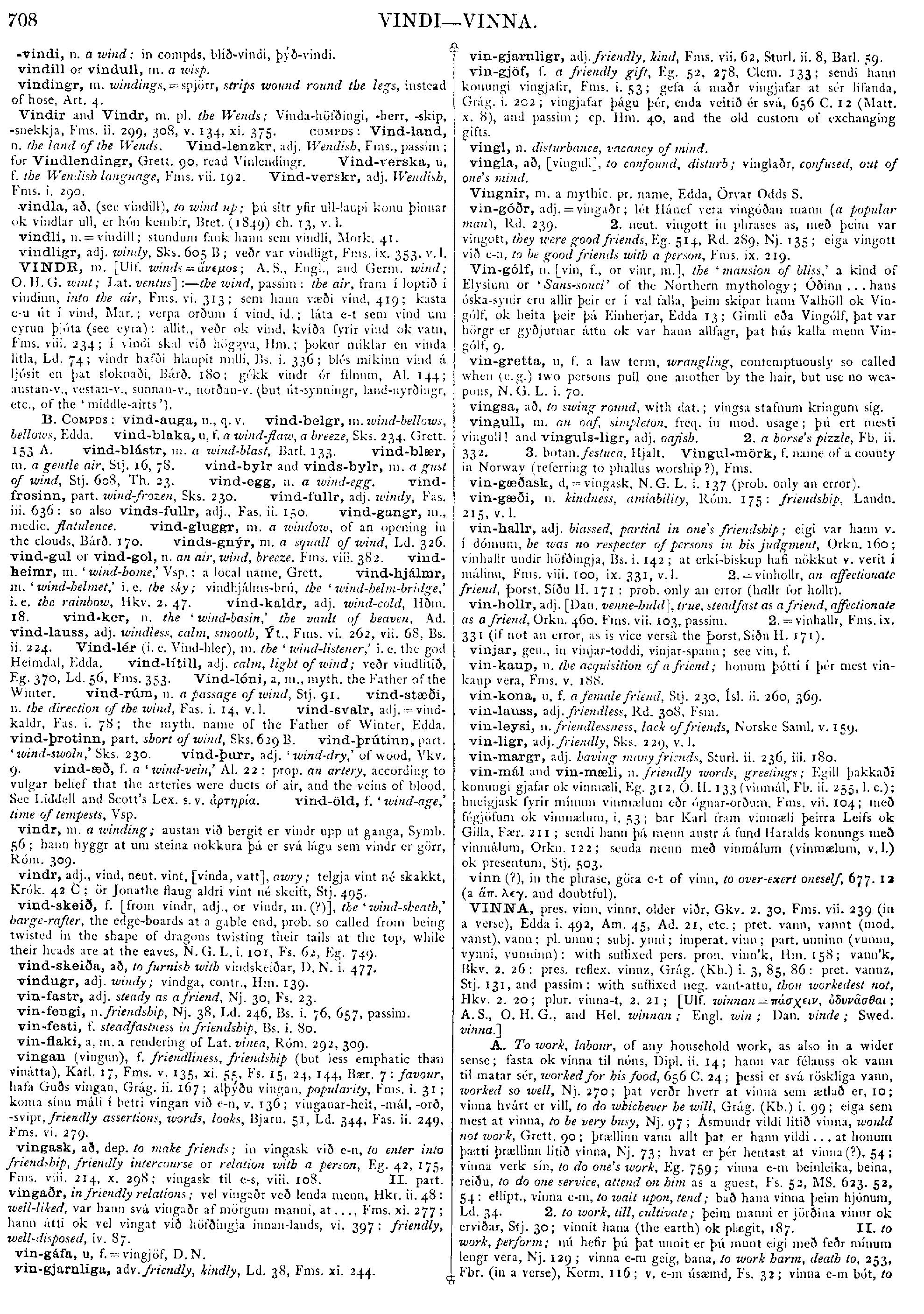
VINDR, m. [Ulf. winds = GREEK; A.S., Engl., and Germ. wind; O.H.G. wint; Lat. ventus] :-- the wind, passim: the air, fram í loptið í vindinn, into the air, Fms. vi. 313; sem hann væði vind, 419; kasta e-u út í vind, Mar.; verpa orðum í vind, id.; láta e-t sem vind um eyrun þjóta (see eyra): allit., veðr ok vind, kvíða fyrir vind ok vatn, Fms. viii. 234; í vindi skal við höggva, Hm.; þokur miklar en vinda litla, Ld. 74; vindr hafði hlaupit milli, Bs. i. 336; blés mikinn vind á ljósit en þat sloknaði, Bárð. 180; gékk vindr ór filnum, Al. 144; austan-v., vestan-v., sunnan-v., norðan-v. (but út-synningr, land-nyrðingr, etc., of the 'middle-airts'). B. COMPDS: vind-auga, n., q.v. vind-belgr, m. wind-bellows, bellows, Edda. vind-blaka, u, f. a wind-flaw, a breeze, Sks. 234, Grett. 153 A. vind-blástr, m. a wind-blast, Barl. 133. vind-blær, m. a gentle air, Stj. 16, 78. vind-bylr and vinds-bylr, m. a gust of wind, Stj. 608, Th. 23. vind-egg, n. a wind-egg. vind-frosinn, part. wind-frozen, Sks. 230. vind-fullr, adj. windy, Fas. iii. 636: so also vinds-fullr, adj., Fas. ii. 150. vind-gangr, m., medic. flatulence. vind-gluggr, m. a window, of an opening in the clouds, Bárð. 170. vinds-gnýr, m. a squall of wind, Ld. 326. vind-gul or vind-gol, n. an air, wind, breeze, Fms. viii. 382. vind-heimr, m. 'wind-home,' Vsp.: a local name, Grett. vind-hjálmr, m. 'wind-helmet,' i.e. the sky; vindhjalms-brú, the 'wind-helm-bridge,' i.e. the rainbow, Hkv. 2. 47. vind-kaldr, adj. wind-cold, Hðm. 18. vind-ker, n. the 'wind-basin,' the vault of heaven. Ad. vind-lauss, adj. windless, calm, smooth, Ýt., Fms. vi. 262, vii. 68, Bs. ii. 224. Vind-lér (i.e. Vind-hler), m. the 'wind-listener,' i.e. the god Heimdal, Edda. vind-lítill, adj. calm, light of wind; veðr vindlítið, Eg. 370, Ld. 56, Fms. 353. Vind-lóni, a, m., myth. the Father of the Winter. vind-rúm, n. a passage of wind, Stj. 91. vind-stæði, n. the direction of the wind, Fas. i. 14, v.l. vind-svalr, adj. = vindkaldr, Fas. i. 78; the myth. name of the Father of Winter, Edda. vind-þrotinn, part. short of wind, Sks. 629 B. vind-þrútinn, part. 'wind-swoln' Sks. 230. vind-þurr, adj. 'wind-dry,' of wood, Vkv. 9. vind-æð, f. a 'wind-vein,' Al. 22: prop. an artery, according to vulgar belief that the arteries were ducts of air, and the veins of blood. See Liddell and Scott's Lex. s.v. GREEK. vind-öld, f. 'wind-age,' time of tempests, Vsp.
|
Source: Cleasby/Vigfusson, page b0721, entry 26 View original page image as: [TIFF] [PNG] [View previous entry] [View next entry] |
[Comment on this entry] [View comments] |
The following entry has been hand-corrected once. |
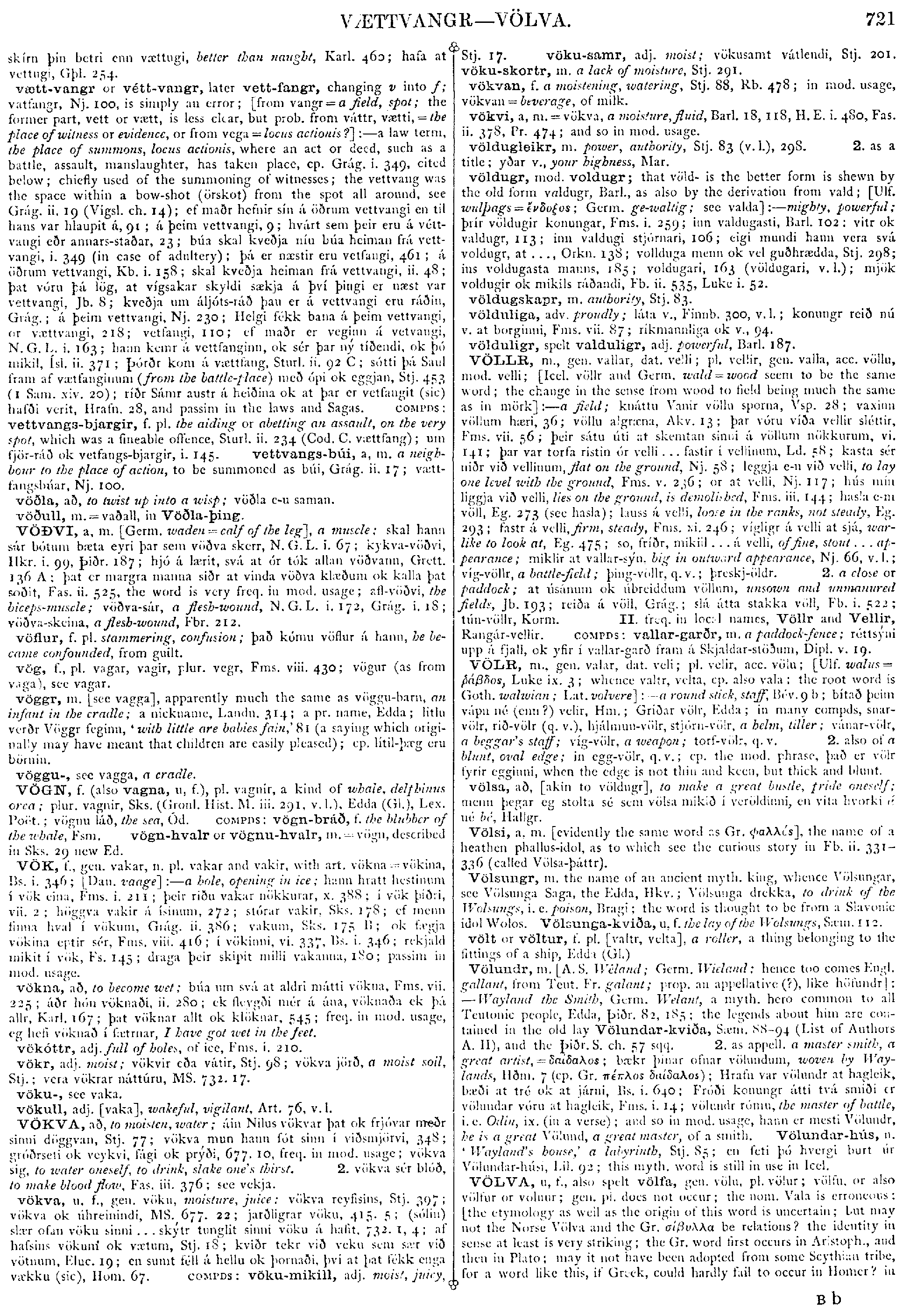
VÖLLR, m., gen. vallar, dat. velli; pl. vellir, gen. valla, acc. völlu, mod. velli; [Icel. völlr and Germ. wald = wood seem to be the same word; the change in the sense from wood to field being much the same as in mörk] :-- a field; knáttu Vanir völlu sporna, Vsp. 28; vaxinn völlum hæri, 36; völlu algræna, Akv. 13; þar vóru víða vellir sléttir, Fms. vii. 56; þeir sátu úti at skemtan sinni á völlum nökkurum, vi. 141; þar var torfa ristin ór velli ... fastir í vellinum, Ld. 58; kasta sér niðr við vellinum, flat on the ground, Nj. 58; leggja e-n við velli, to lay one level with the ground, Fms. v. 236; or at velli, Nj. 117; hús min liggja við velli, lies on the ground, is demolished, Fms. iii. 144; hasla e-m völl, Eg. 273 (see hasla); lauss á velli, loose in the ranks, not steady, Eg. 293; fastr á velli, firm, steady. Fms. xi. 246; vígligr á velli at sjá, warlike to look at, Eg. 475; so, fríðr, mikill ... á velli, of fine, stout ... appearance; miklir at vallar-sýn. big in outward appearance, Nj. 66, v.l.; víg-völlr, a battle-field; þing-völlr, q.v.; þreskj-öldr. 2. a close or paddock; at úsánum ok úbreiddum völlum, unsown and unmanured fields, Jb. 193; reiða á völl, Grág.; slá átta stakka völl, Fb. i. 522; tún-völlr, Korm. II. freq. in local names, Völlr and Vellir, Rangár-vellir. COMPDS: vallar-garðr, m. a paddock-fence; réttsýni upp á fjall, ok yfir í vallar-garð fram á Skjaldar-stöðum, Dipl. v. 19.
|
Source: Cleasby/Vigfusson, page b0738, entry 28 View original page image as: [TIFF] [PNG] [View previous entry] [View next entry] |
[Comment on this entry] [View comments] |
The following entry has been hand-corrected once. |
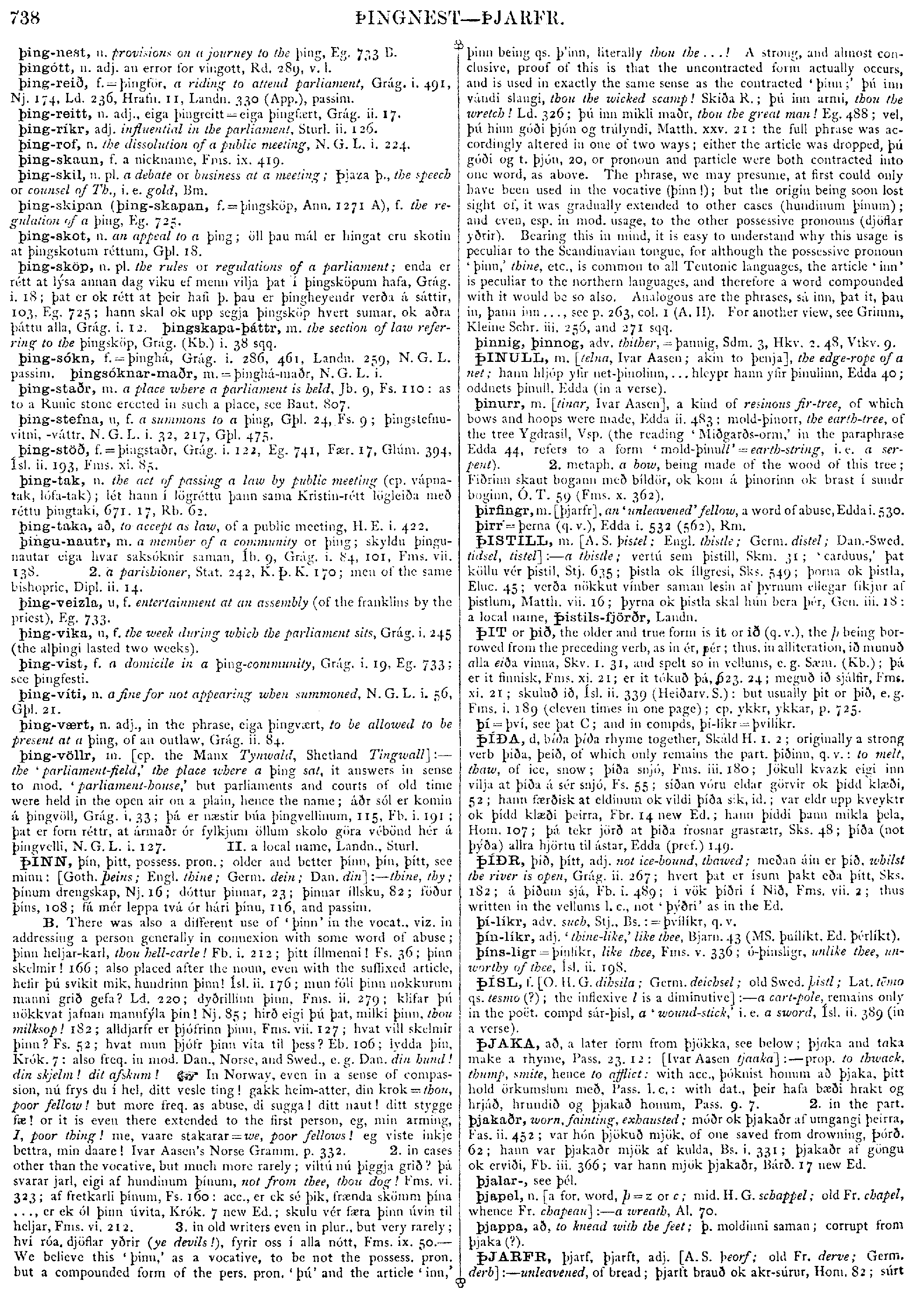
þinurr, m. [tinar, Ivar Aasen], a kind of resinous fir-tree, of which bows and hoops were made, Edda ii. 483; mold-þinorr, the earth-tree, of the tree Ygdrasil, Vsp. (the reading 'Miðgarðs-orm,' in the paraphrase Edda 44, refers to a form 'mold-þinull' = earth-string, i.e. a serpent). 2. metaph. a bow, being made of the wood of this tree; Fiðrinn skaut bogann með bíldör, ok kom á þinorinn ok brast í sundr boginn, Ó.T. 59 (Fms. x. 362).
|
Source: Cleasby/Vigfusson, page b0742, entry 6 View original page image as: [TIFF] [PNG] [View previous entry] [View next entry] |
[Comment on this entry] [View comments] |
The following entry has been hand-corrected once. |
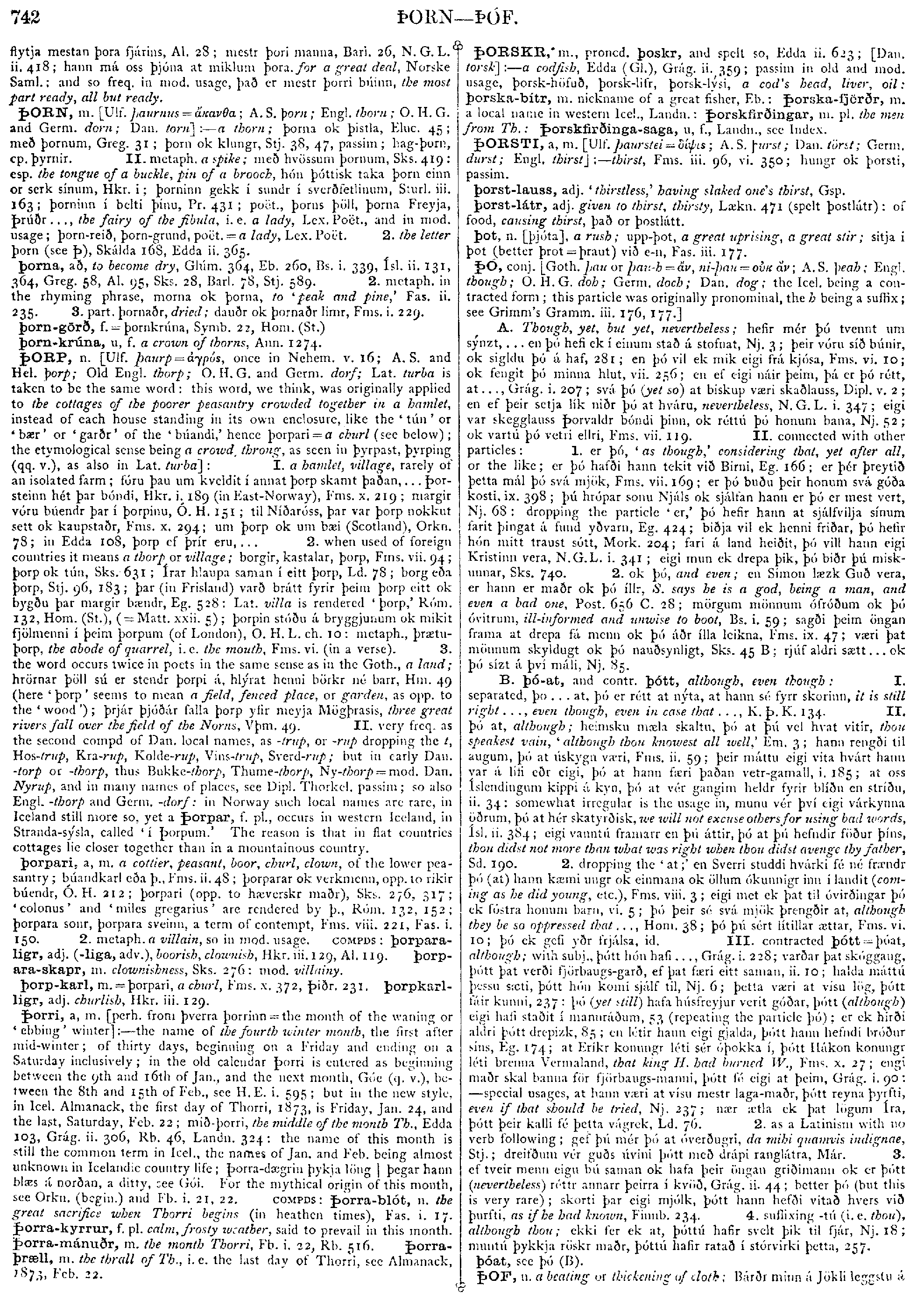
ÞORP, n. [Ulf. þaurp = GREEK, once in Nehem. v. 16; A.S. and Hel. þorp; Old Engl. thorp; O.H.G. and Germ. dorf; Lat. turba is taken to be the same word: this word, we think, was originally applied to the cottages of the poorer peasantry crowded together in a hamlet, instead of each house standing in its own enclosure, like the 'tún' or 'bær' or 'garðr' of the 'búandi,' hence þorpari = a churl (see below); the etymological sense being a crowd, throng, as seen in þyrpast, þyrping (qq.v.), as also in Lat. turba]: I. a hamlet, village, rarely of an isolated farm; fóru þau um kveldit í annat þorp skamt þaðan, ... Þorsteinn hét þar bóndi, Hkr. i. 189 (in East-Norway), Fms. x. 219; margir vóru búendr þar í þorpinu, Ó.H. 151; til Níðaróss, þar var þorp nokkut sett ok kaupstaðr, Fms. x. 294; um þorp ok um bæi (Scotland), Orkn. 78; in Edda 108, þorp ef þrír eru, ... 2. when used of foreign countries it means a thorp or village; borgir, kastalar, þorp, Fms. vii. 94; þorp ok tún, Sks. 631; Írar hlaupa saman í eitt þorp, Ld. 78; borg eða þorp, Stj. 96, 183; þar (in Frisland) varð brátt fyrir þeim þorp eitt ok bygðu þar margir bændr, Eg. 528: Lat. villa is rendered 'þorp,' Róm. 132, Hom. (St.), (= Matt. xxii. 5); þorpin stóðu á bryggjunum ok mikit fjölmenni í þeim þorpum (of London), O.H.L. ch. 10: metaph., þrætu-þorp, the abode of quarrel, i.e. the mouth, Fms. vi. (in a verse). 3. the word occurs twice in poets in the same sense as in the Goth., a land; hrörnar þöll sú er stendr þorpi á, hlýrat henni börkr né barr, Hm. 49 (here 'þorp' seems to mean a field, fenced place, or garden, as opp. to the 'wood'); þrjár þjóðár falla þorp yfir meyja Mögþrasis, three great rivers fall over the field of the Norns, Vþm. 49. II. very freq. as the second compd of Dan. local names, as -trup, or -rup dropping the t, Hos-trup, Kra-rup, Kolde-rup, Vins-trup, Sverd-rup; but in early Dan. -torp or -thorp, thus Bukke-thorp, Thume-thorp, Ny-thorp = mod. Dan. Nyrup, and in many names of places, see Dipl. Thorkel. passim; so also Engl. -thorp and Germ. -dorf: in Norway such local names are rare, in Iceland still more so, yet a Þorpar, f. pl., occurs in western Iceland, in Stranda-sýsla, called 'í Þorpum.' The reason is that in flat countries cottages lie closer together than in a mountainous country.
|
Source: Cleasby/Vigfusson, page b0744, entry 35 View original page image as: [TIFF] [PNG] [View previous entry] [View next entry] |
[Comment on this entry] [View comments] |
The following entry has been hand-corrected once. |
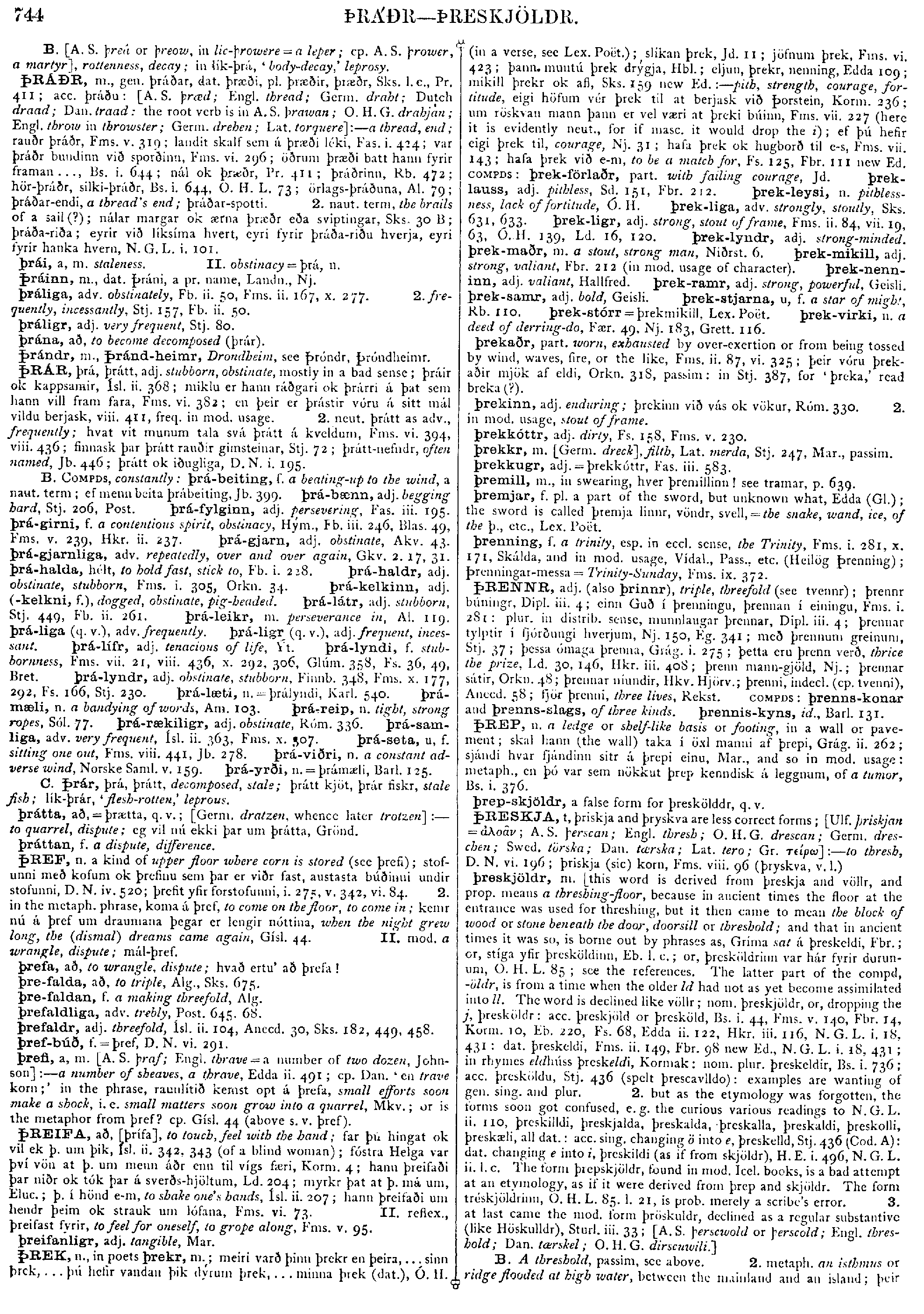
þreskjöldr, m. [this word is derived from þreskja and völlr, and prop. means a threshing-floor, because in ancient times the floor at the entrance was used for threshing, but it then came to mean the block of wood or stone beneath the door, doorsill or threshold; and that in ancient times it was so, is borne out by phrases as, Gríma sat á þreskeldi, Fbr.; or, stíga yfir þresköldinn, Eb. l.c.; or, þresköldrinn var hár fyrir durunum, O.H.L. 85; see the references. The latter part of the compd, -öldr, is from a time when the older ld had not as yet become assimilated into ll. The word is declined like völlr; nom. þreskjöldr, or, dropping the j, þresköldr: acc. þreskjöld or þresköld, Bs. i. 44, Fms. v. 140, Fbr. 14, Korm. 10, Eb. 220, Fs. 68, Edda ii. 122, Hkr. iii. 116, N.G.L. i. 18, 431: dat. þreskeldi, Fms. ii. 149, Fbr. 98 new Ed., N.G.L. i. 18, 431; in rhymes eldhúss þreskeldi, Kormak: nom. plur. þreskeldir, Bs. i. 736; acc. þresköldu, Stj. 436 (spelt þrescavlldo): examples are wanting of gen. sing. and plur. 2. but as the etymology was forgotten, the forms soon got confused, e.g. the curious various readings to N.G.L. ii. 110, þreskilldi, þreskjalda, þreskalda, þreskalla, þreskaldi, þreskolli, þreskæli, all dat.: acc. sing. changing ö into e, þreskelld, Stj. 436 (Cod. A): dat. changing e into i, þreskildi (as if from skjöldr), H.E. i. 496, N.G.L. ii. l.c. The form þrepskjöldr, found in mod. Icel. books, is a bad attempt at an etymology, as if it were derived from þrep and skjöldr. The form tréskjöldrinn, O.H.L. 85. l. 21, is prob. merely a scribe's error, 3. at last came the mod. form þröskuldr, declined as a regular substantive (like Höskulldr), Sturl. iii. 33; [A.S. þerscwold or þerscold; Engl. threshold; Dan. tærskel; O.H.G. dirscuwili.] B. A threshold, passim, see above. 2. metaph. an isthmus or ridge flooded at high water, between the mainland and an island; þeir
|
Source: Cleasby/Vigfusson, page b0746, entry 25 View original page image as: [TIFF] [PNG] [View previous entry] [View next entry] |
[Comment on this entry] [View comments] |
The following entry has been hand-corrected once. |
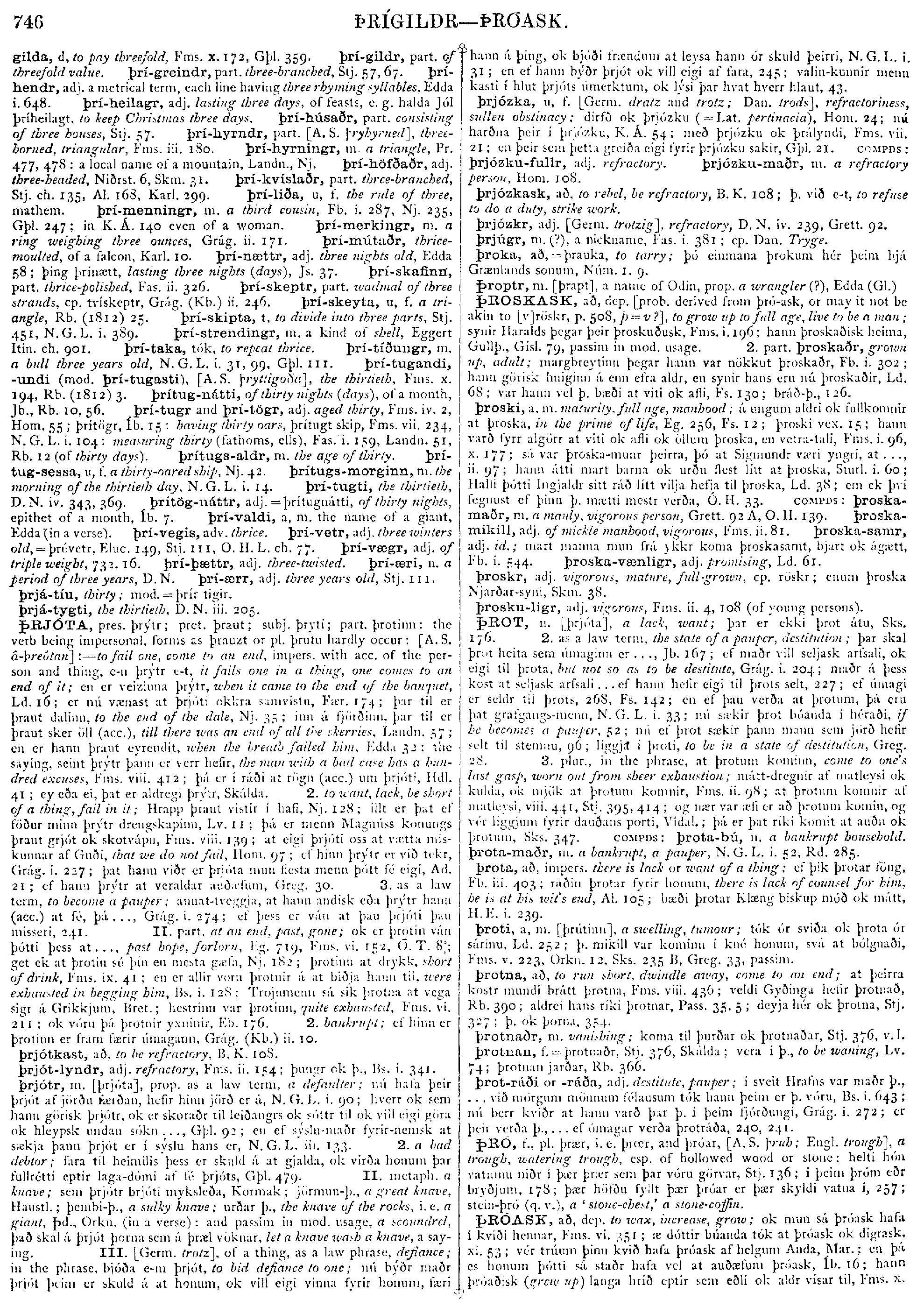
ÞRÓ, f., pl. þrær, i.e. þrœr, and þróar, [A.S. þrub; Engl. trough], a trough, watering trough, esp. of hollowed wood or stone: helti hón vatninn niðr í þær þrær sem þar vóru görvar, Stj. 136; í þeim þróm eðr bryðjum, 178; þær höfðu fyllt þær þróar er þær skyldi vatna í, 257; stein-þró (q.v.), a 'stone-chest,' a stone-coffin.
|
Source: Cleasby/Vigfusson, page b0769, entry 7 View original page image as: [TIFF] [PNG] [View previous entry] [View next entry] |
[Comment on this entry] [View comments] |
The following entry has been hand-corrected once. |
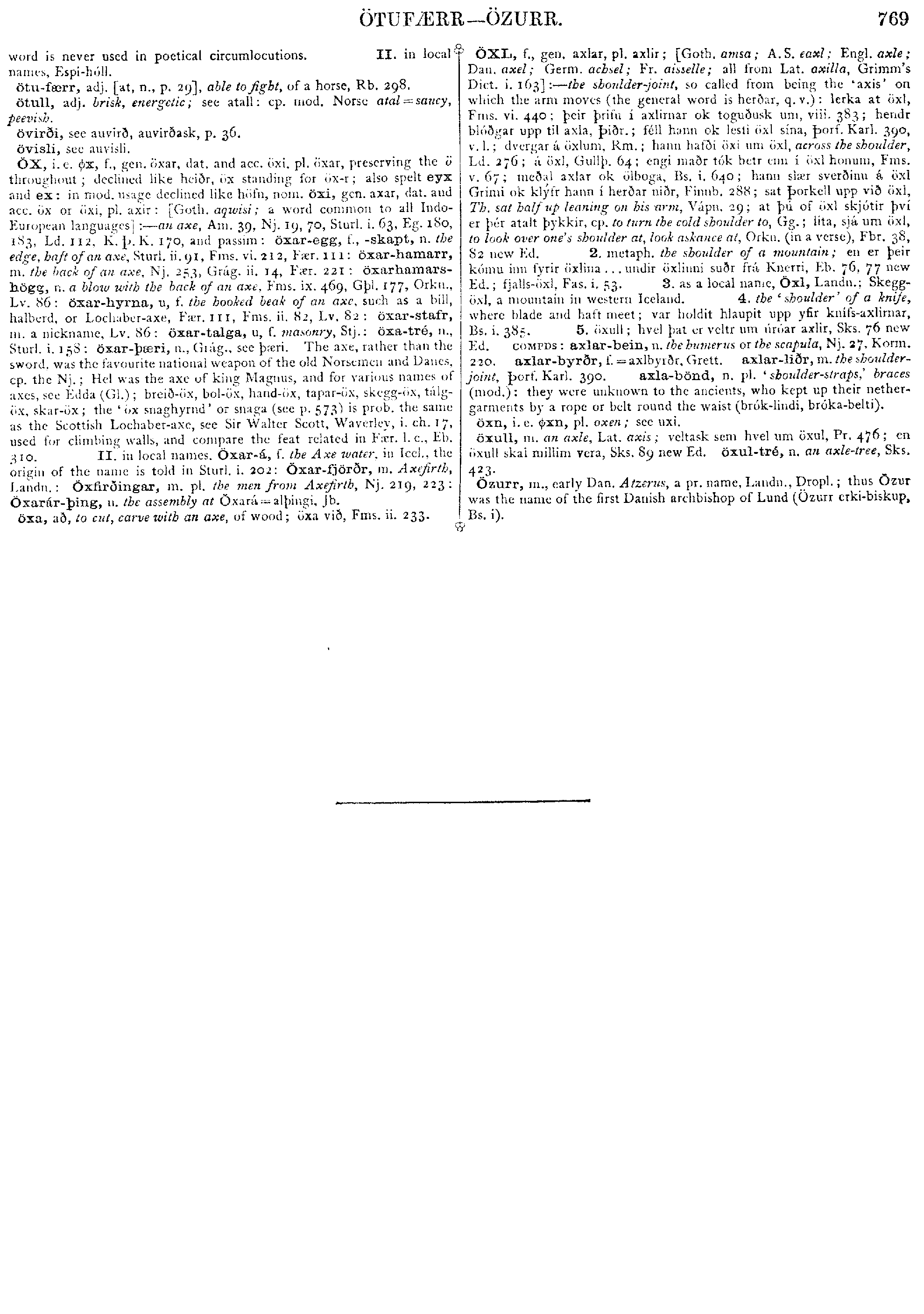
öxa, að, to cut, carve with an axe, of wood; öxa við, Fms. ii. 233.
| Result Page: |  |
Previous | 21 22 23 24 25 26 27 28 29 30 31 | Next |  |
Germanic Lexicon Project (main page)
This search system was written by
Sean Crist
Please consider
volunteering
to correct the data in these online dictionaries.
No rights reserved. Feel free to use these data in any way you please.